The plates are cleared and the last fork goes down, and the voice at the end of the table lifts into the two-line setup you could mouth along with it. A blown tire on a highway shoulder, two summers ago. The irritation lands before the first sentence does.
You have heard the tow-truck driver’s accent and the closing line a dozen times. Your partner has not noticed you could take over the telling, because the guests are leaning in and laughing like it is new.
That repeat is not a stuck partner or a stalling relationship. It is a live act doing several jobs at once: claiming a little credit, keeping a memory in working order, filling a quiet room, settling its own teller.
So the next telling can be read rather than endured. What is it claiming about the person saying it, and what role does it hand you? Listen for that and you can decide to stay, to steer, to say you have heard it, or to bring the changes to a doctor. Here is how.
The story is a piece of who they are

That story has a job, and the job is a claim about who he is. It is a self-portrait with a plot: a blown tire, a highway shoulder, two summers back, and one man standing there with traffic going past him at speed, calm. The trait he wants credited is steadiness under pressure, and the story is how he puts it on the table for people who have not seen it yet.
Watch where the credit sits. It is not in the tow truck or the noise of the traffic. It is in the setup line, delivered flat, the way you would report the weather: car blew a tire, I was on the shoulder, traffic going by. The flatness is the point. A man bragging would raise his voice; he lowers it and lets the shoulder do the work.
Then notice who gets the story and who does not. Guests at the table get it inside ten minutes of sitting down, because they are the ones whose picture of him is still blank in that spot. You have been present for most of the dozen tellings. You already grant him the calm, so there is nothing left to collect from you, which is why it rarely surfaces on a night the two of you are alone.
Someone who never retells anything is not therefore more open than your partner. Plenty of people make the same claim by doing rather than narrating: they change the tire in the rain and never mention it again. Narrating and doing are two routes to the same credit.
One limit on the reading. It holds for a story that flatters or explains the teller. A story that only apologizes, or confesses something he got wrong, is carrying a different weight, and it is worth hearing on its own terms.
Each retelling files the memory deeper

Telling it is the maintenance work that keeps the identity smooth, and smoothness is what a rehearsal produces. Every retelling walks the same path through the events, and a walked path gets easier to walk. The side trails go quiet.
So the version at your table tonight is not the one you sat through the first time. The early tellings had a confused minute in them, a gap where he could not remember whether he called the tow company before or after he got out of the car, an awkward pause while he found the next beat. Those have been sanded off. What is left is the two-line setup, now shorter than it used to be; the middle, where the tow-truck driver’s accent gets a little more polished each year; and the closing line, which has not changed at all.
Meanwhile the wait stretches from forty minutes to an hour and nobody at the table notices. The tire, the shoulder and the punchline hold their shape because those are the parts the story exists to deliver. The clock is scenery.
Here is what rehearsal will not explain. When a story gets shorter and vaguer with each telling instead of smoother, practice is not the reason, and that pattern belongs somewhere further along in this piece.
A familiar story settles an unfamiliar room
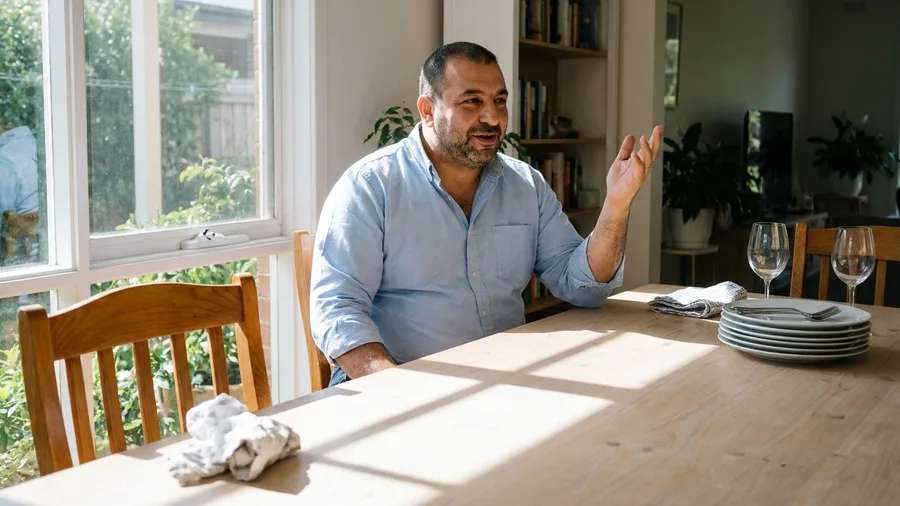
Because the story has been practiced into something reliable, it is also the thing he reaches for when the table goes quiet, and the lull after the plates are cleared is exactly that moment. The five-to-ten-minute tire story starts there. Within a minute there is laughter, someone at the far end offers a roadside story of their own, and the pressure in the room drops.
Compare that to the alternatives. A question to the table could land flat, and the silence after a failed question is worse than the silence before it. The story is the safer instrument because he already knows where the laugh sits and where the pause goes; he has run it a dozen times and it has never once fallen apart.
You can watch the mechanism from your chair. He starts the setup line, and the room turns toward him; by the driver’s accent, forks have stopped. The story is not stealing the evening. It is doing the work the empty room was asking for.
Not everyone settles a table this way. Some people fill the same lull with questions about the others at it, and some fill it with news. This reading explains the anecdote-teller, the one with a stock of stories ready, and not every quiet partner you have ever sat beside.
🌱 GROWING TIP
Notice the job, not the plot
Before you react to the story, ask what it is doing for the teller in this room. Is it claiming a trait, settling a silence, or lifting a mood? That answer tells you whether to listen or to steer.
The plot is not what the story is for

Once the timing does its work, the content turns out to be mostly packaging. A tire lets go on a highway, the car sits on the shoulder, a tow truck eventually arrives: those are the wrapper. What the teller is actually after is the conclusion the story is built to force, which is that this is a person who keeps his head when the roadside goes wrong.
Listen to the closing line and the reason for the drift becomes obvious. The wait can run forty minutes in one telling and an hour in the next, and nobody at the table corrects it, because the number was never the point; the calm, competent self at the center was, and that part does not move. Pulling the wait apart is arguing with a receipt over a purchase the teller was not making.
This is where the partner’s reply matters most. “You’ve told me this one” answers the plot, and it lands like a rebuke: the telling stops flat, and the room reads it as the partner shutting something down. Answering the value instead, in a few words, “you really do keep your head,” meets what the story came out to collect, and the teller can put it down satisfied.
The details are scenery and the claim is the cargo; a partner keeps the evening by responding to the claim, not the scenery.
Get the two swapped and the wrong one gets audited. Correct the hour back to forty minutes and the teller hears an argument; credit the steadiness and the hour never comes up.
Reading the room while it is happening
Signs it is ordinary polishing
- The same words that land in the room also land in the retelling.
- The drift is frictionless: the hour, the weather, the driver's mood.
- The tire, the shoulder and the punchline stay exactly put.
Signs to stop being patient
- They ask you what happened on the shoulder four minutes ago.
- The story has begun losing its own ending, not just its length.
- They can no longer say who was in the tow truck.
Every retelling is tailored to its listener
Each retelling is edited for the room it is told in, and the value being claimed gets a slightly different shape depending on who is across the table.
With friends the swearing comes out. With teenagers the danger is played up, the shoulder a little closer to the traffic. With the neighbor who owns a truck, the tire is played up, because that is the man who will appreciate what a blown tire at speed actually means.
The teller is reading fit, not counting repetitions. Which version lands with this listener, not whether the partner has heard it a dozen times. Those are two different questions, and the teller is only asking the first, which is exactly why he does not seem to notice the second. He is not tracking the record; he is tracking the audience.
You are the one person who sees the seams. Friends, teenagers, the truck neighbor each get one cut; you get all of them and remember what changed.
So you develop a cue: a glance across the table, a half-smile that says here it comes. It is worth knowing that the teller rarely stops for it. Not from coldness, but because the audience being read at the table is the new listener, the one who has not heard it, and your half-smile is not what he is watching.
The teller's focus vs. the partner's focus
What each person is tracking during the retelling
The gap is not a failure of attention; it is a difference in job.
The weariness is about your role, not the tale
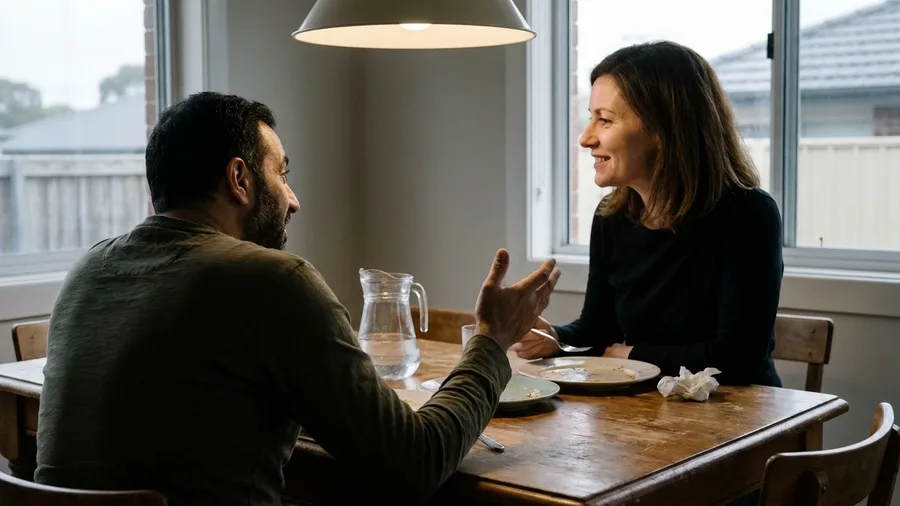
The annoyance belongs to the job, not to the story. It sits in the fixed smile, the reaction that has been pre-empted before you can give it, the same audience part you play night after night.
The wait stretching from forty minutes to an hour does not cause it, and the tow-truck driver’s accent does not cause it. If a different person told you the same anecdote at the same table, it might not bother you at all. What bothers you is the role.
Here is the trap. You cannot react freshly to something you have heard a dozen times, so your face settles, and the teller reads that flat face as disinterest in him. He is not wrong to read a flat face; he is missing that the tiredness attaches to the position you occupy, not to the man telling the story. Neither of you has a word for it, so it becomes a small unspoken grievance that keeps its seat at the table.
There is one thing worth separating out here.
If the same telling happens at every meal and your own stories never get told, that is not a repetition problem. That is a conversation that runs one way, and it needs its own look.
⚠️ COMMON MISTAKE
Don't wear the flat face
A flat expression during the story reads as disinterest in the teller, not fatigue with the role. If you need a break, take it before the story starts, not during.
Being the audience is a form of intimacy

Sitting through it again tells him you are the one person he does not have to perform for. That is the exchange happening under the plot: the partner is a known, safe listener, and safe listeners are rare enough that people relax into them the way they relax into a familiar chair.
With guests, the tire story is work. He watches for the laugh, checks the accent bit landed, adjusts the middle for the truck neighbor. With the partner, none of that is required, because the reaction has already been given a dozen times and the ground is solid.
Tolerating and resenting look identical from across the table. Same nod, same half-smile, same pause where the closing line goes. The difference lives behind the face, and it leaks anyway, in the timing of the laugh and where the eyes go.
A partner who sits through it warmly is feeding something real back to the teller. A partner who sits through it with a fixed smile is feeding the same act a colder version of it, and the teller usually reads the chill without knowing what it means.
This cuts off where the traffic runs one way. If the partner’s own day never gets asked about, if the audience role never reverses, then the sitting-through is not intimacy being offered, it is a shift being worked.
They walk away lighter, and that is the payoff

What he gets is the evening after: the story finishes, the shoulders come down, and the rest of the night moves easier. The payoff is not the telling, it is the lift that follows it.
Watch a tense night. Something has been sitting wrong since he came in, the plates are cleared, and out comes the tire and the tow-truck driver. Ten minutes later he is asking about the neighbor’s truck and the flat mood has quietly broken.
That is why the story surfaces more on the days it has been a grind. On a good night the payoff is already there and the anecdote stays in its box. On a slow, heavy, off night the retelling is doing the work of a walk around the block.
For the partner, this explains the pattern without excusing every instance. The lift is real, and it is his, and the partner is the one who supplies it, but supplying it is not a standing obligation for every dinner.
Some nights the audience can be given freely. Some nights it can be handed off, and the mood still lifts because a new listener gives a better laugh than the one who knows the ending. The payoff does not demand the same person every time.
What changes when you read the retelling as a bid
You can steer a story without shutting it down

A better ending to the story asks for something new: the driver’s exact words as he unhooked the car, the name of the road, what the teller did with the rest of that afternoon. The plot gets one more beat and the teller gets to be interesting again, which is the whole point.
Not every move has to be a question. When the neighbor is standing in the doorway holding a six-pack and the tire is warming up, the door works better than the redirect: hand the story over like a gift, ‘the neighbor has never heard this one — I want to hear about his week,’ and step out of the audience while the new listener fills it.
There is a warmer version for the kitchen at midnight, after the guests have gone and the plates are stacked: name it plainly, admit you have heard it, and say you like that it is his. ‘That tire story — I know it by heart, and I like that it’s yours’ keeps the door open without pretending you were listening for the first time.
Each move has a room. The question belongs at the table with a fork still in your hand.
The handoff belongs when there is a fresh audience in front of you and a guest willing to be drawn in. The warm naming belongs when nobody else is around and the honest thing is the only thing left to say.
None of it works on a night when the story is carrying something heavier than the punchline — a bad week, a silence that has gone on too long, a teller who needs to hear himself say it again. Then the audience is the point, and a question is a door closing on a man who needed the room to stay still.
🧭 Three moves to steer without shutting down
Notice the opening line
Catch the two-line setup before the story takes over the room.
Pick the moment
At the table, use a new question; with guests, use a handoff; in private, use warm naming.
Ask or hand off
Say the line and then stop talking, letting the new direction land.
Check the result
If he relaxes or laughs, the steer worked; if he tenses, the story needed the audience.
Lost details need a clinician, not patience

Steering is for ordinary repeats. The line between habit and something needing a doctor sits in what happens to the story itself: a habit keeps its shape, a change loses it.
Listen for the version that gets vaguer rather than smoother. The tire, the shoulder and the closing line have held for a dozen tellings; if the tow-truck driver’s accent starts to blur, if the wait is no longer forty minutes or an hour but a shrug, the story is thinning instead of polishing. Three patterns are worth acting on, not filing away: the details receding as the telling smooths out, the same story arriving twice in one sitting without the teller noticing, and a teller who cannot recall having told it an hour earlier.
When the question turns from manners to medicine, the next step is a clinician and a plain-language health source, not another round at the table. Keep numbers, percentages and condition names out of the dining room; only a professional can fill those slots, and guessing at them out loud tends to frighten the teller without informing anyone.
And the polished story itself is not the signal. A tire tale told well to new guests is a working piece of self-presentation, and treating it as a symptom insults the person telling it while misreading the room. Watch the changes, not the repitition. The repeat, kept intact, is a habit; the repeat that is coming apart is a question for someone qualified to answer.
When to step in — at a glance
🔁 Order of signs
Vagueness first, then repeats, unawareness last
📉 Details
Losing fixed points — place, time, who spoke
🤔 Awareness
Denies it happened, or seems unbothered by the gap
👂 Your role
Note the date and what changed; say it once, kindly
Next step
If any of these appear, talk to a doctor or clinician rather than waiting it out.
You can say you have heard it

The honest admission, said once and warmly, is available to you, and it goes down far easier than another year of a fixed smile at the same table. Everything depends on where and when it lands. In private, in a quiet moment after the guests have gone, it reads as candor between two people. In company, or in the middle of the telling, it reads as a public correction, and the teller will spend the rest of the evening defending the story rather than hearing you. Wait until the plates are stacked and nobody else is listening.
The trick that keeps it from stinging is to make it a trade. Say you have heard the tire story, then hand over a request in the same breath: ‘tell it to the neighbor — I want to hear about your week.’ That gives the teller something to do and gives you something back, so the exchange is a swap rather than a rebuff. Roughly a dozen tellings in, the partner who says it plainly in private and offers the handoff usually gets the same small sequence: a beat of quiet, a short laugh, and then a teller who turns toward the guests and starts checking who has actually heard this one.
The cost of staying silent is not the story. It is the smile you keep putting on for a plot you can recite.
Frequently Asked Questions
Why does my partner tell the same story every time we have people over?
The story is doing a job: it claims a trait, settles an unfamiliar room, or regulates mood. With guests, the teller is collecting credit for a trait they do not yet know. With you, the credit is already granted, so the story rarely surfaces.
Does repeating a story help their memory?
Yes. Each retelling is rehearsal: it strengthens the path through the story and sands off the side details. The version you hear now is smoother and shorter than the first telling. That is normal. If the story gets vaguer rather than smoother, that is a different pattern.
How can I get out of hearing it without hurting his feelings?
Ask a new question at the end (‘what did the driver say after that?’), hand off to a fresh audience (‘tell it to the neighbor — I want to hear about your week’), or name it warmly in private. Each works in a different setting. None of them shuts the story down.
When should I worry that it is more than a habit?
When the story gets vaguer instead of smoother, when it loops twice in one sitting, or when the teller does not remember telling it. In those cases, talk to a clinician. Do not try to diagnose it at the dinner table.
Is it okay to just say I have heard it before?
Yes, if you do it warmly, in private, and not mid-story. Pair the admission with a request so it is a trade rather than a rebuff. The usual result is a small laugh and a teller who checks the audience more often.
The closing line is not the point
The verdict is plain. Stay for the ending when the story is doing a job: steadying the teller, settling a table, telling a stranger who they are. Step in only when details are vanishing, when the same telling loops inside one conversation, or when the audience is always you and never them.
So picture the plates cleared again and the two-line setup beginning. You can still mouth the closing line. What changes is that you read the bid before the plot.
The next time it starts, listen for what the story claims about the teller, whether calm or competence or nerve, and answer that instead of the tire, the shoulder, the hour.
Listen for the claim, not the plot
Next time the tire story starts, catch the trait they are asking you to credit. Reply to that, and watch what changes.