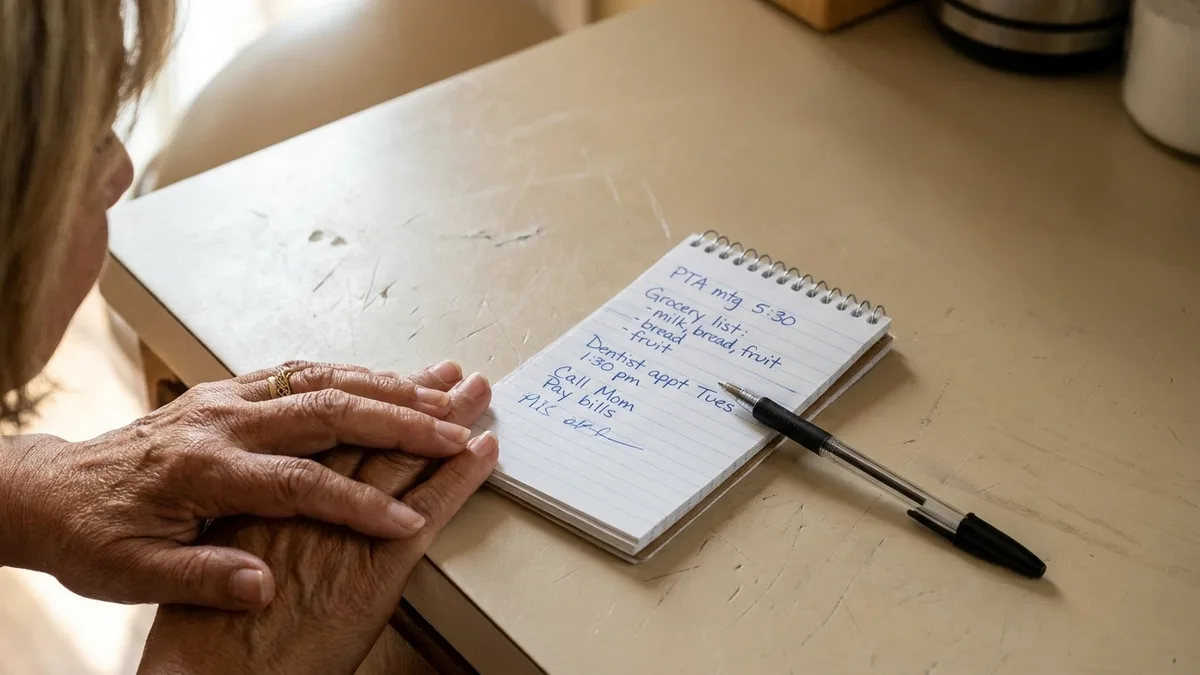
Why did I stop asking for help? You have watched yourself quit a hundred small requests without deciding to, and the question is whether that is peace or something you should still try to move.
The scene is ordinary. She is sixty-eight, he is seventy-one, forty-one years married, both retired in a house they have owned for thirty. Two adult children live nearby. His knee is bad. She keeps both calendars, his and hers, and the silence looks like not minding, or not needing to ask.
It rarely is one mood. It is a set of prices: an ask that comes back as her job, a history that makes a request sound like a verdict, care for a husband who is declining, or a settled conclusion that help will not come.
So the useful question is not whether she is resigned or resentful in general. It is which of four silences she is living inside, because each one calls for a different first move.
By the end you can name yours and make that move: hand over one whole recurring job, schedule included, ask once, and do not take it back. After four decades this is a renegotiation, not a conversation, and where his health is the obstacle the move is outside help.
Quick Tips Before You Start
Write the whole job down
Before you hand over a task, list its schedule, its standard, and the follow-up it needs, not just the task name.
Ask once, then stop
Repeating the request turns a handover into a reminder, and reminders keep the ownership with you.
Name the consequence
State what you will stop doing if the job slips — the card not sent, the room not prepared — and then actually stop.
Price outside help
If his health, not his willingness, is the obstacle, a handyman at $65 an hour may be the honest answer.
Expect slow
After four decades this is a renegotiation, not a conversation. Give it months, not a single evening.
What an Ask Actually Costs Her
Before you can name the bargain, you have to see the price tag. In a long marriage, a request for help is rarely a clean handover. It comes with a conversation, a schedule, a standard, and often a second correction.
This first group of reasons is about that arithmetic. The ask looks small from the outside. From the inside, it frequently costs more than simply doing the job.
1. Every request comes back as her job

A woman asks her husband to deal with the gutter man, and he agrees before the sentence is finished.
Then the quotes arrive in her inbox, because his is a mess of old newsletters, and somebody has to be home for the visit, and somebody has to look up whether the downpipe is included. She is now running a project she started in order to stop running a project.
Noticing the clog is still hers. Deciding what needs doing, choosing which quote is honest, standing in the driveway at noon to check the work – all of it stays on her side of the ledger, and the calendar she keeps for both of them is where it lands. So one ask costs her a conversation, an oversight, and a second correction; doing it herself costs her the chore and nothing else. The arithmetic is not close. That is worth saying plainly, because the obvious reading – she stopped asking out of hurt or pride – is wrong. She stopped because asking turned out to be the more expensive option. And this is not how it works in a house where he owns a domain outright, cars or money or the medical file, calendar included; hand those over and the request lands clean. The trouble starts where the planning has never lived in his name.
💡 Tip: This does not apply where he owns a whole domain and its calendar outright — cars, money, medical appointments. There a request can land as a clean handover, not a new supervisory job.
⚠️ COMMON MISTAKE
Don't confuse asking with delegating
A request that keeps the planning with you is not a handover. It is permission for him to help you do your job. The handover only happens when the schedule, the standard, and the follow-up move too.
2. Doing it herself is faster, and that’s the trap

I used to think the answer was to show him once. Sit him down, walk him through where the paperwork lives, and the next time he would do it himself.
I was wrong about what showing costs. After forty-one years of one person holding the household’s routines, teaching is not a five-minute conversation. It is a trade with no finish line – instruction, watching, correcting, and at the end of it the fair chance that the next handover comes back to her anyway. Calling that a second job is not an exaggeration; it is a job that pays in nothing.
What the field keeps finding is that expertise does not transfer by demonstration. Judgment goes with it – which quote is honest, which plumber to call back, what counts as finished – and judgment is built over years of doing the thing, not over one afternoon of being told.
So she does it herself tonight, and that speed is real. It gets the gutter sorted before the rain and spares her the evening lesson. The bill arrives later, quietly: every task she rescues teaches the household that the split is working fine, and that confirmation is what she buys with tonight’s hour.
The distinction that keeps the arrangement frozen is between cannot and has never had to. His bad knee is a real limit – ladders and lifting are genuinely not his to do, and no conversation changes that. Phone calls, quotes, and a calendar entry are not. Treat the second as though it were the first and he becomes more limited each year, and so does she.
What she gets is speed now. What she pays is the task, permanently, in her name. The saving is real. So is the interest.
💡 Tip: The difference between 'he cannot' and 'he has never had to' matters. His bad knee is a real limit on ladders and lifting. Phone calls, quotes, and calendar entries are not. Treating both as incapacity keeps the arrangement frozen.
3. A half-done job makes the next ask harder

The standard advice is to say something the first time and say it kindly, and it fails because the correction is never filed as a correction. A complaint about the card sounds like a complaint about him, and that is the whole reason it stays unsaid.
So before you say anything, notice what happened the last time he took something on. A real skill gap and strategic helplessness look identical from the outside, and they call for different answers: a gap is closed with instruction and time, helplessness with one whole task, its schedule, and no rescue, watching whether the work moves or stalls. The cards in this house are the test. He agrees to handle gifts and cards, misses his sister’s birthday, buys nothing; she redoes it once, then quietly keeps the whole domain for good, and the question of which explanation was true never gets answered.
Ask yourself which one you would find out if you left it alone for a month. If the honest answer is that you never will, because the half-done job costs less to fix than to raise, the silence is not patience. It is the task coming back, plus a lower standard – the guest room left unprepared, the holiday shrunk to one meal – or the fatigue and snapping that only show up later.
Redoing it silently buys the evening and charges the domain back to you, standard included. One whole job, handed over with its schedule and left alone long enough to see the outcome, is the only version that tells you which half-done job you are dealing with.
4. Asking out loud makes her the nag

The cost arrives before the behaviour does. She has decided the gutters can wait rather than raise them a second time, and the thing she is protecting is not his temper but her own reflection in the hallway mirror.
Asking twice turns a logistics problem into a character problem, and the character under review is hers. First request: reasonable. Second: now the tone needs adjusting, the timing was off, she is going on about it. He can comply or shrug, and either way the flaw stays filed under her name. Whatever she absorbed about women who nag was never argued with, only taken in, so a repeat ask now feels like proof of something wrong with her rather than a fact about a task nobody has done.
What keeps the picture clean is a domain with one owner and a written date – the recycling his, the car service his, the calendar she keeps for both of them carrying his entries in his name so the reminder is the calendar’s job and not her voice. The American Psychological Association is the place to read on learned roles and how couples talk, not a figure to quote.
💡 Tip: The American Psychological Association is the source to check on communication patterns and learned roles — not for a number to quote at anyone.
Four Bargains — At a Glance
🔁 Futility
Ask, then manage
⏱️ Cost
Faster alone
🛡️ Protection
Keep the peace
📉 Resignation
Expect nothing
What to watch
The same silent wife can be in one bargain this week and another next year. The question is what the silence is buying her right now.
The History They Built
None of this happens in a vacuum. The silence has backing — forty years of a split that worked well enough at the time and then quietly hardened into identity.
This next group of reasons covers how retirement, health, and history turn a simple request into something that sounds like a verdict.
5. Forty years of split chores taught them both

Forty-one years ago, in the first year of the marriage, someone had to take the money and someone the kitchen, and the taking was quick and mostly unspoken. By year 41 those early grabs have hardened into territory. Money is his, cars are his, medical appointments are his; the kitchen is hers, gifts and cards are hers. Neither of them chose this arrangement last spring. It chose them in 1984 and then stopped being visible.
The calendar is where you can see it. She keeps both calendars, which means she can see across every domain in the house, including the ones that are not hers. She knows his dentist appointment is Tuesday before he does. She knows the car service is due before he does. Seeing across the whole board is a different job from owning any square on it, and nobody assigned it to her either.
Then he retired. The house they bought 30 years ago now holds him all day, and the hours went into his column while the responsibilities stayed exactly where they were. A retired husband is not a redistribution.
Presence and ownership are different things. A domain can be handed over with its schedule, its standard and its consequences attached; it cannot be borrowed for a Saturday afternoon and handed back. That is why ‘he is home all day now’ changes nothing on its own, and why any request she makes in year 41 reopens four decades of arrangement rather than settling one task.
💡 Tip: If a domain was never his, start with one small one he can have completely. Nothing on her calendar. None of her reminders.
🔄 How a Task Becomes Hers for Good
The ask
She asks for help with one recurring task and he agrees.
The first miss
A step is missed — a card, a call, a date — and nobody mentions it.
The rescue
She fixes it once, quietly, so the evening is not lost.
The standard drops
Next time the guest room stays unprepared or the holiday shrinks.
The silence
She stops asking, and the task returns to her ledger permanently.
6. A request now sounds like a verdict

Because a plain sentence stopped being available to her somewhere around year fifteen. ‘Can you take the cards this year?’ is a logistics question in her mouth and a summary of his life in his ear. Forty-one years of the same split sits behind six words, and he hears the arc of it: that he has not been enough, that the marriage has been quietly tallied and found wanting. She knows this before she opens her mouth, so she does not open it plainly.
So she softens the request until it thins out and disappears. ‘If you get a chance.’ ‘No rush at all.’ ‘Honestly, don’t worry about it, I’ll pick something up.’ Each cushion is meant to spare his feelings, and each one quietly removes the ask from the room. By the time she has finished padding it, there is nothing left for him to do and nothing left for her to resent him for not doing – only the card, still unbought, and the birthday, still coming.
The softenings are not weakness. They are protection, and what they protect is not only his ego. Admitting the split has been unfair would mean reopening forty-one years of marriage, not just reassigning the cards or the gutter quote. That is a much larger conversation than the one she thought she was having, and she can feel the size of it before she says a word.
The exception is real and worth naming. Where the request is framed forward and specific, it can land without indicting the past. ‘The cards are yours from January. The birthdays are on the calendar. No reminders will follow.’ That is a handover, not a verdict, because it describes the next twelve months rather than the previous forty-one. The difference is not tone. It is tense. A request about what will happen is survivable; a request about what has happened reads as a bill.
One more test: is she asking for a whole job, or for relief from a feeling? A whole job with dates and a standard can be handed over. A feeling cannot, and any ask built on the feeling will arrive as the accusation she was trying to avoid.
The silence buys the story of a marriage that has been fine, and charges her the labour plus the unsaid sentence. The past stays protected. The present pays for it.
💡 Tip: Write the request down before you say it. If it contains 'always' or 'never', rewrite it until it names one job and one start date.
💡 PRO TIP
Start with the smallest whole job
Pick a recurring job that has its own schedule and its own clear finish — the greeting cards are ideal. Hand it over with the calendar entries, then say nothing for one full year. If it slips, do not rescue it.
7. She has stopped expecting, not just asking

The guest room door stays shut now when the adult children drive over. No fresh sheets, no folded towels on the end of the bed, and the second car in the driveway has gone grey with dust though she used to wash it every Saturday morning without being asked.
That is what a stopped expectation looks like from the outside, and it is easy to read it as a woman who has finally relaxed. The words tell you more than the room does. ‘The gutters are not mine to do anymore; the handyman is the plan and he comes in October’ is acceptance, a decision with a boundary around it. ‘He won’t do it’ and ‘it doesn’t matter’ are a different sentence entirely, because neither one has a plan attached.
What usually makes the difference visible is a family holiday, a move, or a health scare, when the household suddenly needs the guest room and finds it bare. The shrunk holiday, one meal instead of the table full, is not a preference she arrived at. It is the operating level now.
The calm that comes with that is not the same as contentment. It is a write-off, no request, no expectation, no handyman booked either. The silence spares her the disappointment, and it hands over the whole domain along with whatever comes next, which is a closed account rather than peace.
What She Is Protecting
Some silences are not about the task at all. They are about protecting him, protecting the evening, or protecting a version of the marriage that still holds together on paper.
This last group is where the quietest bargains live, and where the cost is easiest to miss.
8. Asking feels unfair while he is declining

“I’ll just do it, he’s got the knee.” It is a reasonable sentence, and it is how a whole domain changes hands without anyone deciding it should.
The bad knee is real. Ladders and lifting are genuinely out, and it is right to stop asking for those. But watch what gets folded in with them: the phone calls for quotes, the date on the calendar, the follow-up when the gutter guy does not show. None of that needs a working knee, and all of it drifts to her once ‘he can’t’ becomes the shorthand. A handyman at $65 an hour, this example’s number and not a typical price, is what accommodating looks like. Absorbing looks like his share arriving on her side of the ledger with no end date and no one called. When health is the obstacle, outside help is the answer, not another request, and the National Institute on Aging is the place to check on caregiver support and respite. The silence protects him and it protects her sense of fairness, and it bills her the caregiving load with no edge to it.
💡 Tip: The National Institute on Aging is the source to check on caregiver support and respite — not a number to quote at the dinner table.
Accommodating vs. Absorbing
Accommodating
- Check: is the task closed or open? Closed tasks (mow once, lift once) end. Open tasks (bills, quotes, calendar) have no finish line.
- If no end date exists, it is not accommodating. Swap the request for a service, not another reminder.
- Test it in ten seconds: name the date this stops. If you cannot, you are absorbing.
Absorbing
- The tell: the task was never on a clock. It repeats weekly and had no end before his knee.
- Skip the conversation if he deflects. Book the handyman once, $65 an hour in this example, and tell him after.
- If she has stopped asking the adult children too, that is the signal to restart with them first, not him.
9. One more argument costs more than one more chore

Every article about marriage tells you to say the hard thing out loud. That advice skips the part where saying it costs something, and the something is usually the whole evening.
The scene repeats: she brings up the cards or the gutters, he answers with his own list of jobs he has done, voices rise, and she lets it drop so the night can end. Nothing moves. Next week the task is still hers. One argument costs more than one chore tonight, so the trade is rational, and peace is a real good she is buying.
The payment comes later, as fatigue, as snapping at the adult children, as the guest room that stays shut. What the silence signals is not that she has made peace with the split. It is that the bill has been deferred, and the resentment is accruing quietly. The smaller version is one sentence about one recurring job, its schedule, and what she will stop doing, which is not the same as the full catalogue.
One Week to Hand Over a Single Job
10. Couples who never get here hand over whole jobs

The cost of ownership comes first: friction, not comfort. Silence runs smooth for weeks because nothing is asked; a handover runs awkward for months because something is. What keeps some couples out of the silence is not a better argument but a different structure, one where whole jobs have owners instead of every task being raised, argued, and quietly returned to her.
In the counterexample, medical appointments belong to one person, with the calendar entry and the reminder in that person’s name, and the cars belong to the other, service dates included. No weekly request is needed because no one is waiting to be asked. The calendar she keeps for both of them can carry his entries, but the reminder has to sit in his name or it is still hers with extra steps.
Standards get settled once at handover, not re-litigated every time: what done means for the kitchen, the gifts and cards, or the gutters. Then a half-done job is a skill problem or a breach, not a fresh verdict on the marriage. The ask is made once, and she does not rescue the task; the consequence stays visible and the ownership stays his.
This is slow to build after 40 years, and it should be said plainly: it is a renegotiation, not a conversation. The couple here are 68 and 71, retired, in the same house 30 years, and the split has had 41 years to harden. Silence buys short-term smoothness and charges long-term load; ownership buys short-term friction and charges a real renegotiation.
The first line can be as short as this: “The cards are yours from January, the birthdays are on the calendar, and I won’t be reminding you.” Then stop. No apology, no second version, no offer to help if he gets stuck.
💡 Tip: Pick the domain you most resent keeping. Hand over that one first. A clean handover of one domain teaches both of you more than ten small requests.
Frequently Asked Questions
Is it normal to stop asking your husband for help?
It is common, and it is not a single feeling. Most long-married women who go quiet are running one of four bargains: the ask is futile, the cost is higher than the chore, the silence protects him or the peace, or she has stopped expecting anything. What matters is which one you are inside, not whether it is normal.
How can I tell if my mother has given up or is just content?
Listen for whether she names a decision or a closed door. Acceptance sounds like ‘The gutters are the handyman’s job now.’ Resignation sounds like ‘He won’t’ or ‘It doesn’t matter,’ with no plan behind it. The guest room and the holidays are usually the clearest tells.
What if his health makes it genuinely impossible for him to help?
Then the answer is outside help, not another request. A handyman at $65 an hour in this example, a cleaning service at $120 a visit, or a family member given one specific domain. The line to hold is whether the accommodation has an end date and a plan, or whether it quietly transfers everything to her forever.
How do I restart asking without a fight?
Hand over one whole recurring job with its schedule, its standard, and its consequences. Say it once. Do not remind, and do not rescue it if it slips. After four decades this is a renegotiation, not a conversation, so expect months rather than an evening.
Why does he hear a simple request as criticism?
At year forty-one, a request carries the whole history. ‘Can you take the cards this year?’ can sound like a verdict on forty years of marriage. Making the request forward-looking — one job, one start date, no catalogue of old failures — separates the logistics from the history.
Which Silence Are You In — and What to Hand Over First
The four are distinguishable. Futility is every ask returning to her desk. Cost is speed, the half-done job, the word nag. Protection is his decline, or an evening bought with her own labour. Resignation is the stopped expectation, and it shows in the guest room nobody prepares, the holidays that shrank, the second car going unwashed.
Then make one move. Choose a single recurring job, hand over its schedule and its standard and what you will stop doing, ask once, and leave it. After four decades this is a renegotiation rather than a conversation, so the first handover tests the arrangement, not your right to ask.
Where the knee, not the willingness, is the real obstacle, the move is outside help. In this example that means a cleaning service at $120 a visit or a handyman at $65 an hour, this household’s numbers and not what anyone typically pays; the National Institute on Aging is where to read on caregiver support.
And the calendar you keep for both of you is the ledger. If one whole job, schedule and all, leaves your head and sits in his name, the silence was futility or cost, and it can still change. If it comes back to you, or you never let it go, that answers the question you started with: which silence this is.
Pick the one job you resent most, and hand it over this week
Write down its schedule, its standard, and what you will stop doing. Say it once. Then send nobody a reminder — including yourself.