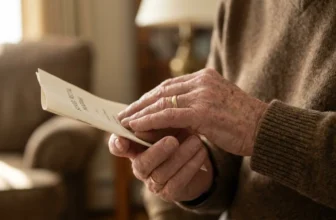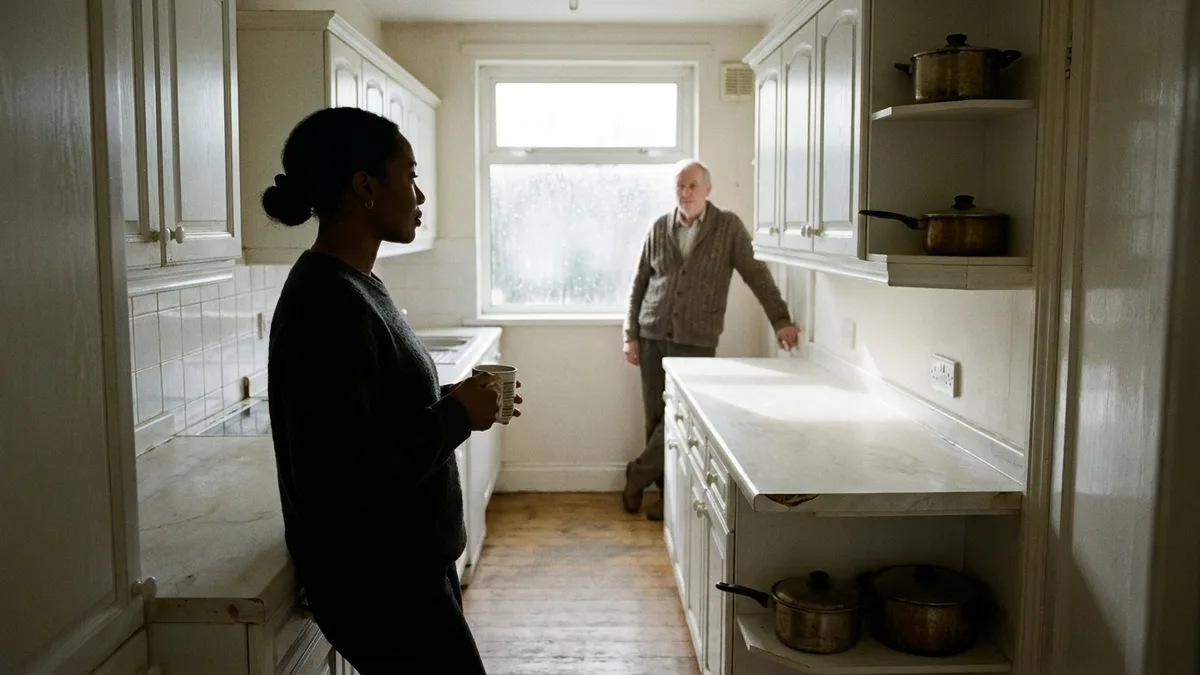
By the end of this you will be able to say out loud which part of your week is yours, and which single morning of his needs to leave the house. Start with the hour you already know. He is at one end of the kitchen at 8:15 asking what you are doing today, and you are at the other end with your coffee, on a Wednesday, three days into a week that is Monday, Wednesday, Friday at the dental office and not much else. The question is ordinary. It lands badly because it is the same question as yesterday, and your answer is the same, and he stays where he is.
Before he retired this hour belonged to you. He was out the door at 6:40 and back at 6, so the weekday hours you actually spent awake together came to about three. Now they come to about thirteen. The house lost its empty hours without anyone sitting down and agreeing to give them up, which is why the loss arrives as a feeling rather than a decision you can point to.
That feeling is not a verdict on the marriage. It is what a reshaped week does, and the causes are specific enough that you can find yours in the list below, name it, and stop treating it as evidence about the two of you. By the end you will have two moves: one recurring commitment of yours declared non-negotiable, and one recurring morning of his that takes him out of the house. If you do only one this week, do the first.
The loneliness is the arithmetic of thirteen hours and a lost separate calendar, not proof that love failed. The first move is to protect one thing of yours while he takes one morning out of the house.
| Part of the day | Before he retired | After he retired |
|---|---|---|
| 6:40 a.m. | He left for work; kitchen empty | He is at the counter with the paper |
| 8:15 a.m. | House quiet; her morning to herself | He asks what they are doing today |
| Noon | She ate at the dental office | Lunch at home, two people in one kitchen |
| 6:00 p.m. | He came home; overlap begins | Overlap has been going since morning |
| Weekday overlap | About three waking hours | About thirteen waking hours |
Three shared hours become thirteen
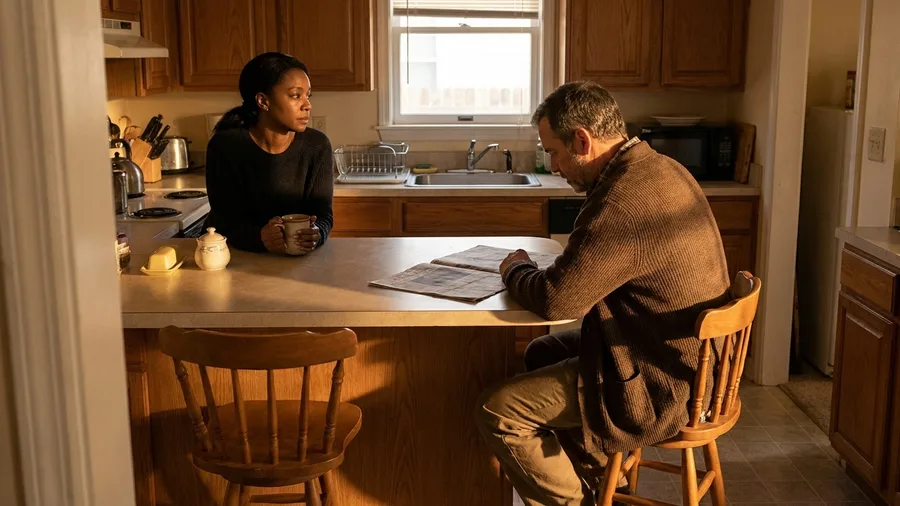
Because the house gained about ten waking hours of him a week, and no one thought to take ten hours of something else away. Before he retired, the weekday arithmetic was already settled: he left at 6:40 and was home by 6, which left roughly three waking hours when both of you were in the house at the same time. Now it is about thirteen.
The old buffer is what disappeared without anyone noticing its job. The 6:40 departure and the 6 p.m. return did more than mark his workday. They separated his day from yours. Between them sat a long clean stretch you could give to the dental office, to errands, to the phone, to no one at all.
There is no replacement for that buffer, and the house offers nowhere to hide from its absence.
In 1,700 square feet there is one kitchen and one TV room. At 8 in the morning that kitchen has a second chair in it, occupied, and the hour you used to spread your things across the counter now has someone watching the counter. This is not a complaint about his company. It is a description of a small building.
What makes the tiredness hard to speak about is that nobody agreed to the change. It arrived as a feature of the calendar, so the exhaustion feels like it must be a failing of yours, some meanness you would rather not admit to.
It is not. The marriage has not shrunk because the empty kitchen went. Your day has lost its unclaimed hours, and unclaimed hours are what a working week is actually built out of. You can love the man at the counter and still need an hour the counter belongs to one person.
🌱 GROWING TIP
Name the hours, not the feeling
Before you say anything to him, write down what your weekday looked like a year ago and what it looks like now. The number of shared waking hours is usually the whole story.
Retirement keeps his timetable, not hers

His 6 a.m., his noon lunch and his 6 o’clock news came through retirement completely intact, while your three office days quietly bent around them. He finished 38 years at the regional logistics company at 65, and the shape of his day survived the job. The shape of yours did not have the same protection, because it is three days, not five, and because nobody counts part-time work as real structure.
So errands get booked into your Monday and Wednesday as though those afternoons were spare, and his requests land on the days you are at the dental office as though you could shift them.
Tuesday choir is where you can hear it most clearly. It used to open with you picking up your keys and going. Now it opens with a question: can you skip it this week, could you go late, could you be back for his dinner. Nothing hostile is being said.
A commitment discussed before every keeping of it is a commitment that has already become optional. Ask yourself whose plans moved the last three times the two calendars disagreed, and the answer is the same each time.
Over a year, that repetition does something the single argument never does. It teaches both of you which time is real and which time is negotiable, and a person learns that lesson by watching who rearranges. Your days off from the office are not the household’s leftover hours. They are the paid structure that remains, and they carry a schedule the rest of the week should form around.
One kitchen, two people who lunch at home

Because the bending happens in the same two rooms at the same two hours every day, which is why the kitchen at noon can make you angrier than any large question about the marriage. Small frictions become large when nothing about them is a one-time event.
The spaces are exact. One kitchen, one TV room, 1,700 square feet. The kitchen hour you once had before work now has him at the counter. The TV room at 6 is his news, at the volume news is watched at.
This is why lunch lands harder than the big decisions. A debate about retirement happens once and is finished. Lunch at noon happens again tomorrow, in the same square footage, with the same two people who both want the counter, and the hundredth small collision is not the hundredth of anything. It is the whole pattern, felt at once.
What settles it is not more talking. It is a claimed piece of the place.
A chair that stays yours. A table, a corner, a shelf with a simple rule attached. It works because it changes what the day physically contains, room by room, in a way no conversation can arrange.
And the annoyance is information, not evidence of pettiness. It is telling you exactly where the house stopped being yours. Wanting an unshared corner back is not a slight against him. It is a reading of the room.
The arithmetic of a retired week
What actually changed when his workday ended
The retirement talk crowds out the week
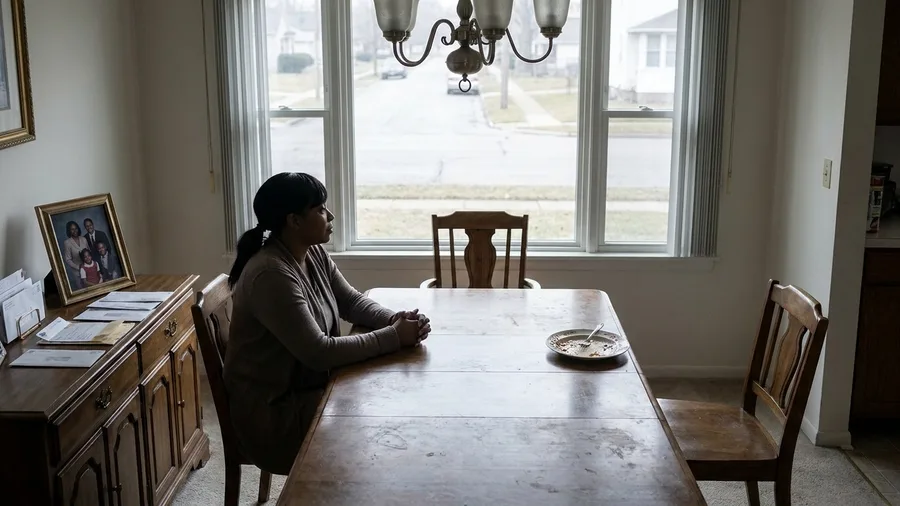
A fight about the kitchen counter is small because it is about a room; the wider damage happens in the sentences, where errands and amounts crowd out everything that is not a task. The two Social Security checks and the small pension land in an account she has run for years, and sometime in the past year he began checking it every morning, scrolling the balance at the counter before the coffee is poured. That is where the day’s first conversation now begins, and it is a status report.
By nine the doctor’s appointment has been confirmed, by noon the account re-checked, and by evening the calendar for the week has been discussed twice. The subjects that used to fill a whole evening – a cousin’s wedding, a memory from the year they met, an opinion about something neither of them controls – do not fit in what is left. A week that once offered three hours to fill can absorb a headline and a story; a week with thirteen fills itself with who was where, what cleared, what is owed.
Notice what those exchanges have in common: every one of them ends in a decision, and none of them is talk for its own sake. Talking is the part that asks nothing of anyone. So set aside one stretch a day, an hour or a single subject, where money, the doctor and the calendar are off the table.
Pick the meal you both sit down for and make it the one that carries nothing administrative. The account can wait until afterward; the point is a slot in the day that is not about the household’s business.
The couple friends were his colleagues first

The same 38-year job that set his 6 a.m. alarm also supplied a share of the couple’s social life, so when the logistics company stopped sending invitations, the thinned dinner invitations were not about her. For years the Saturday plans arrived through people whose desks sat near his. Whoever he worked beside, his wife and the wife of a colleague ended up at the same table twice a year, and no one had to decide anything.
Some of those pairings were purely situational, two men who shared a floor and two women who made polite conversation, and they did not outlive the job. The ones that lasted had a line of their own – the two women who started calling each other directly instead of waiting for the men to arrange a night out. That detail tells you which friendships were real and which were the job wearing a social face.
Her own people never depended on his pay stub. Tuesday choir, the Thursday walk with two friends, Sunday mornings at the church thrift shop – none of those arrived through him, and all of them still hold a chair for her.
There is a difference worth naming between being invited as a couple and being called by a friend. One makes you half of a social unit. The other gives you a phone number and a standing date that exists whether or not he is in the room.
What a standing plan is, and what it is not
A commitment
- Someone else is waiting at a fixed time
- A slot is held for you
- Canceling has a cost that lands on other people
- It stays on the calendar without renegotiation
A hobby
- You do it when the week allows
- No one is waiting on the other end
- Moving it costs only you
- It gets discussed every time it comes up
Her standing plans get treated as optional
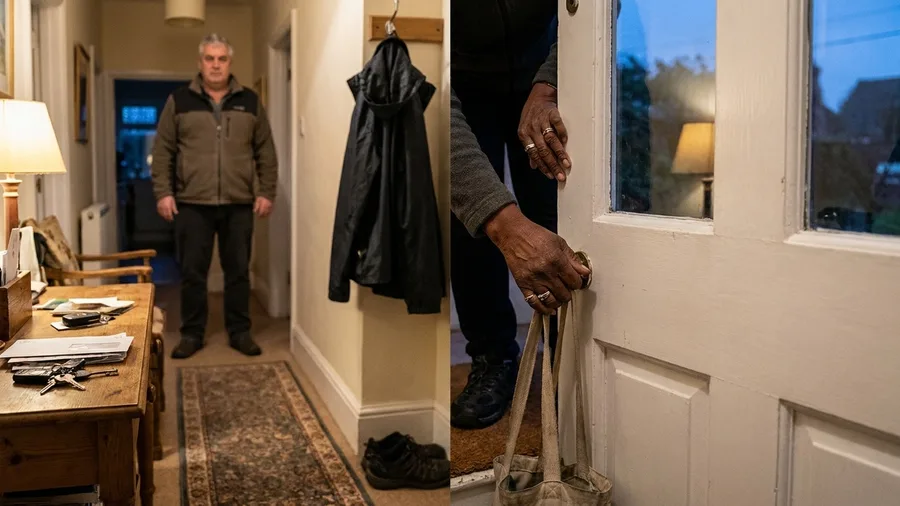
The dates that look easiest to move are the ones that are hers: choir on Tuesday evening, the Thursday walk with two friends, Sunday mornings at the church thrift shop – recurring, social, and already on the calendar. An empty Tuesday morning next to a fixed choir night makes the choir look like the flexible item, and he asks the question lightly, as if a yes costs nothing.
It does cost something. ‘Can’t you skip it?’ is a small sentence, but every yes tells both of them the same thing: her plans are provisional and his open day is the default. Do that for a season and you have taught the household whose time counts.
A commitment is not a hobby, and the difference is other people. A hobby can move on a whim without anyone noticing. Cancel the Thursday walk and two women stand at the corner at 8:30, waiting for someone who is not coming, and the cost of the change lands on them, not on him.
So stop moving the walk first. Say once, plainly and without a negotiation attached, that Thursday morning is not movable, and let it stay said. The weekly re-argument is what keeps it provisional. A single clear statement is what makes it real.
One sentence said once, then kept, does more than a discussion repeated every week.
He waits for her to build his week

The two mornings he arranged on his own are the giveaway: Tuesday and Saturday golf, booked by him, in his name, with men he called himself. That is what a self-made week looks like. Everything else is the part he brings to her to fill.
Errands, the afternoons of news, the question at 8:15 a.m. – none of it has a phone call behind it. The social secretary work that follows is unpaid and invisible: she is the one who suggests the couple, picks the restaurant, sends the text, and finds him at the door on Friday evening being thanked for a night she built.
Watch the couple whose retirement is calm and the difference is usually timing. His standing commitments were already there on retirement day – the volunteer shift, the weekly breakfast, the league – because a life assembled from an empty calendar has to be built by the person living it. When it gets built by the wife instead, the invitations land on her desk for however many years.
What she can hand back is the next one. Not the whole list, just the next: he chooses the couple, he makes the call, he owns the follow-up. She supplies the names and numbers once – once – and then stops being the reminder and the managed handover.
If the night is awkward, it stays awkward. That is the cost of it being his.
Same room, no conversation

Because a room can hold two people for an evening and nothing passes between them, and that is lonelier than an empty room, not warmer. In the one TV room his news is on, her tablet is open, and the only sentence spoken in three hours is a question about dinner or what is on Thursday.
Thirteen shared waking hours is a measurement of proximity, not of exchange. Presence without exchange raises the amount of company and lowers the amount of being known, which is the specific arithmetic behind the ache – more man in the house, less of him reaching her.
The person she used to have the good conversations with – a sister, the friend from the Thursday walk, someone in choir – is usually still there. The obstacle is the house: it is never empty enough to make the call, or she feels watched making it, so the conversation she needs goes unmade while he sits six feet away.
Solitude, even the dull kind, at least felt chosen. This does not, and that is why the loneliness sharpened after retirement instead of softening. The empty kitchen was hers; the full TV room is nobody’s.
The trip they planned becomes next spring
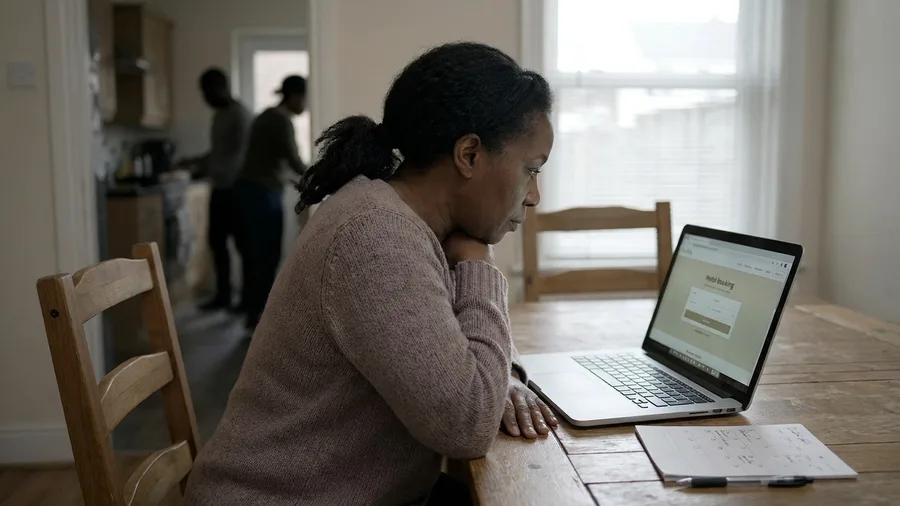
Retirement was supposed to hold more than errands, the news at 6 and the same four rooms. In the first year you took one 10-day trip, which was exactly as long as it needed to be and then became the exception the calendar never repeated. Since then the days have run together: a Tuesday and a Wednesday you could swap without anyone noticing.
So the bigger trip keeps sliding to ‘next spring’, and you can hear what happens to it from across the kitchen table. An undated plan asks nobody for a booking; ‘next spring’ is a season that never arrives with a date circled on it, and it waits there while the last ten days recede into something you did once. It is not one trip you are postponing. The version of retirement you described to each other, somewhere back when he still left at 6:40, has quietly moved into the same unbooked pocket.
A small plan with a date gets executed in a way the large undated one does not. Four days in October, a set departure and a room already booked is a decision; ‘next spring’ is a mood, and it costs nothing to keep on the shelf.
Stop waiting for him to price the big trip. Book the four days yourself, or pick the dates and put one concrete thing in his hands with a deadline attached – the driving route, the rental car, one call to a hotel. Left to next spring, the plan and the marriage’s account of itself stay on the shelf. The week gets what it is given a date for.
The two-calendar week at a glance
⛳ His fixed points
Golf Tuesday and Saturday
🎶 Her fixed points
Choir Tuesday evening
🚶 Her walk
Thursday morning, two friends
🛍️ Her Sunday
Church thrift shop
💼 Her workdays
Mon, Wed, Fri at the dental office
The rule
A shared calendar works only when both sides have entries they did not get permission for.
Weeks with two calendars feel less lonely
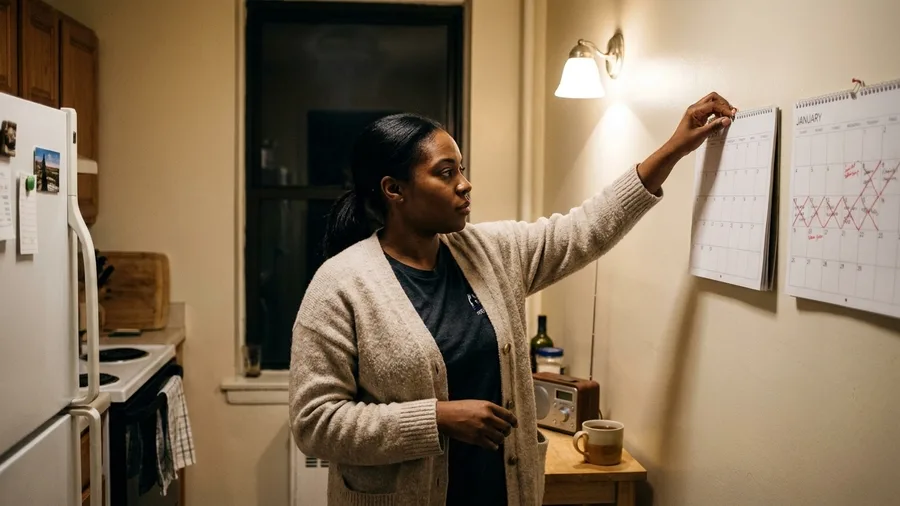
The couples who come out the other side of retirement still keep two calendars, and the mornings are where they diverge. His Tuesday and Saturday golf stays his; her Thursday walk stays hers; the afternoon is the shared part, with a lunch and something to report from a morning the other person did not attend.
His side of that calendar has to be filled by him. The golf, the standing errand, the volunteer shift that puts him out of the house from nine to noon, all of it works only if he made the call, because a commitment arranged on his behalf is still her job in a different costume. Her side works only if it is held rather than reopened, so the Thursday walk is not up for discussion every Wednesday night.
Two honest exceptions sit underneath this. It gets harder when she has stopped working too, because then the house has no outside anchor at all, and it gets harder when his health keeps him from going anywhere alone, because a morning out is not on the table. The shape needs adjusting in those cases, not setting aside.
So one fixed weekly thing of hers gets said out loud before the next Monday arrives. The Thursday walk, choir, the Sunday thrift-shop shift, whichever is really hers, named in a plain sentence so the week opens with her entry already written down and nobody has to renegotiate it from scratch.
Frequently Asked Questions
Is it normal to feel lonely when my husband retires?
Yes. The number of shared waking hours can jump from about three to thirteen, and the hours that used to be yours alone can drop to almost none. That is a change in the shape of your week, not a verdict on your marriage.
How do I tell him I need space without hurting his feelings?
Name the time and the place, not the person. “The sunroom is mine before nine” is easier to hear than “I need space from you.” Say it once, plainly, and then keep it, so it reads as a fact rather than a complaint.
Why does he ask what we are doing every morning?
Because the structure that used to answer that question is gone. A workday used to tell him where to be at 8 a.m. Now the day is open, and asking you is the quickest way to fill it. His own standing plan, made by him, takes the pressure off that question.
Should I stop rescheduling my own plans for him?
Yes, starting with the ones other people depend on. A standing walk with two friends is a commitment, not a hobby. Moving it costs them, and it teaches both of you that your time is the flexible part of the week.
What if he has health limits and cannot get out of the house alone?
The two-calendar shape still applies, with adjustment. His outside commitment might be a shorter errand, a phone call at a fixed time, or a class he can do seated. The point is that some part of his week has structure that does not come from you.
How long does it take to adjust to retirement as a couple?
There is no fixed number, but the couples who settle into it usually do so by rebuilding the week on purpose rather than waiting for it to sort itself out. Two separate mornings and one protected commitment of yours are a practical place to start.
The Thursday Walk and the Tuesday Golf
Say the verdict plainly: this is a schedule-and-space problem before it is a marriage verdict. Three shared waking hours became thirteen, the rooms are shared, most of the talk is logistics, and none of that means the love failed. It means the week was never renegotiated.
The trade is specific. Your Thursday walk with two friends is non-negotiable, and his Thursday 9-to-noon standing volunteer shift, or the breakfast with former colleagues, goes on the calendar as his morning out. If you do only one this week, declare the walk, because it is the move you can make without anyone’s agreement. His morning can follow once the shape of yours is visible.
Then watch 8:15. The question at the kitchen counter can become a Wednesday question with an answer already written on both calendars, instead of a daily test of whether he is home. The point was never to fill the house with more togetherness. It is to give each of you a week the other can miss, so the hours you do share have something to carry.
Start with the Thursday walk
Before Monday, name the one commitment of yours that is not movable, and ask him for the one morning he will take out of the house. Two sentences. One week.