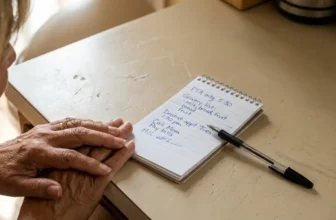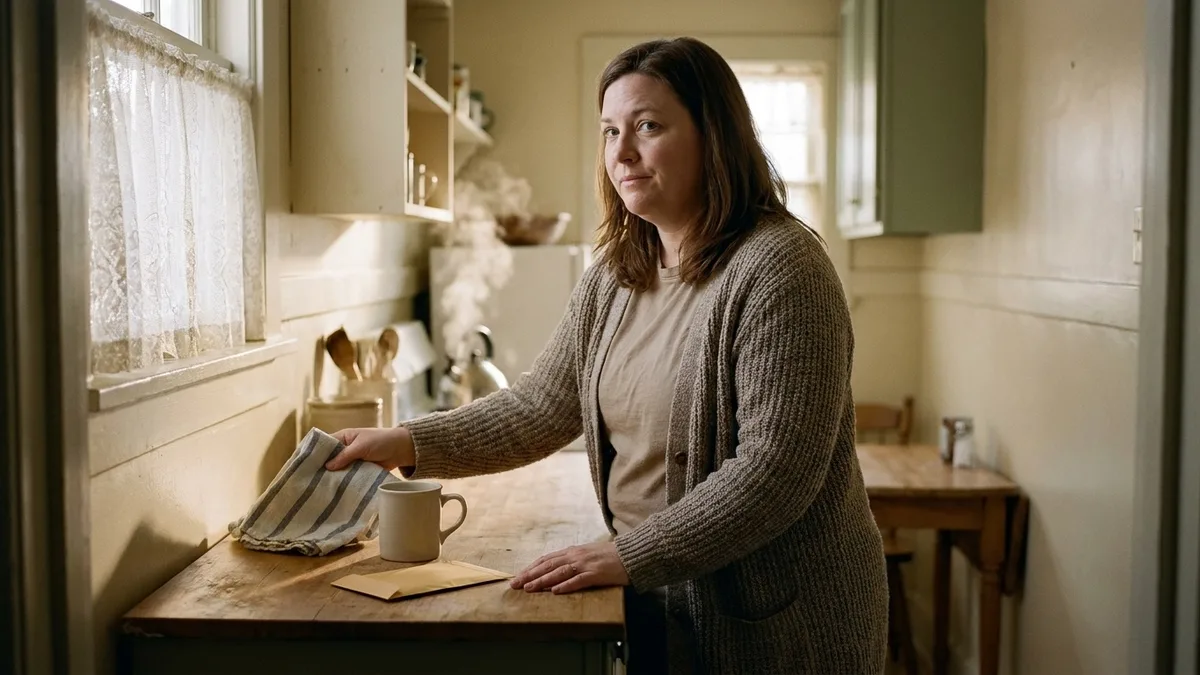
The cost of getting this wrong is that you spend twenty years waiting for a marriage to feel like the movies, and it never does, because the movies left out the dish towel and the car-fund jar. I am the middle daughter of two people married on June 8, 1963, in Dayton, Ohio. They hit sixty years in June 2023, Dad 84 and Mom 82. From 2011 to 2023 I lived a mile away in Kettering, visiting every Sunday and most Saturday mornings, through a knee replacement and thirty-three radiation treatments.
I expected the secret to be romance, or luck. What I actually watched was Sunday church, Friday pizza or the fish fry, Saturday errands, a weekly cash envelope, and a thirty-minute pause in the kitchen before either of them said another word. Ordinary infrastructure, repeated until it held.
That is the useful part: these are mechanisms, not personalities. You did not have to be my father to do the dishes by hand, and you do not have to be my mother to keep the envelope. Each habit below comes with what it required, what it cost, and who it would fail.
So pick by the strain you are actually under right now, whether that is money, drift, conflict, or someone’s health, and run one for two weeks before you add a second.
Quick Tips Before You Start
Pick one habit, not eight
Choose the one that matches your worst week, not your best intentions.
Try it for two weeks
Two weeks shows you if a system fits your household. A month is too long to admit it doesn't.
Name the cost out loud
Every habit below spends something. Say what yours will spend before you start.
Copy the system, not the people
Your parents' system worked for their jobs and their bodies. Yours has different ones.
The Ordinary Infrastructure
The first three habits are the ones nobody writes about, because they are boring and they happen every week. They are also the ones that made the other five possible. A marriage without a working week is a marriage that has to renegotiate everything from scratch on a Tuesday night.
Watch for the cost in these. Repetition is not free, and neither is a shared ledger.
1. They Ran the Marriage on a Weekly Routine
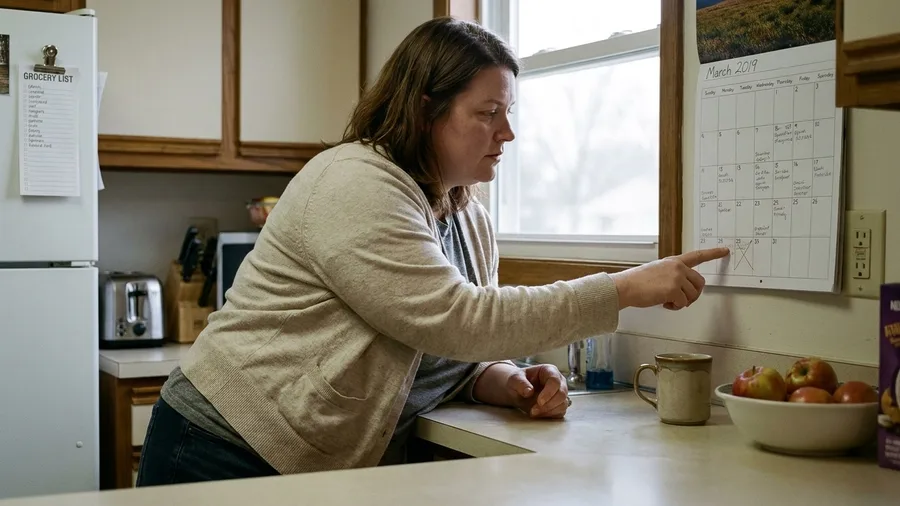
The cost came first: every Friday belonged to pizza or the fish fry, every Saturday morning to errands, every Sunday to church, and by the end of a decade there were almost no unclaimed weekends left. Repetition is not free. What my parents bought with that was a week with a default order, so nobody had to negotiate what Saturday was for. What they spent was the spontaneous Saturday, the spur-of-the-moment trip, the nothing-planned morning.
The schedule was built around work, not around leisure. Dad put in 38 years at the tool-and-die shop and Mom did 22 as a school secretary once the youngest started first grade, and the fixed points held through both. Sunday church, Friday fish fry, Saturday errands: those were the pegs everything else hung on, and after enough years the week ran itself without either of them deciding it should.
Where this earns its keep is the couple who drift more than they fight. If the problem is weeks that blur and evenings where two people sit in the same room on separate screens with nothing to say, a fixed point gives the week a spine, and that is often enough. Where it fails is a couple who needs novelty to feel alive; for them the same routine is a slow leak, and they will resent it by month three.
So the exception is real. This behaviour is fine when the repetition is holding something you both want, and it turns corrosive when it is holding a silence in place, when the Friday fish fry is the only thing you still do together and neither of you would choose it. You can tell the difference by asking what the routine protects. If it protects time together, keep it. If it protects you from a conversation, it is not a habit, it is an avoidance with a calendar.
💡 Tip: Pick two fixed points, not five. One weekday meal and one weekend morning is enough to feel the difference.
2. Money Was a Shared Chore, Not a Secret
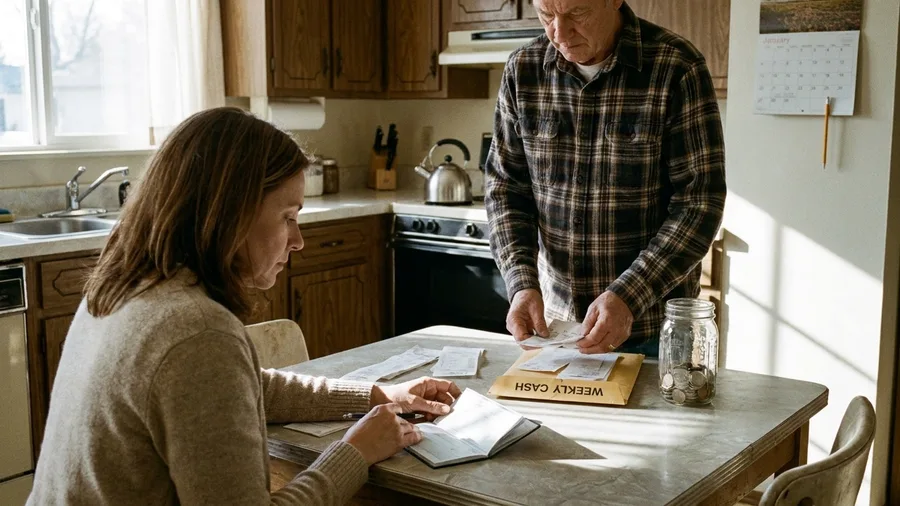
” my mother would ask from the kitchen table, and my father would answer from the other room without looking up, because he could see the balance in his head. That is the whole system: one joint checking account, a weekly cash envelope for groceries, a car-fund jar on the counter. Both of them could see where the money went.
The week had a shape; the money that paid for the fish fry and the Saturday errands had to have a shape too, and theirs was visible at all times. After 1987 they carried no credit-card debt. The rule was not moral, it was structural, and it kept small leaks from turning into private power struggles. Mom paid the bills at the kitchen table. Dad knew the balance. Neither of them had an account the other could not see, and the ranch house they bought in 1971 for $23,500 was a fact on the shared ledger, not one person’s secret.
It suits couples who can stand a single visible system and the small friction of that. It fails two people with wildly different spending instincts, who may need a hybrid, not one envelope forced on both.
Their Money System, Beyond the Basics
📋 Bills paid
Mom, at the kitchen table
🧠 Dad's role
Knew the balance cold
📅 Frequency
Weekly envelope refill
🏡 House cost today
Well under $200k
⚠️ Skip if
Spending instincts clash
The detail that made it work
Neither ran a balance the other couldn't see.
3. Chores Were Split by Skill, Not by Gender
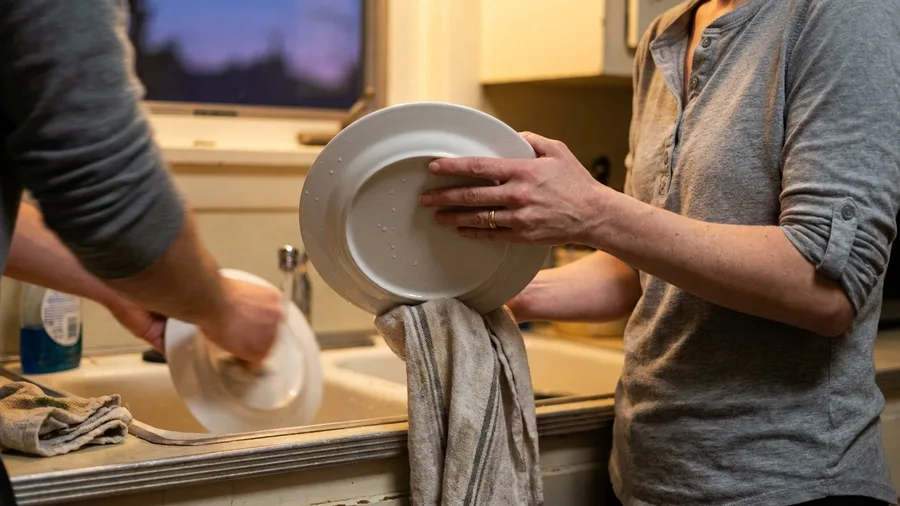
The standard advice is to divide the housework evenly, fifty-fifty, and to renegotiate whenever the balance tips. What I watched for twelve years was nothing like that, and it held.
There was no dishwasher in the Kettering ranch until 1998. So every night Dad stood at the sink with his sleeves pushed up, washing by hand, and Mom stood beside him with a towel. On holidays he made the gravy, whisking flour into the pan drippings while she carved the turkey, because gravy was the one thing he would not let anyone else touch. Mom paid the bills at the kitchen table; Dad never wrote a check. The line between them was drawn by who could stand to do what, not by who was supposed to.
What that arrangement quietly bought was twenty-five years of a kitchen that ran itself. What it quietly spent is harder to see. It spent the assumption that it would always work, because the split was never written down, and a division nobody has named is a division nobody has agreed to revisit.
Then in 2011 Dad had his knee replaced and could not stand at the sink for six weeks. Mom took over the dishes without a conversation about it. The principle had always been ability, so when his ability changed, the chore moved. That is the difference between a split made of skills and a split made of roles: a role would have waited for him to heal; a skill just reassigns.
What neither of them did, in all those years, was keep a tally. I never once heard either say I did more than you this week. The ledger they cared about was whether the house ran, and it did.
Here is where it fails. This only works if both people can say out loud what they hate doing, and if neither uses the word skill to dodge the whole indoors. I have seen one partner claim all outdoor work and all car maintenance and never once touch a dish, and call that a split by skill. It is not; it is a split by preference dressed up as fairness. If you try this, name your hates to each other before you name your jobs.
Does Your Chore Split Work?
- ✅ Each of you can name two chores you don't mind — That is the base of a skill split. Build from there.
- ✅ You have not discussed who does what in a year — Silence is fine if the house is running and neither of you is resentful.
- ⚠️ One of you handles all the bills and the other has never seen the balance — Not a disaster, but one illness or one bad week makes it one.
- 🛑 One person does all indoor work because they are 'better at it' — That is not a skill split. That is a permanent assignment dressed up as talent.
- 🛑 You keep a private tally of who did more this week — The tally is the argument. It will outlast whatever chore started it.
How They Disagreed
Every marriage argues. The habits that matter are the ones around the argument: where it happens, how long it runs, and what happens the next morning. These two are the ones I watched most closely, because they are the ones I have gotten wrong in my own relationships.
4. They Argued in the Kitchen, Then Paused 30 Minutes

Thirty minutes was the length of the whole fight. Dad took it walking around the block, Mom took it at the kitchen table with a spiral notebook, and when he came back through the door they sat down and finished it in the same room. Anger had an address and a clock.
I never once saw it happen in front of us. The pause did the work of keeping a disagreement between two people instead of letting it settle over the whole house like weather. It did not make them agree. They still went around about Dad’s golf league and Mom’s garden club for years and finally split the Saturdays.
The move fits couples who go hot fast and need a wall between the flare and the words. It fails when the walk becomes the answer instead of the interval.
💡 Tip: The walk only counts if you come back. If the walk is how the conversation ends, that is avoidance, not a pause.
5. They Apologized With Actions Before Words
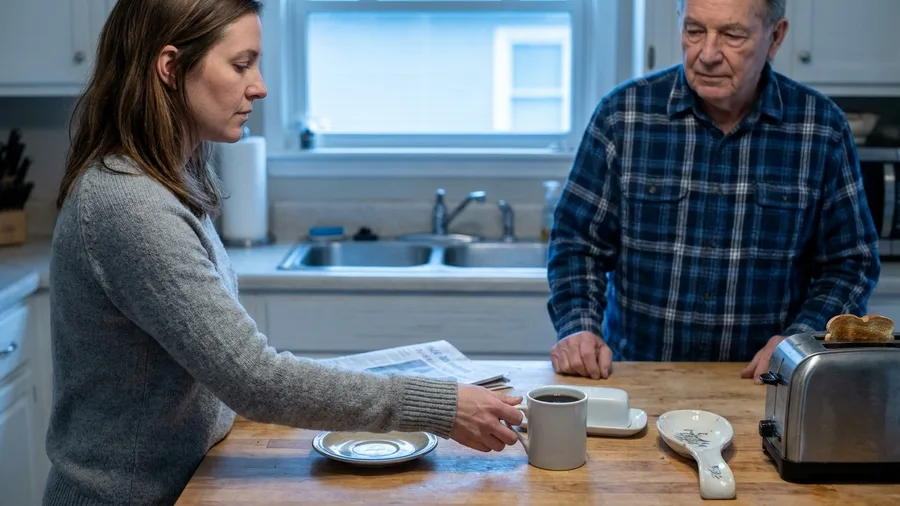
I spent years misreading this one. I thought a marriage that never said the words out loud was a marriage that never actually repaired anything – that the coffee and the plate were just politeness laid over an old grudge. I was wrong about what I was watching.
The fight had already been named in the kitchen. What came after was the proof. Dad made Mom’s coffee the next morning without being asked, and Mom fixed his plate without a word, and neither of them waited for the right sentence to arrive first. The gesture was the sentence. But it only worked because the argument had been spoken to its end – silent service dropped on top of an unfinished fight is not repair, it is sulking with chores.
This suits couples who would rather do almost anything than talk about feelings, provided both can read an ordinary morning as an apology instead of an evasion. It fails for anyone who needs the words to trust that it is over. If that is you, the coffee will never be enough, and pretending otherwise just teaches you to doubt it.
⚠️ COMMON MISTAKE
The apology that isn't one
Doing the dishes after a fight is not an apology if the fight was never named. It is a way of pretending the fight did not happen, and the other person can tell the difference.
Room for Two Separate People
The couples I see struggle most are the ones who did everything together and then could not find anything to say at dinner. My parents had separate Wednesdays and separate Tuesdays, and the marriage was better for it.
6. They Kept Separate Friends and Separate Tuesdays

They kept standing time apart, and it was on the calendar like a dentist appointment. Dad had his Wednesday golf league all summer. Mom had her garden club on the second Tuesday of the month, and neither expected the other to come along or give it up.
When the two collided, they traded Saturdays so no one lost the thing entirely. Here is the honest question: in your relationship, does each of you have one evening a week that is yours by default, no negotiation required? If yes, you already run some version of this. If no, and one of you has quietly stopped asking, that is the line to watch – separate lives keep the marriage fed until they become the place one of you actually lives.
The reason I trust the habit is what it did at dinner. They had things to tell each other that had nothing to do with us.
Separate Lives: Feeding the Marriage or Avoiding It
Feeding it
- You have something to say at dinner that isn't about the house
- You come home glad to see them, not relieved to be gone
- The time apart is planned and both of you know the schedule
- Neither of you has to give up the thing entirely
Avoiding it
- You schedule something every night they are home
- You feel relief, not anticipation, when they leave
- The separate life is never mentioned
- You stopped inviting them years ago
7. In-Laws Got Manners, Not a Vote
It’s a Tuesday night in 1995, and your mother-in-law is at the head of the table you set, saying the green beans are overcooked. Your seven-year-old is still awake past her bedtime because Grandma thinks she should stay up. You catch your partner’s eye across the table and understand in that half-second whether you are about to be backed or quietly overruled.
Researchers who study family systems keep landing on the same finding: in households where an extended family member moves in, the marriage holds when the couple’s authority stays intact and the relative’s role is warm but advisory. The couples who struggle are rarely the ones with the difficult relative. They are the ones where the two partners have not agreed, in advance, on what the relative is allowed to decide.
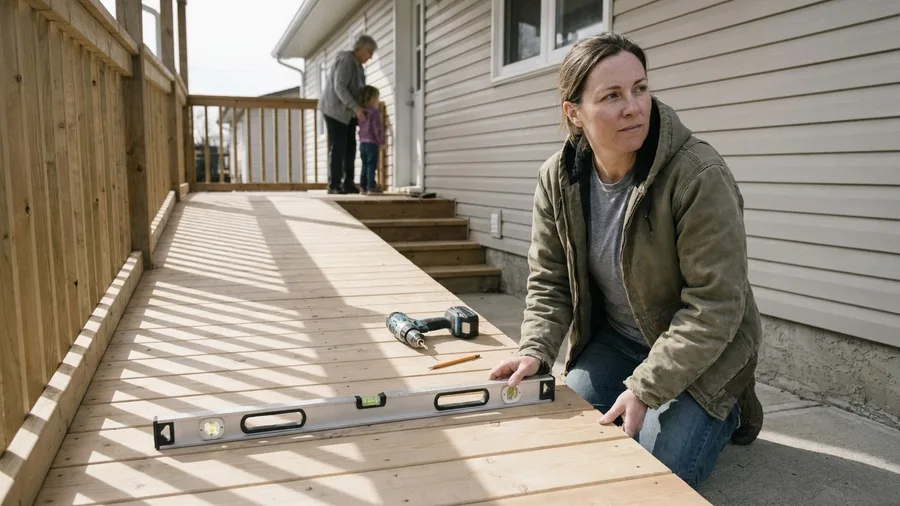
When Mom’s mother came to live with them after her stroke in 1994, she stayed eighteen months, and Dad spent a weekend building a wooden ramp to the side door so she could get out to the porch. Her room was the downstairs one, so she would not have to take the stairs. Grandma could say whatever she liked about dinner. Bedtime and discipline stayed with Mom and Dad, and when she pushed on either, Mom said so plainly.
The version nobody puts on a card: Mom absorbed almost all of the friction with her own mother, because it was her mother to handle, and Dad chose being courteous over being right for a year and a half. It works with extended family who are involved and close. It breaks when one partner quietly sides with the relative against the other, because then the couple is no longer the thing making decisions.
Weathering the Hard Parts
The last habit is the one that gets tested whether you planned for it or not. Health crises are not a special case in a long marriage; they are the ordinary case. What matters is whether the marriage can absorb them without becoming only a nurse-and-patient arrangement.
8. Illness Made Them Teammates, Not Nurse and Patient

The obvious answer is that the well partner steps up and the sick one receives, and that is exactly the arrangement that can quietly hollow a marriage out. The harder question is how two people stay married to each other when one of them is, for a stretch, mostly a patient.
Dad had his knee replaced in 2011, and for six weeks he could not stand long enough to do the dishes he had done by hand since before the dishwasher arrived in 1998. Mom took them over. That is the obvious half. The half that mattered more was that he let her see him on the couch, needing the help, and did not perform being fine.
Then in 2015 Mom was diagnosed with breast cancer and went through thirty-three radiation treatments, and Dad drove her to every one. They sold the second car in 2016, partly to simplify and partly because one car was what the weeks actually required. Mom kept paying the bills from the kitchen table on the days she had it in her, and on the days she did not, Dad knew where the envelopes were.
The failure here is not a lack of devotion. It is one person refusing to be seen scared, incapable, or in need, and the other slowly becoming staff instead of a spouse. The couples this suits are the ones facing a health crisis right now, who can let the ordinary systems carry the weight while they get through it.
💡 Tip: Let your partner see you scared at least once during a health scare. It is the difference between a team and a to-do list.
Frequently Asked Questions
Did your parents ever come close to divorce?
Not that I saw, and I was in the house for the last twelve years of the marriage. What I saw instead was a couple who had the same argument for decades and kept solving it by alternating Saturdays. That is not the same as a happy marriage, but it is a durable one.
How long did it take for the weekly routine to feel normal?
For them it was never not normal; they built it in their twenties and never renegotiated it. For a couple starting now, two weeks is enough to feel whether a fixed point fits your week or fights it. If it fights it, pick a different fixed point.
What if my partner refuses to try any of these?
Start with the one that requires nothing from them, like a weekly cash envelope or a fixed Friday meal. You can begin a system alone and let it become shared. If they actively block a system you are already running, that is a different conversation, and it is worth having plainly.
Which habit matters most if we are in a health crisis right now?
The eighth one. Let your partner see you scared and incapable at least once. The instinct to protect them by hiding it is the thing that turns a marriage into a care arrangement.
Is it too late to start if we have been married twenty years?
No. My parents started their systems in their twenties, but the systems themselves are simple enough to copy at any point. Pick the one that matches your current strain, run it for two weeks, and add a second only if the first held.
Pick the Habit That Matches Your Worst Week
The verdict is not one grand secret and it is not a template. It is eight habits, each of which cost something and each of which would fail somebody. Choose by your worst week: fighting about money, start with the shared weekly chore and the visible balance; feeling drift, start with two fixed points on the calendar; escalating fast, start with the thirty-minute pause and the repair you make with your hands the next morning; facing illness, start with dividing the team roles before the crisis divides them for you. Then leave it alone for two weeks.
What I measured across those Sunday visits and Saturday errands from 2011 to 2023 was not romance. It was small systems, repeated. I got it wrong for years by calling it luck, which was the lazy answer and also the one that let me off the hook.
You do not have to become your parents. Copy the one mechanism that matches your strain, run it for two weeks, and let ordinary repetition do the work the movies never show. Then go dry a dish.
Choose one habit tonight
Look at your calendar and your bank balance this evening. Pick the habit that matches your worst week, and put it on the calendar for two weeks.