The story most people carry about prehistoric women was not pieced together from skeletons or burial sites or the chemical record of ancient bone. It was agreed upon at a conference table in 1966.
Somewhere in school, or in a pop-science book with an illustrated timeline, the picture arrived fully formed: men ranged out across open ground to hunt large game, women stayed near camp gathering plant foods and tending children. The division felt ancient. It felt biological. It felt like a fact about nature rather than a claim about history.
It was neither. The ‘Man the Hunter’ framework was formalised at the 1966 Wenner-Gren Foundation symposium as a theoretical proposal – and then, almost immediately, mistaken for established science. The actual evidence in the ground was filtered through that framework for decades afterward.
What the skeletal record, grave assemblages, isotopic chemistry of prehistoric bone, and use-wear patterns on stone tools show, when read without that filter, is something else entirely: women who hunted large game, manufactured and used stone tools, held pharmacological knowledge precise enough to distinguish remedy from poison, and served as the primary architects of the information systems that kept bands alive across generations.
That picture does not slightly revise the school-taught version. It removes the prehistoric anchor from every gender-role assumption that has ever borrowed the phrase ‘it was always this way’ – in evolutionary psychology, in clinical research, and in the quieter assumptions people carry about what is natural and what is not.
The ‘Man the Hunter’ Story Was Invented in 1966
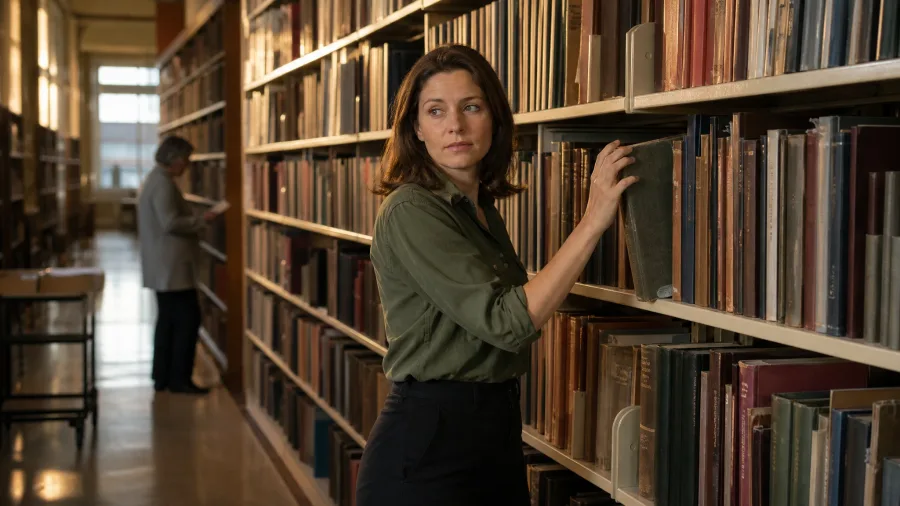
The picture most people carry of prehistoric gender roles did not accumulate slowly from decades of fossil analysis – it was proposed at a single academic meeting and then treated, almost overnight, as settled history.
In 1966, the Wenner-Gren Foundation convened a symposium that codified what became known as the Man the Hunter hypothesis. The participants were not primarily working from bones, burial sites, or stone-tool edge-damage studies. They were working from behavioural observations of a handful of contemporary forager societies, and they projected that framework backward across the entire Upper Paleolithic.
Once formalised, the hypothesis stopped being a proposal and started acting like a filter. Funding followed it, excavation priorities followed it, and the categories researchers used to interpret ambiguous finds followed it – a feedback loop that made the framework look like it was being confirmed when it was actually being repeated.
The cost showed up most clearly at the level of inconvenient data. A female skeleton bearing the kind of mechanical stress markers that, on a male skeleton, would read as load-carrying or weapon use got attributed instead to grinding grain or surviving childbirth. A female burial containing a projectile point became the burial of a woman interred near a male relative’s weapon.
That is not a finding. That is an assumption absorbing contradictory evidence without updating.
The reader who was taught this as established science was taught a theoretical proposal – one conference, one framework, then decades of interpretation shaped by that framework. Everything that follows in this article is what the physical evidence actually shows when the 1966 filter is removed.
Women’s Skeletons Contradict the Passive-Support Role
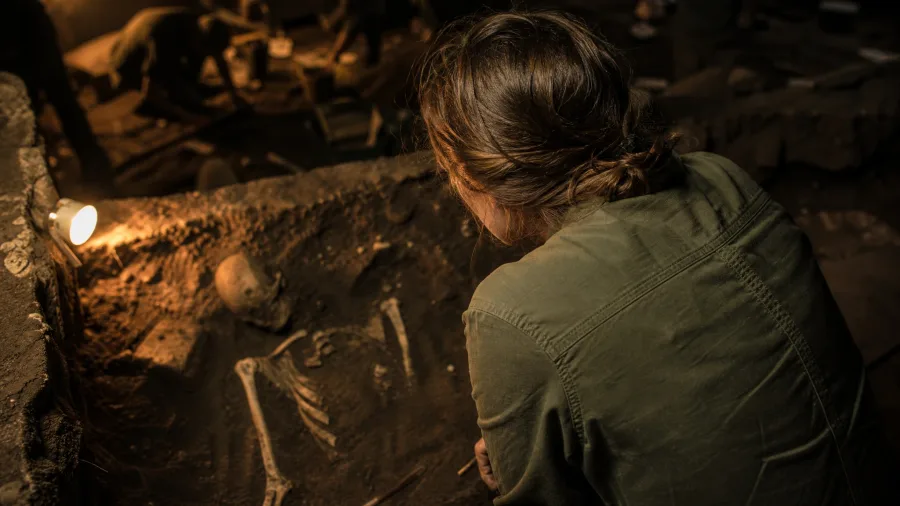
The skeleton does not soften for a preferred theory. It records what a body did, in the form of bone geometry and the ridges that form at muscle-attachment sites where tendons pulled hardest across a lifetime of repeated effort.
Those attachment-site changes – entheseal markings, in the technical literature – are not subject to the interpretive flexibility that makes grave goods ambiguous. They are mechanical records. A bone that was chronically loaded in a particular direction shows it.
When biomechanical researchers applied the same load-modelling frameworks to female remains that had long been used on male ones, the attributions changed. Skeletal damage in women that the older literature had assigned to domestic grinding or birth complications produced different readings under the updated analysis – readings consistent with long-distance travel under load, or with the high-force, asymmetrical limb use that comes from hauling and throwing. The primary literature carries the specifics; the reader is directed there.
Two lines of evidence reinforce each other here. Entheseal development indicates which muscle groups were chronically worked; stress-fracture patterning indicates the direction and type of force that caused them. Together, the two can distinguish a life of kneeling at a grinding stone from a life that regularly involved moving hard and fast across terrain carrying weight.
This pattern holds across Upper Paleolithic sites in Eurasia, the Americas, and sub-Saharan Africa – not one population, not one time window. A single anomalous site could be explained away. A continent-spanning pattern appearing across multiple time periods within the same broad era is something the old framework had no mechanism to account for.
⚠️ COMMON MISTAKE
The Asymmetric Caveat Problem
The argument that a female burial's weapons 'probably belonged to a male relative' is a legitimate caveat — but it was applied only to female burials, never as a general caution about male ones. That asymmetry is not archaeology. It is the 1966 framework defending itself.
Female Hunters Appear in the Burial Record on Multiple Continents
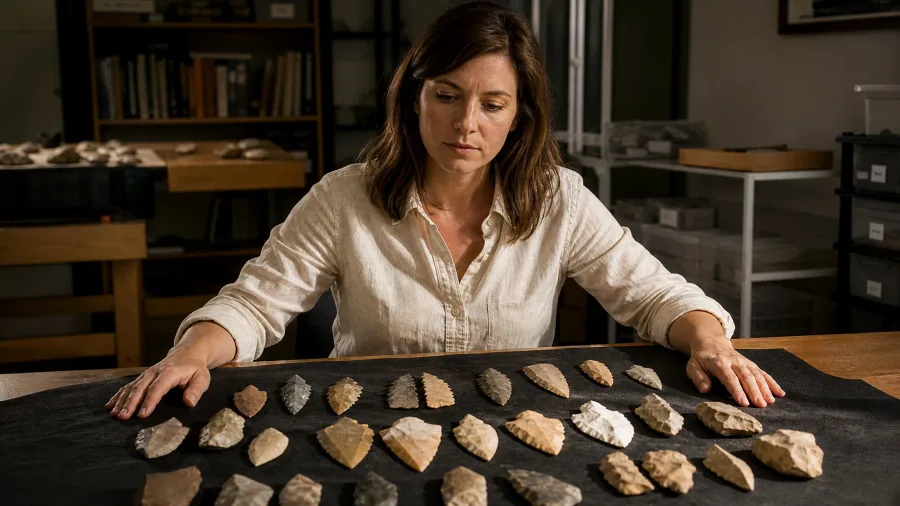
If women’s bodies show loading patterns consistent with sustained physical labour in the field, the burial record offers the most direct evidence of what that labour was – and what it shows, across multiple continents, is women interred with the equipment of hunters.
Grave goods are deliberate. Mourners who knew the deceased selected the objects placed with them; a projectile point or a large-game processing tool in a burial is an argument, made by people who were present, about who that person was. Female burials containing hunting weapons, multiple projectile points, and tools specifically associated with butchering large animals have been documented at sites spread across Eurasia and the Americas – populations with no contact with each other, which rules out a shared cultural borrowing.
The volume and specificity of weaponry matters. An incidental hunter – someone who joined an opportunistic chase once in a season – is not buried with a specialist’s assemblage. The burials in question carry what specialists carry.
Stable isotope analysis adds a second, independent line. The chemistry of bone collagen preserves a dietary record accumulated over years; in a number of these populations, the isotopic signatures in female remains show large-game protein consumption at levels matching male remains from the same sites. The primary sources carry the figures.
The interpretive caveat is fair: a grave good could represent a gift, an heirloom, or a symbol rather than personal use. That caveat is worth holding. What is not fair is applying it only to female burials. For decades, a weapon in a male grave was read as evidence of a hunter without qualification, while a weapon in a female grave required an alternative explanation. The asymmetry was not a finding either – it was the framework deciding in advance what it was willing to see.
The Prehistoric Knowledge Hierarchy — What Actually Held Groups Together
From most specialised (hardest to replace) to most foundational (most widely shared)
Foraging Was a Technical Knowledge System, Not Passive Picking
The mislabelling runs deeper than hunting. The activity the old framework called ‘gathering’ was never a matter of wandering out and picking whatever looked edible – it was a working knowledge system dense enough that acquiring it took years and getting it wrong could kill people.
A competent plant forager in the Upper Paleolithic held something closer to a pharmacist’s inventory than a shopping list. Hundreds of species, indexed by where they grew, what time of year they were safe, which growth stage was edible versus toxic, and what preparation the plant required before it could be eaten at all. Acorns leached in running water for a day. Certain roots fermented before drying. Heating sequences that had to be followed in order – skip a step, and the food that fed you last season poisons you this one.
That last point matters. These were not flexible guidelines. They were exact procedures where the margin between nourishing and lethal was a step in a sequence, held in memory, with no written record to check. The cognitive structure is closer to applied chemistry than to harvesting.
The caloric weight of plant foods to forager diets is documented in the ethnobotany literature – the reader is directed there for figures – but the point is that this knowledge was not supplementary. It was economically central to group survival, which means the person who held it was not filling time between more important activities.
The word ‘gathering’ is doing quiet damage every time it appears. It works the same way the word ‘just’ does: it removes the technical architecture from an activity so the activity sounds instinctive, low-stakes, something any person would naturally know. But this knowledge had to be built across seasons, corrected when it failed, and passed deliberately to the next learner. That is the profile of expert knowledge – and expert knowledge was not what the 1966 framework was willing to credit here.
Tool Manufacture Was Not a Male Specialisation
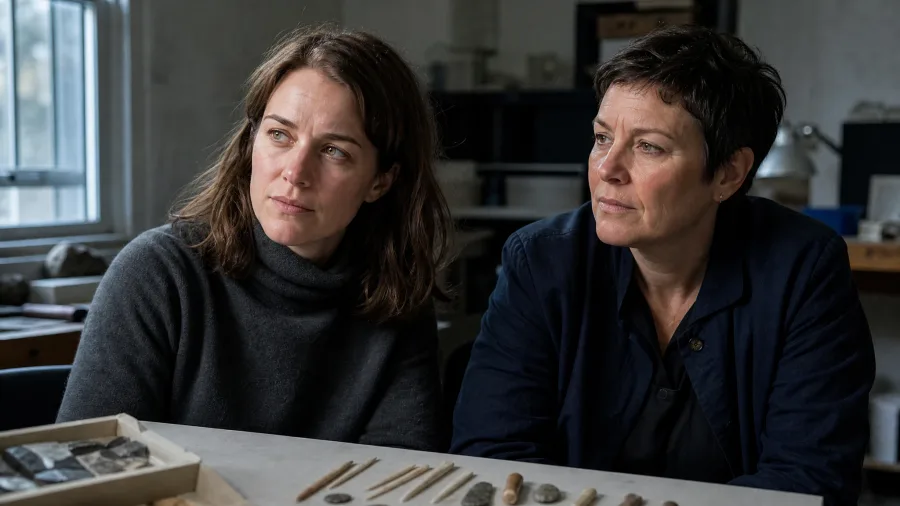
The same pattern holds for the tools themselves. Nobody derived ‘men made the tools’ from the tools – it was imported wholesale from the theoretical framework and applied as a default to every ambiguous context the evidence presented.
Use-wear analysis can read a stone tool’s working edge under a microscope. The pattern of micro-fractures and residue left on a flint scraper tells researchers whether it processed hide, plant material, or animal bone. What it cannot do is record the sex of the hands that held it. That gap was filled not by evidence but by assumption – and the assumption came from the 1966 framework, not from anything the tools themselves indicated.
Cave-site hand stencils are a different kind of record. Each one is a physical impression of a specific hand. Recent research applying digit-ratio and hand-dimension analysis to those stencils – the primary sources carry the specifics – has challenged the picture of prehistoric cave sites as predominantly male spaces. The hands preserved on those walls are more varied than the old story required.
Then there are the eyed needles. Upper Paleolithic bone needles with drilled eyes represent some of the most demanding precision work in the prehistoric record: pressure-flaking bone down to a consistent diameter, then drilling an opening smaller than a millimetre without fracturing the shaft. The contextual evidence links this tool category to fine hide-working and fitted clothing, and that activity is consistently associated with female practitioners. The person who made those needles was a specialist, not a bystander to the ‘real’ manufacturing.
The honest position is that sex attribution for tool manufacture is genuinely difficult across the board. That difficulty cuts both ways – which is exactly why decades of confident attribution to men, applied without scrutiny, should have been flagged as the assumption it always was.
What the 1966 Framework Said vs. What the Evidence Shows
The 1966 Template
- Women gathered passively; men hunted actively
- Female skeletal damage = grinding and childbirth
- Weapon in female burial = belonged to a male relative
- Tool manufacture = default male activity
- Fibre work = low-skill domestic background task
The Archaeological Evidence
- Female burials with specialist hunting weapons across Eurasia and the Americas
- Biomechanical re-analysis attributes female bone loading to long-distance travel and high-force limb use
- Isotopic signatures show large-game protein consumption equal to male remains at same sites
- Cave hand stencils include a significant proportion of female hands
- Net-hunting reframes fibre work as hunting infrastructure, not domestic craft
Textile and Fibre Work Was Advanced Cognitive Engineering
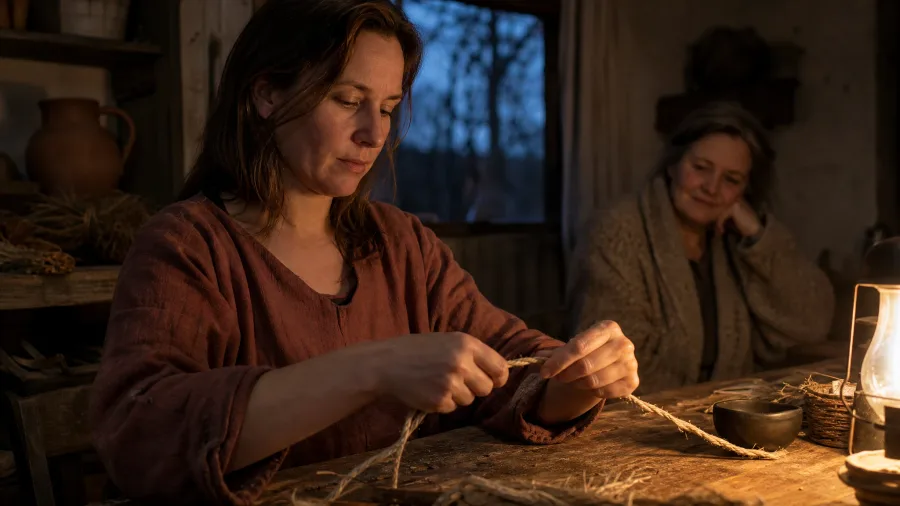
Fibre technology is the domain where material survival has done the most damage to historical understanding. Plant fibres, sinew, and hide strips decay almost completely under normal preservation conditions, which means an entire engineering tradition has been systematically written out of the record – not because the work was marginal, but because organic material rots.
The work itself was not simple. Producing load-bearing cordage or a functional net required selecting fibre by tensile property and seasonal availability, processing it through retting, drying, splitting, and twisting in sequence, then selecting a structural pattern calibrated to the intended load. A net that fails mid-drive loses the hunt. The cognitive demands are those of an engineer working without written specifications.
Net-hunting reframes who the hunter was.
Where the archaeological record shows groups driving animals into fibre nets, the hunting credit has typically gone to whoever closed in with a weapon. But the net had to be built first – and maintained, and repaired after each use. The person who manufactured that infrastructure was not a bystander to the hunt; they were a precondition for it. The same applies to carrying systems, clothing designed to prevent cold-weather death, and cordage used in shelter construction.
Calling this work ‘domestic’ is a classification error, not a description. The category ‘domestic’ belongs to industrial-era household organisation; it did not exist in a small forager band. A net is hunting infrastructure. Labelling its manufacture otherwise demotion by vocabulary, and the evidence never asked for that label.
How Far Each Domain Was Misrepresented by the 1966 Framework
0 = accurately described, 100 = completely erased or inverted
- Large-Game Hunting: Female specialist hunters documented on multiple continents; framework treated it as exclusively male
- Tool Manufacture: Attribution to men was an assumed default, never derived from use-wear analysis
- Fibre and Net Technology: Reclassified as domestic background work; actually hunting infrastructure and cognitive engineering
- Plant Taxonomy and Foraging: Described as passive gathering; actually a multi-variable expert knowledge system
- Pharmacological Knowledge: Almost entirely absent from mainstream accounts of prehistoric female cognitive life
Scale reflects interpretive distortion, not absolute importance. All domains were critical to group survival.
Pharmacological Memory Was Probably a Specialised Female Domain
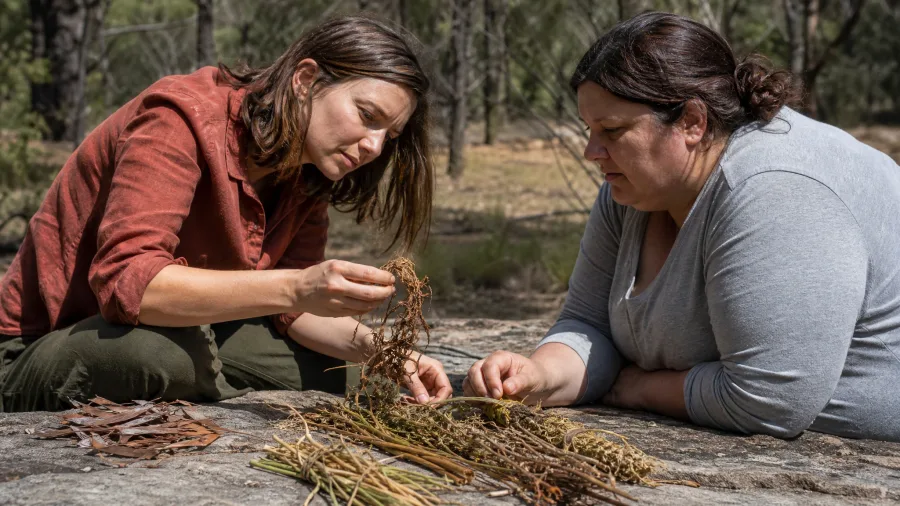
Where expert knowledge becomes most consequential is where the cost of getting it wrong is immediate and irreversible – and no knowledge domain in the prehistoric record fits that description more precisely than plant pharmacology.
Foraging knowledge and pharmacological knowledge are not the same thing, even when they draw on the same plants. A forager needs to know which root is safe to eat. A pharmacologist needs to know that the same root, prepared as a decoction from the dried bark rather than the raw flesh, at a quantity calibrated to the patient’s body weight and the plant’s potency in late-season growth, treats fever rather than causing organ failure. The margin between those two outcomes can be a single step in a preparation sequence.
The cognitive structure required is closer to a dosing system than to a field guide. One species, used differently, can be medicinal, inert, or lethal – and the variable that determines which outcome occurs might be which part of the plant, how it was dried, how long it was heated, or what condition the person receiving it is already in. That entire calculation had to be carried in living memory, without notation of any kind.
The cross-cultural record is striking here. Ethnobotanical research across societies with no shared history consistently finds this specific category of knowledge held predominantly by women. That pattern is not proof of what happened 40,000 years ago – contemporary forager practice cannot be mapped directly onto Upper Paleolithic conditions – but when the same distribution appears independently across populations that never contacted each other, it is the strongest proxy the record can offer.
Knowledge that others cannot replicate, and that can determine whether someone lives or dies, gives its holder a form of influence that grave goods do not always record but that shapes a group’s daily decisions in ways that compound quietly over generations. Erasing this domain from accounts of prehistoric female cognitive life is not a gap in the literature. It removes the most technically demanding expert system the evidence suggests women controlled.
💡 PRO TIP
How to Read a Burial Assemblage Fairly
When evaluating a burial's status indicators, apply every caveat — gifting, inheritance, symbolic placement — to all burials equally, or apply none. The moment a caveat is raised only for female burials, it has stopped being archaeology and started being advocacy for the framework.
High-Status Female Burials Undermine Assumed Social Hierarchies
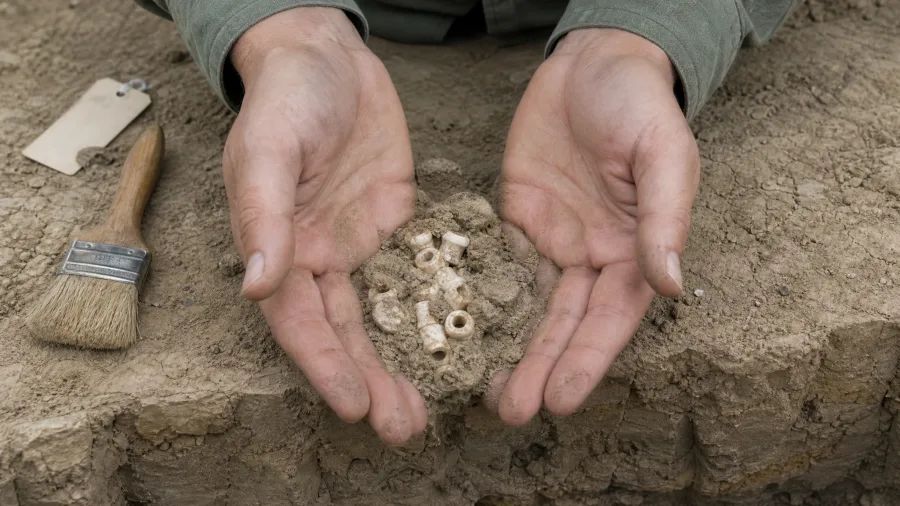
If expert knowledge generates social standing, that standing should leave traces in how the dead were treated – and across multiple continents, the burial record delivers exactly that evidence.
Archaeologists assess the status of a burial from several converging indicators at once: the quantity and quality of objects placed with the body, the labour invested in constructing the grave itself, its position within the site relative to other burials, and what the specific objects imply about how the person spent their life. No single indicator settles the question, but when several point the same direction, the inference is considered solid.
Female burials carrying that convergence of high-status markers have been documented at geographically separate sites – among them the Sungir site in Russia, where a woman was interred with thousands of mammoth-ivory beads and grave goods of a quality matching the most elaborate male burials at the same site, and the Wilamaya Patjxa site in Peru, where a young woman was buried with a hunting toolkit consistent with big-game specialisation. These populations had no contact with each other.
The standard counterargument – that a high-status female burial reflects her proximity to a powerful man rather than her own role – runs into two problems. In documented cases, the grave goods are functionally matched to the deceased’s own body and apparent activities, not symbolically borrowed. And the argument is raised selectively: it is applied to female burials as a default, while male weapon burials are read as straightforwardly indicating male hunters. The asymmetry is the tell.
Status in a small band is not a title. It is influence over decisions, control over knowledge others rely on, and the irreplaceability that comes from being the person the group cannot afford to lose. The burial record, read without the 1966 framework filtering the interpretation, shows women who held exactly that.
What Makes a Prehistoric Burial 'High Status' — At a Glance
⚗️ Grave-Good Specificity
Tools matching the deceased's apparent role, not generic items
🏗️ Burial Construction Effort
Depth, lining, and structured placement requiring significant group labour
📍 Site Placement
Central or elevated position relative to other burials at the same site
🦴 Isotopic Signature
Dietary profile consistent with high-protein, large-game consumption over years
🔁 Cross-Site Consistency
Pattern repeating across unconnected populations on multiple continents
The Reliability Rule
A single indicator is suggestive; three or more converging indicators from independent evidence types is treated as robust by the field.
Teaching Across Generations Was Women’s Primary Cognitive Labour
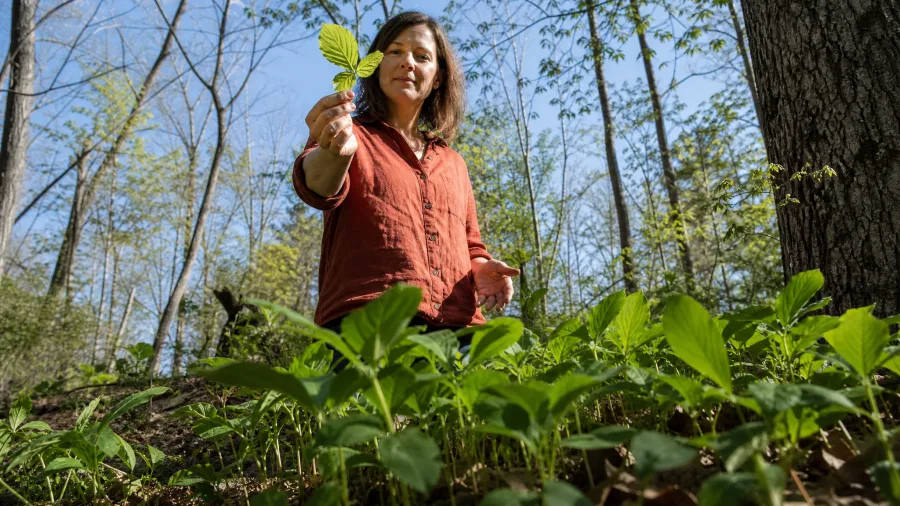
Controlling knowledge matters most when you are also the person responsible for whether the next generation receives it accurately – and in a band with no writing, no external storage of any kind, that responsibility was total.
Every piece of survival knowledge – which plants kill at which dose, how to read seasonal terrain, the precise tension required in a net knot that will hold under load – existed only in the minds of living people. One generation that transmitted it carelessly, or not at all, and the knowledge was gone. There was no archive to consult.
That pressure changes what teaching means. A child watching an adult scrape a hide can copy the motion well enough. A child watching an adult prepare a medicinal plant cannot safely copy the sequence without understanding why each step matters and what skipping one actually does. The person teaching has to hold a working model of what the learner currently understands, sequence the information to close the gap, and catch the errors before they become habits – or, in pharmacology, before they become fatalities. Researchers who study how knowledge moves between generations document these as distinct and demanding cognitive operations, and the reader is directed to that literature for detail.
Calling this work ‘mothering’ and filing it under domestic life performs the same sleight of hand as calling net-manufacture a household chore. The label does the demotion. The actual activity – managing a community’s accumulated knowledge and moving it intact across a generation – is the kind of work that determines whether the group survives its next hard winter.
In any honest accounting of cognitive labour, the person carrying that responsibility is not a background figure. They are the most consequential person in the band.
🔍 How the Myth Was Built — and How It Is Being Dismantled
1966 — The Framework Is Codified
The Wenner-Gren Foundation symposium formalises 'Man the Hunter', drawing on contemporary forager observations rather than skeletal or burial evidence.
Post-1966 — Evidence Is Filtered Through the Template
Funding priorities, excavation categories, and interpretive defaults all follow the new framework, bending ambiguous data toward expected conclusions.
Late 20th Century — Isotope Analysis Enters the Field
Stable isotope analysis of bone collagen allows dietary reconstruction over years of life, producing protein-source data that does not align with predicted sex-based dietary splits.
2000s–2010s — Biomechanical Re-analysis Begins
Researchers apply the same load-modelling frameworks to female skeletons that had previously only been applied to male remains, producing new attributions for the same bones.
2010s–Present — Burial Record and Cave Art Re-examined
High-status female weapon burials and female-hand-dominated cave stencil sites are documented across multiple continents, with findings directed to primary sources.
Now — Psychology Faces the Warrant Problem
Evolutionary psychology and clinical frameworks built on the prehistoric premise are left without the anchor the myth supplied — and the field is beginning to account for that.
The Myth’s Staying Power Reveals a Bias in Psychological Research Itself
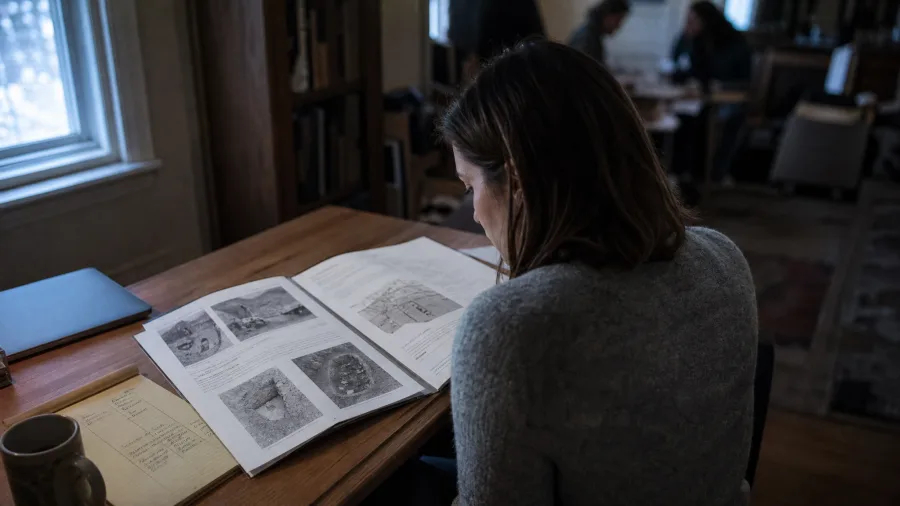
The myth proved durable because it was useful. Evolutionary psychology frameworks built entire models of sex-differentiated behaviour – male risk-tolerance as an adaptive default, female nurturing as a biological baseline – on the premise that prehistoric labour divided exactly along those lines. Therapy models drew from the same well, treating female ambition or comfort with authority as a departure from a natural order that needed explaining. Workplace research designs framed measured gender differences as stable and innate rather than asking what the conditions producing them were.
The logical structure of the error has three steps, and each one depends completely on the one before it. The prehistoric premise – women were passive, domestic, cognitively secondary – was treated as established fact. That supposed fact was then labelled natural because it was ancient. And natural was treated as equivalent to inevitable. Pull the first step out, which the skeletal and burial evidence now does, and the chain collapses.
The cost was not merely academic. Social psychology research consistently finds that when people believe a gender role is ancient and biological, departing from it carries a real psychological weight – the discomfort is not invented, but its source is. The myth manufactured the cost and then watched people pay it.
The corrected record does not simply reverse the story. It does not replace ‘men were the important ones’ with ‘women were the important ones.’ It shows something harder to absorb: a species whose labour, cognition, and social organisation varied widely by context and population, not by a fixed biological script. Every clinical model, research design, or self-concept that borrowed ‘it was always this way’ as its warrant borrowed from a fabricated foundation.
Frequently Asked Questions
Did prehistoric women really hunt large game, or is that just a modern reinterpretation?
The burial evidence and isotopic data make a strong case for specialist female hunting across multiple continents. High-status female burials containing projectile points and large-game processing tools have been documented in Eurasia and the Americas among populations with no shared contact. Stable isotope analysis of bone collagen at some sites shows female dietary protein signatures equivalent to male remains at the same locations. The primary sources carry the figures; the pattern is not a single-site anomaly.
Why did the ‘Man the Hunter’ narrative survive so long if the evidence contradicted it?
The hypothesis was codified in 1966 and then shaped what researchers looked for — funding priorities, interpretive categories, and the default explanations for ambiguous findings all followed the template. When a female skeleton showed heavy physical loading, the explanation was grinding or childbirth, not long-distance travel under burden. The framework protected itself by making female hunters and heavy labourers categorically unexpected, so disconfirming evidence was absorbed rather than recognised as disconfirming.
What does stable isotope analysis actually tell us about what prehistoric women ate?
Isotope analysis of bone collagen reconstructs dietary protein sources over years of a person’s life, not just what they ate near death. Different protein sources — large game, fish, plant protein — leave distinct isotopic signatures in the collagen. In some Upper Paleolithic populations, female remains carry isotopic signatures indicating large-game protein consumption at levels comparable to male remains at the same sites. The field-specific figures are in the primary sources; the reader is directed there for the population-level detail.
How does this affect evolutionary psychology’s claims about natural gender roles?
Evolutionary psychology frameworks that treat male risk-taking and female nurturing as ancient adaptive defaults were drawing on the prehistoric premise as a warrant. That warrant was the 1966 framework projected backward, not the cumulative verdict of the fossil record. Without a fixed prehistoric template, those frameworks lose their ‘it was always this way’ anchor. The corrected evidence shows variation, flexibility, and context-dependence across populations — which is a very different foundation for reasoning about what is ‘natural’ in human behaviour.
Were prehistoric women also responsible for making tools, or just using them?
The attribution of tool manufacture to men was an assumed default, not a finding derived from use-wear data. Use-wear analysis can tell researchers how a tool was used and what material it processed; it cannot inscribe the sex of the manufacturer. Cave hand stencils — where digit-ratio and hand-size analysis has been applied to assess sex distribution — challenge the assumption that lithic production sites were predominantly male spaces. Eyed needles, which required precision bone-working, are contextually associated with female practitioners at several sites.
Why does the fibre and textile evidence matter so much if the materials rarely survive?
That is precisely the problem: fibre materials decay almost completely under normal preservation conditions, so the entire domain of fibre technology is systematically under-represented in the archaeological record. The cognitive work done there has been underestimated in direct proportion to how poorly the materials survive. Net-hunting evidence — where groups drove animals into constructed fibre nets — reframes fibre work as hunting infrastructure, not domestic craft. A group without that technology lost a hunting method entirely; the person who held and transmitted that manufacturing knowledge was indispensable to the group’s survival strategy.
What Psychology Owes the People It Built This On
The verdict the evidence delivers is plain. The prehistoric ‘default female’ was not passive, not domestic in any meaningful sense, and not cognitively secondary. She was a hunter whose skeleton records the loading. She was a toolmaker whose use-wear patterns sit on the same implements. She was a pharmacologist whose knowledge domain had no margin for error. She was the transmission system the next generation depended on.
What you were taught in school now has a precise name: a theoretical framework proposed at the 1966 Wenner-Gren Foundation symposium, not a finding extracted from the record at Eurasia, the Americas, or sub-Saharan Africa. The record from those sites shows something the framework was designed not to see.
The psychological cost of having taught it as fact is specific. It gave every gender-role assumption built on top of it a warrant it did not earn – ‘it was always this way’ – and that warrant then ran forward into research designs that asked the wrong questions, clinical models that measured women against a false baseline, and individual self-perceptions that treated culturally constructed limits as biological constants. The myth did not merely describe a world; it built one. So when an evolutionary argument, a workplace policy, or a clinical framework reaches for prehistoric precedent to justify what women naturally are or do, the question to ask is the same one this article started with: where did that picture actually come from? The answer, it turns out, was always a conference room.
The Evidence Is in the Primary Sources
The figures behind the isotope studies, skeletal re-analyses, and burial assemblages discussed here are in the paleoanthropology and ethnobotany literature — go to those sources directly rather than taking any secondary account, including this one, as the final word.