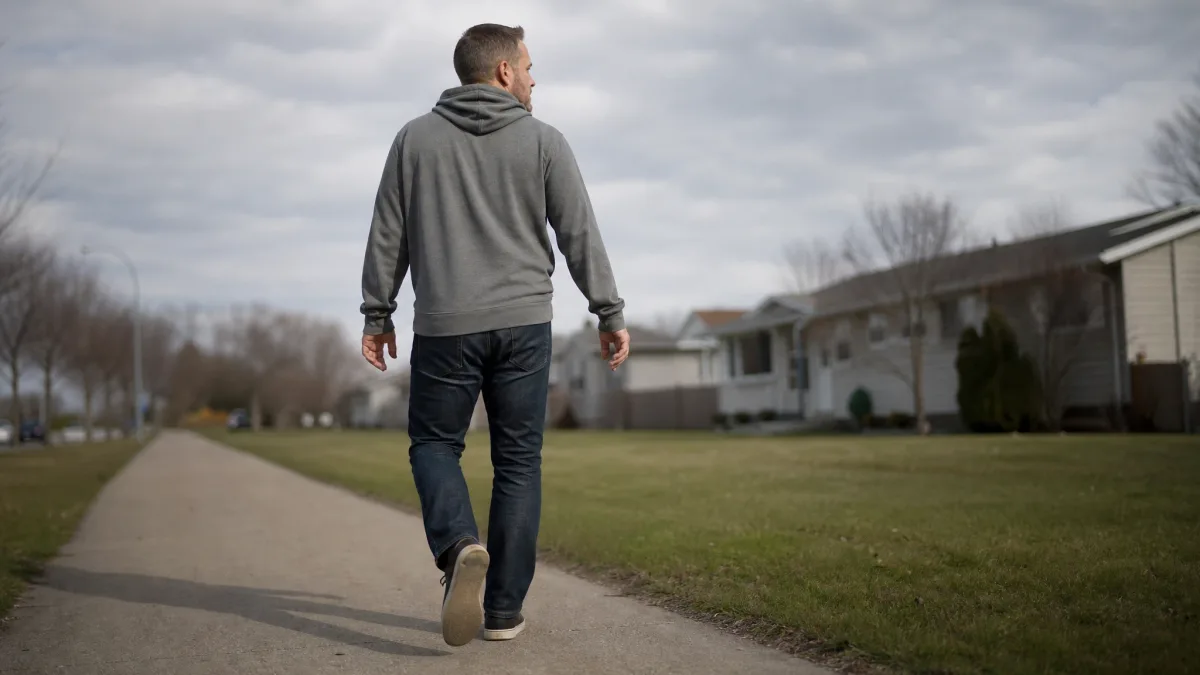
Read this once and you will know exactly why a 10-minute walk reliably shifts mood, focus, and stress where most self-help advice stalls — and you will have one concrete step to take in the next 24 hours, no purchase required.
The 30-day program that ended on day three. The morning routine that required a perfect morning. The journaling system that needed a subscription, a quiet hour, and a version of yourself that only shows up when things are already going well. The quitting was not a discipline failure. Each of those methods set a price — in time, setup, and ideal conditions — before it would hand over anything in return.
A 10-minute walk covering roughly half a mile asks for none of that. No app, no equipment beyond shoes you already own, no window of calm before it works. And because the threshold is that low, the walk actually gets taken — which is the one thing every elaborate system kept failing to guarantee.
The walk works not despite being simple but because of it. The design matches the problem: people need help most on exactly the days they have the least willpower, the least time, and the least desire to do anything at all. What follows is a plain account of why that match holds, what the walk reliably delivers, and what it does not.
Self-Help Sets a Price Most People Will Not Pay

Most self-help systems fail because of what they cost before they deliver anything. A 30-day program asks for a month of consistent effort before the results are visible. A guided meditation app runs $12.99 a month and requires finding a quiet room, sitting correctly, and completing a full session before the benefit kicks in. A structured morning routine can consume an hour before work even begins – and that hour has to be carved out of sleep, or from the morning itself, every single day.
That front-loaded price is the structural problem.
When the cost of starting is high enough, most people drop out before the habit has time to form – usually within the first two weeks, often within the first few days. No habit means no benefit. No benefit means the person concludes they were not disciplined enough, not consistent enough, not the kind of person who sticks with things. The design failed them, but they absorb the failure as personal.
A 10-minute walk sits beneath the threshold where that negotiation even starts. There is no subscription to justify, no hour to find, no preparatory ritual to complete. The resistance that kills larger commitments does not have enough material to work with. That is not a small distinction – it is the whole mechanism. A system that requires ideal conditions to function is not a stress tool; it is a fair-weather habit. The 30-to-60-minute time demand that comes standard with most structured programs is not what makes them effective. It is what makes them easy to quit.
⚠️ COMMON MISTAKE
The Setup Cost Is the Real Problem
When a habit requires preparation before you can begin it, the preparation becomes the first thing to skip. A 10-minute walk requires nothing beyond footwear you already own — that is not a compromise, it is the whole point.
Motivation-Dependent Habits Collapse the Moment You Need Them
There is a second structural flaw that runs even deeper than cost: the habit requires willpower to begin, and stress is precisely what depletes willpower. The days when a journaling practice or a breathwork app would help most are the days when opening the app, choosing a prompt, and sitting with the exercise feels like assembling furniture without instructions. The overhead is modest in absolute terms. In a depleted state, it is a wall.
This is the motivation trap. A habit that only runs when conditions are decent is not solving the problem – it is riding alongside it.
A 10-minute walk has almost no decision load at the front end. There is no app to open, no sequence to remember, no version to choose between. The only input it needs is both feet moving. That minimal friction is not a sign that the habit is too simple to be useful – it is the reason the habit survives exactly the states that cause everything else to fail. When a person is most depleted, the walk is still reachable. The journaling prompt, the breathing sequence, the goal-setting ritual – each requires the person to already be in better shape than they are.
If a habit only shows up on good days, it is functioning as a reward, not a tool. The walk earns its place by being available on the worst day – not because it requires less commitment, but because its design never demanded that commitment in the first place.
What People Believe About Walks — and What Is Actually True
Complexity Hands the Mind a Reason to Delay
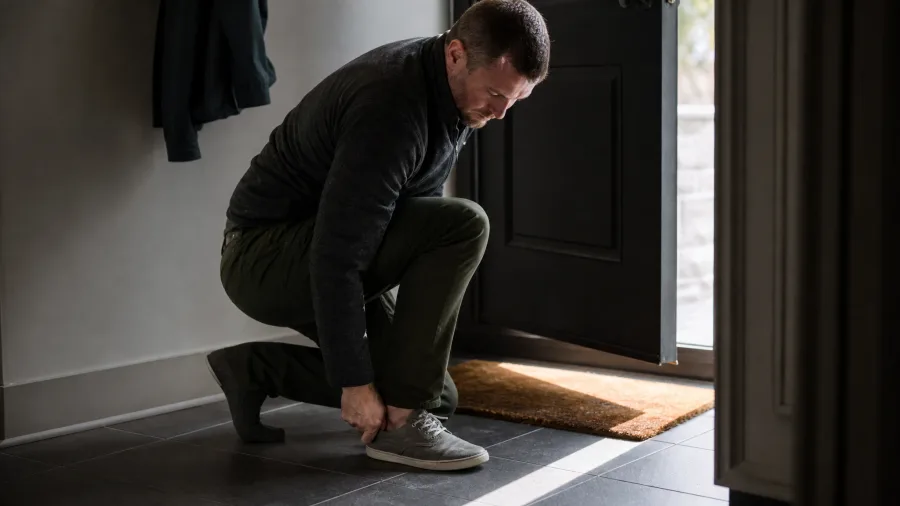
Even when willpower is intact, complexity finds another way to stop a habit before it starts. The podcast needs picking. The notebook is in a different room. The app downloaded an update overnight and the phone is at 8 percent. Each small obstacle is minor on its own – and each one, in the moment, functions as permission to skip the whole thing today and do it properly tomorrow.
The walk has no correct version to delay for.
There is no optimal time of day that must be protected, no special gear beyond footwear already sitting by the door, no preparation phase that has to be completed first. If back pain has been quietly shaping your movement habits, daily movement for back pain matters more than step counts alone. It cannot be done wrong. A structured morning routine requires laying items out the night before, holding a specific window in the schedule, and moving through a set sequence in order – any one of those failing means the whole thing stalls. The walk starts the moment both feet are on the floor.
That absence of moving parts is not evidence the habit is too shallow to produce a real effect. It is the feature that makes the effect reachable. Every requirement a habit carries is a potential exit the mind can take on a hard morning. Zero requirements means zero exits. The escape route that works on almost every other method – ‘I’ll set it up properly and start tomorrow’ – has nothing to attach to here.
Walk vs. Typical Self-Help System
10-Minute Walk
- Zero setup — no equipment, no subscription
- Works on low-willpower days by design
- No correct or incorrect version to worry about
- Fits inside a lunch break or commute gap
- Benefit arrives in the first 10 minutes, not after 30 days
Structured Self-Help Program
- Requires time, money, or app setup before day one
- Demands motivation to initiate — scarce on hard days
- Complex sequences create pre-habit reasons to postpone
- Typically needs 30–60 minutes to run as designed
- Dropout before habit forms, leaving no proof of concept
Movement Uses the Stress Response as It Was Intended

Something real happens in the body – and it runs whether or not the walker believes it will.
The stress response is preparation for physical action. Heart rate rises, stress hormones move through the bloodstream, muscles load. The whole system is designed to exit through movement, not through sitting still and reasoning at the ceiling. When that exit never comes – because the stressor was a difficult email, not a physical threat – the body stays in the prepared state. The activation has nowhere to go.
Walking provides the exit.
At 3 mph, covering roughly half a mile in 10 minutes, the body is doing exactly what the stress response set it up to do. The distance is almost beside the point – it is the sustained movement itself that engages the mechanism. The body does not consult the walker’s mood first. It does not require a particular frame of mind, a belief that this will help, or any mental reorientation before the process begins. The shift is structural, not motivational.
This is where sitting with the problem and trying to think it away runs into a wall. The cognitive effort gets stacked on top of a body still running its alert state. The thinking and the physical condition are two separate problems, and the thinking only addresses one of them.
For anyone who wants precise figures on cortisol, heart rate variability, or related measures, the primary research literature is the right place – those specifics should be taken from sources, not from an article making a general case. The mechanism described here is the structural one: a system built to exit through movement, given the movement it was waiting for.
The Rhythm of Walking Loosens Repetitive Thinking
Alongside the body’s activated state, the mind tends to be running its own problem on a loop – and the walk’s rhythm addresses that through a completely different route.
Rumination is not best understood as a thinking problem. It does not yield to a better argument or a more determined attempt to reason past it. It is a loop, and a loop needs an interrupt – something that changes the conditions, not something that fights the loop directly.
Walking turns out to provide that interrupt without requiring any effort to stop thinking. The mild demands of balance and navigation – even on familiar ground – draw on some of the same mental bandwidth the loop was using. Not enough to require concentration, but enough to gently crowd out the repetitive cycling. The rumination is not suppressed. It simply has less room to run at full speed.
This is worth distinguishing from distraction. A podcast drowns the problem out; the walk does not do that. The problem is still there – it has not been pushed down or avoided. What changes is the perspective available to approach it. The loop was preventing any angle other than the one already being turned over; the walk creates space around it so re-entry is possible from somewhere less worn.
The effect is stronger outside, where small variations in the environment add mild perceptual novelty. But it is not absent on a treadmill or in an indoor corridor on a wet day. The rhythmic movement carries most of it regardless of setting.
The problem is the same after the walk as before it. What is different is the quality of thinking brought to it.
💡 PRO TIP
The Clarity Arrives After, Not During
Do not judge the walk while you are on it. Rumination often peaks in the first two or three minutes before the rhythmic crowding-out takes hold. The test is how the problem feels once you are back inside — not what you were thinking at the halfway point.
Ten Minutes Is Enough Because the Benefit Is Front-Loaded

Ten minutes is enough – not as a compromise, but because that is roughly where the effect actually arrives.
Mood research consistently places the shift early in a walk’s duration rather than at the end of a long one. The benefit does not accumulate in a straight line from minute one to minute sixty; it front-loads. Readers who want precise thresholds should check the primary sources directly – but the general pattern is well-documented enough to push back hard on the assumption that more is simply better.
That assumption is the real obstacle. Someone who decides they need 30 minutes waits for a 30-minute gap. The gap does not arrive on Tuesday, or Thursday. The weekend comes and something else fills it. The 10-minute walk taken at noon on a Wednesday – slotted into a lunch break, a gap between calls, or the ten minutes before sitting back down at a desk – outperforms that unmade 30-minute walk by the only measure that matters: it happened.
Ten minutes sounds almost too small to bother with.
That is exactly the problem. The dismissal is the obstacle, not the duration. A walk that fits inside a commute gap or the transition between work and home requires no new block of time, no schedule restructuring, no calendar entry. It slides into existing space.
Longer walks do provide more. That is not in dispute. The question is whether the extra return from 30 minutes justifies the higher threshold – the threshold that, on the harder days, causes the whole thing to be skipped. For most people, most of the time, it does not.
10-Minute Walk — At a Glance
🕐 Time cost
10 minutes
📏 Distance covered
0.4–0.6 miles
💰 Equipment cost
$0 — footwear you own
🧠 Setup required
None
📅 When it fits
Lunch break, commute gap, work-home transition
🌧️ Weather dependency
None — works indoors with no change to the core mechanism
The structural advantage
A 10-minute walk requires no new time block — it slots into gaps that already exist in most people's days.
A Mood Shift Changes How the Rest of the Day Reads
A small mood shift is not a small thing when mood is the lens through which every remaining task gets read.
The walk does not remove the problem. The email that felt impossible to start before stepping outside is the same email when you return – same subject line, same deadline, same sender. What changed is the state doing the reading. A body that has moved through its stress response rather than sat inside it interprets the same facts differently. The email goes from immovable to manageable. Not easy. Just approachable enough to begin.
That ceiling is worth naming honestly. The walk is not a treatment for clinical depression or anxiety disorders, and describing it as one would be a different kind of dishonesty than underselling it. For those conditions, professional care is the right path.
What the walk actually offers is a mood floor.
Not a transformation – a floor. A reliable lower bound below which the day is less likely to sink when the habit runs consistently rather than occasionally. One walk produces a shift in a single afternoon. Ten walks across two weeks produce something closer to a different baseline for reading difficult things. The compounding is quiet and incremental, which is exactly why most self-help advice ignores it – there is nothing dramatic to promise.
Dramatic and inconsistent is the architecture of most structured programs. Modest and repeatable is the architecture of the walk. On a genuinely hard day, modest and repeatable is the one that shows up.
Timing the Walk to the Problem It Needs to Solve

Positioning the walk well does sharpen what it delivers – but the answer depends on what the day is actually asking for.
First thing in the morning, the walk costs almost nothing: the day’s decisions haven’t stacked yet, the inbox is still closed, and 10 minutes outside before any of that starts produces a small, clean sense of having already done something. That feeling carries. People who walk before work tend to report that the first hour at their desk feels less like climbing a wall.
Midday does a different job. Desk-bound tension builds quietly – shoulders tighten, concentration frays, and most people reach for coffee when what’s actually depleted is not caffeine but the ability to sit still and focus. A walk taken at lunch interrupts that buildup before it peaks and has the clearest association with sharper afternoon work. Pairing that midday reset with the right sleep habits for brain health creates a fuller picture of low-effort daily recovery. For anyone whose concentration reliably drops around 1 or 2 p.m., the timing is not a coincidence.
Evening walks help with decompression, but they’re the least reliable mood fix. If the day’s frustrations are already running on a loop before the walk begins, the walk shares space with the rumination rather than interrupting it.
None of those slots is the right answer in the abstract. The right slot is whichever one survives a week when everything is going wrong. A midday walk that disappears every time a meeting runs long is worth less than a morning walk that happens without negotiation. The walk already fits inside a lunch break, a commute gap, or the transition between work and home – no new block of time needs to be invented, only claimed.
🚶 How One Walk Moves Through Your Day
Put shoes on and step outside
The only two decisions required — everything after this is already in motion.
First 1–3 minutes
Resistance peaks here; rumination may run loud — this is normal, not a sign it is not working.
Minutes 4–7
Rhythmic movement begins crowding out the loop; perceptual attention starts shifting to the environment.
Minutes 8–10
The front-loaded mood effect has landed; physical throughput has addressed the stress response.
Back inside
The problem you left with is unchanged — the state interpreting it is not, and the quality of thinking improves.
What You Listen to Changes What You Get From the Walk
Most people never consciously decide what to listen to on a walk – they hit play on whatever was running last, and that default shapes what they get without them realizing it was a choice.
Walking in silence, or with only ambient sound, allows the mind to drift in a specific and useful way. It is not blank-mind meditation and does not require any technique. It is the mild, unfocused wandering that tends to loosen a mental loop from the outside rather than trying to think through it directly. This is where the clarity effect described earlier actually lives – not in the movement alone, but in the combination of movement and unstructured mental space.
A podcast or phone call redirects attention usefully but trades that drift for something else. The loop does not get cleared; it gets postponed. That can be the right call – sometimes an interesting conversation is exactly what the hour needs – but it is a different return, not a better one.
Upbeat music sits in between.
It preserves the mood benefit and makes the walk more enjoyable, which matters because a walk that feels good to take gets repeated. If the choice is between a silent walk that feels like a chore and a music walk that becomes a habit, the music walk wins on the metric that counts most: whether it happens again tomorrow.
One week of experimenting – a couple of silent walks, a couple with music, one with a podcast – will tell more than any prescription here. The best mode is the one this particular person will repeat on a Wednesday when nothing is going right. Figure that out once, then make it the default instead of leaving it to chance.
The Walk Decisions That Move the Needle Most
The First Walk That Counts Is the One You Least Want to Take

All the listening choices in the world are secondary to one thing: whether the walk actually happens on the day it costs the most to take.
That day has a recognizable shape. The mood is flat or worse. The couch is already occupied. The thought that surfaces is some version of ‘what’s the point’ – and that specific thought is a signal worth reading carefully, because it describes a body sitting in exactly the state the walk is designed to address. Low motivation, low energy, the edges of stress or dullness: that is not evidence the walk will fail today. That is the test the walk was built for.
The minimum the moment requires is two decisions. Put shoes on. Step outside. That is the entire commitment – not ten minutes, not half a mile, not a destination. The decision to keep going comes after both feet are already moving, which is a very different place to make it from.
Most structured methods quietly require a third thing before either of those two: some degree of readiness, a settled mind, a sense that this is worth doing. They need good conditions to begin. The walk does not. It needs footwear that is already owned and a door.
Which is why the hardest walk is also the most informative one. When resistance is at its highest and the walk happens anyway – and the quality of the next hour is noticeably different from the one before it – the design claim stops being theoretical. That is the moment it either holds or it does not.
Frequently Asked Questions
Can a 10-minute walk really reduce stress, or is that an exaggeration?
The stress response is a physical preparation for movement — walking uses it as designed rather than leaving the body in an unresolved activated state. The mood shift is real and well-documented in general terms, though it is modest and not a substitute for clinical support when that is what is needed. The consistency of even a short walk matters more than the duration: a 10-minute walk taken daily will outperform an occasional 45-minute one.
Does it have to be outside, or does an indoor walk work too?
The core mechanism — sustained rhythmic movement — works indoors on a treadmill or in a corridor. Outdoor novelty adds a perceptual layer that strengthens the rumination-clearing effect, but it is not the source of the benefit. On a bad-weather day, going indoors rather than skipping entirely is the right call. The walk that happens always beats the perfect walk that does not.
What is the best time of day for a 10-minute walk for focus and mood?
Morning creates a sense of agency before the day’s decisions accumulate. Midday breaks desk-bound tension and is well-placed for afternoon focus recovery. Evening is useful for decompression but less reliable if rumination is already running at full speed. The honest answer is that consistency matters more than timing — the best slot is the one that survives a difficult week, not the theoretically optimal one.
Should I listen to music, a podcast, or nothing on my walk?
Each option produces a different return. Silent walking allows the mild mental drift most associated with clearing repetitive thinking. Music preserves the mood benefit and makes repetition more likely. A podcast trades the clarity effect for informational or social benefit — a legitimate swap, but worth knowing you are making it. Run one week of experiments across all three modes, then let the result guide the habit rather than a general rule.
Why do I feel worse in the first few minutes of a walk?
Resistance and rumination often peak in the first two to three minutes of a walk — precisely because the walk has not had time to interrupt the loop yet. This is normal and not a sign the walk will fail. The rhythmic crowding-out effect takes hold gradually; most people notice the shift somewhere between minutes four and seven. The test is how the problem feels when you return, not what you were thinking when you left.
How is this different from just taking a break and sitting quietly?
Sitting quietly leaves the body in the same activated state the stress response created. Walking fulfills the physical preparation the stress response was designed to produce — the shift is physical, not cognitive, and does not require reframing or mental effort to work. Sitting can be restful, but it does not resolve the physiological condition the way sustained movement does.
Seven Days of Walks From Here
A 10-minute walk is not a treatment for clinical depression, anxiety disorders, or any condition that needs professional care. If that is the territory, a walk is not the answer – a professional is. State that ceiling plainly and the walk becomes more useful, not less, because what it actually is becomes clear: the highest-return, lowest-barrier act available for ordinary stress and low mood, and the one that works because its design survives the worst day rather than depending on the best one.
The reader who tried the 30-day program and quit on day four was not failing the method. The method was failing the test that matters most – whether it holds on a Tuesday when nothing is going right and the last thing available is ten minutes and a pair of shoes. That is the test the walk passes.
So the one move for this week is this: find the time slot most likely to survive tomorrow even if tomorrow turns difficult – a lunch gap, a commute window, the transition between work and home – put shoes on, and go for ten minutes. Not to see whether it feels good. To find out whether the threshold is exactly as low as claimed.
Start With the Hardest Day of the Week
Pick the day this week when you will least want to move, and schedule the walk for that morning. The walk was designed for exactly that day — use it to find out if the design holds.