
The bill for not knowing what comes after discharge gets paid in the first six weeks, and I paid it in full: three hospital stays, two ER visits, 14 medications, one three-inch binder of papers. I was 68 that March of 2022. My husband was 71, and we had been married 39 years and had finally reached the retirement we had planned for. When the stroke took the left side of his body and part of his speech, I thought the stroke was the crisis and that discharge would be the return to normal. I was wrong about which part was the emergency.
Discharge day did not hand me a training plan. It handed me 14 medications, three follow-up appointments and a binder I was expected to carry to every one of them. Somewhere in those first weeks the truth settled in: this was a household job, a calendar and a pharmacy and a bathing schedule and a stack of bills, and it could be named, priced and shared with other people. It was never meant to be a private test of how much a wife can endure.
By the end of this you will be able to pick the next appointment or crisis point off the calendar, list the three tasks that always land on you, ask one named person for one specific block of time this week, and put your own health into the plan alongside his. That is the whole of it: the first year is survivable when you run it as a household operation rather than a private measure of your love.
Quick Tips Before You Start
Ask for the written checklist
The hospital case manager can give you a discharge checklist and a phone number for the first week, but you have to ask before you leave the building.
Start one binder
Put every medication list, appointment slip and insurance note in a single three-ring binder; mine was three inches thick by month four.
Price one hour of help
Call your Area Agency on Aging and ask what an aide costs in your county before you decide you cannot afford one.
Schedule your own appointments first
Book your physical and dental visit on the same day you book his follow-ups, or they will not happen.
Name a backup person
Give one neighbor a key and list them as emergency contact; decide who handles insurance calls and write it down.
What the first year actually asks
The first year does not ask you to be a nurse. It asks you to be a dispatcher, a pharmacy technician, a driver and a scheduler, often all before lunch.
Most of what I had to learn was not medical. It was logistical, and no one taught it to me because everyone assumed I already knew.
1. The crisis ends; the caregiving does not
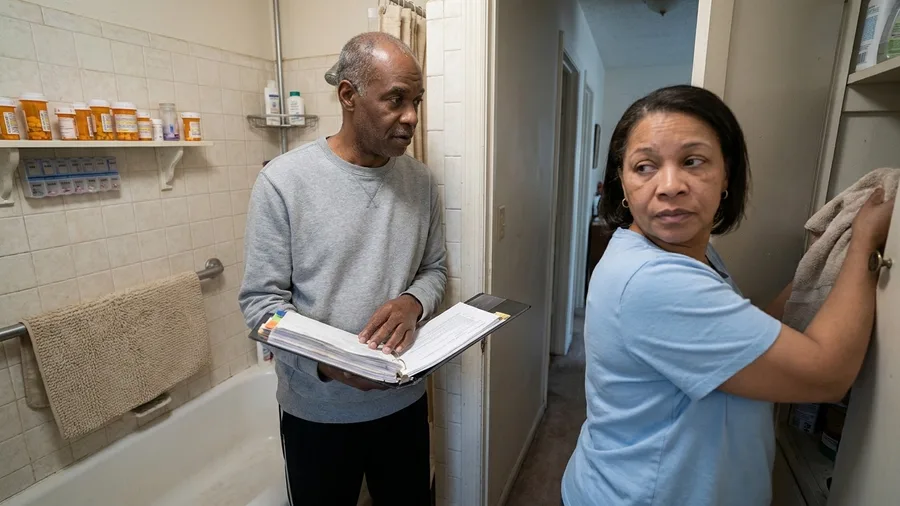
Because the crisis had a script – the ambulance, the hospital, the doctors – and discharge looked like the curtain coming down. It was the opposite. On the March 2022 afternoon they wheeled him to the car, I left with fourteen medications, three follow-up appointments already on the calendar, and a three-inch binder of papers. No training plan. No one walked me through the binder.
The first month was not the recovery story I had pictured after thirty-nine years of marriage. It was a calendar, a pharmacy line, and bathroom logistics. That is the exception worth naming: the first weeks after a hospital stay are survivable, and the difference between a private scramble and a workable week is usually one call you have not made yet.
The hospital case manager could have given me a written discharge checklist and a phone number for the first week of questions. She could not read my mind. I had to ask, and the asking took four minutes.
Naming the tasks out loud – the pharmacy run, the appointment driving, the bathing help – and writing down who to call in that first week turned a fog into a list. The real work began where the hospital stopped. The checklist is not a sign you are failing; it is the first thing you own.
💡 Tip: Before you leave the hospital, ask the case manager: 'What is the phone number I call in the first week if something goes wrong?' Write it on the inside cover of the binder.
2. A stroke is a household diagnosis
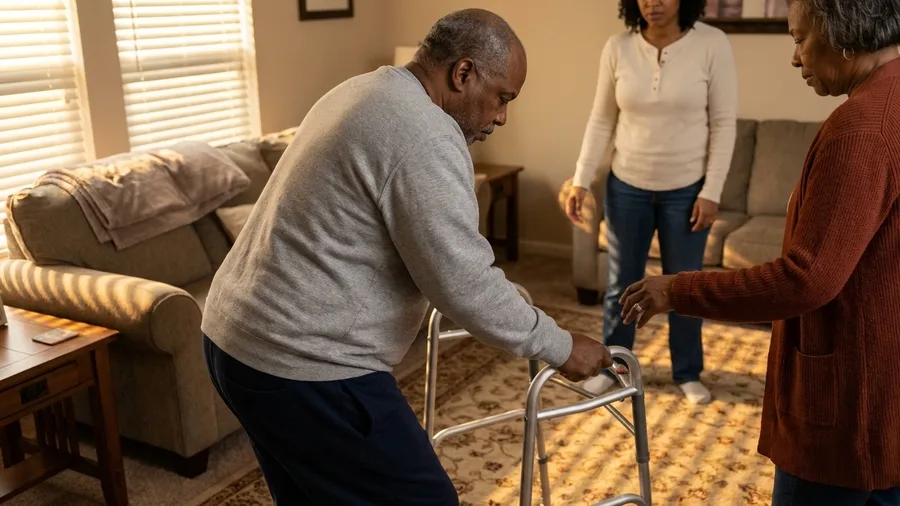
The cost of treating his stroke as his private medical problem is this: you become resentful, and then you feel ashamed of the resentment, and neither of those gets a single task done. His left side went weak, his speech went slow and halting, and he could not drive. My retired days – the ones we had planned – turned into appointment driving and phone calls.
Caregiver researchers keep finding the same thing: the strain lands on the whole household, not only on the person with the diagnosis. They describe a second set of losses – the healthy partner’s routines, plans and sense of self – that go unmentioned because they seem small next to a stroke. They are not small. They are what your days are made of.
He lost his work identity in that stroke. I lost the routine we had saved for. When I named both of those out loud, the room changed – his mood and mine, our roles, all of it sat in the open instead of one of us carrying it alone.
The adult children, forty minutes away and ninety, can learn the slow speech, the yes-or-no questions, the patience. That means you do not have to be the only interpreter in the house.
Naming it as a household diagnosis made my anger legible to me instead of shameful. It was not a verdict on the marriage. It was information about the load.
The First Year — At a Glance
🏥 Hospital stays
3
🚑 ER visits
2
💊 Daily medications
14
📁 Binder thickness
3 inches
👩⚕️ Paid aide
6 hrs/week
The number that matters
None of these were emergencies I could have prevented alone; they were the natural load of a first year without a plan.
3. The house becomes medical equipment
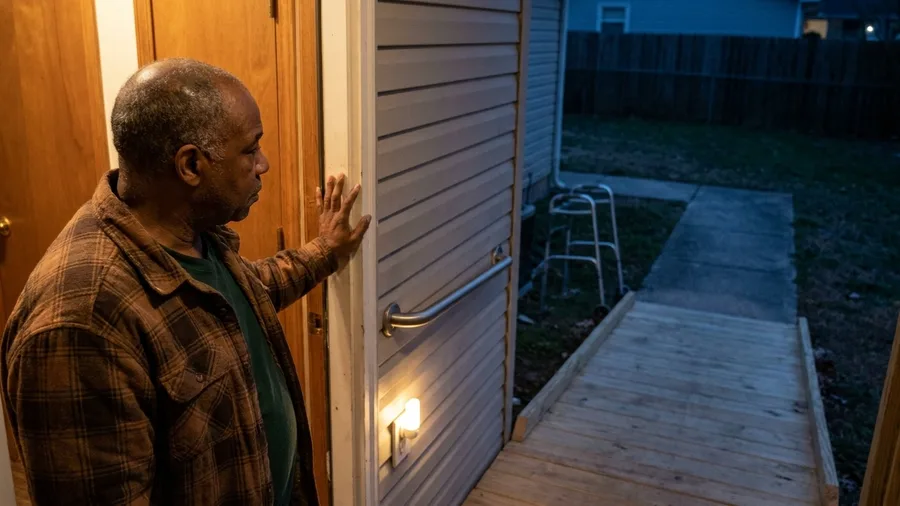
I got the house wrong first. Before I understood that his days now had limits, I was looking at paint and a new light fixture for the hallway, because a house that looked sick felt harder to live in. Then I walked his nighttime route.
The rugs came up first, before anything was bought. The ramp was $1,850, grab bars $420, a shower chair $260, and $90 in nightlights – all of it ahead of any decorative fix. Then I cleared a walker path from bedroom to bathroom and tested it after dark, and the trip still needed nightlights and clear floor before it felt safe.
What that quietly spends is money you did not plan on and every doorway changed. What it buys is fewer falls, and fewer falls is the whole point. The question is not whether the house looks medical. It is which fixes take a fall risk out of his path.
What the Discharge Papers Do Not Tell You
Do these before he comes home
- Test the night route after dark, not at noon
- Move his medications to one lit, waist-high spot
- Put a chair in the bathroom before the shower chair arrives
- Keep the walker path clear of the dog and the mail
- Ask the therapist to watch him use the grab bars once
Do these after the first month
- Widen the bathroom door if the walker catches
- Add a second grab bar if he leans one way
- Replace the ramp with a longer one if the slope tires him
- Move a bed downstairs only if stairs become the barrier
- Repaint anything once the equipment stops moving
The marriage under the job
The job changes the marriage in ways no one warns you about. You are still wife and husband, but now there is a clinical layer between you, and it does not come off at dinner.
This section is about the grief, the anger and the privacy that get lost when caregiving takes over the relationship.
4. Role reversal is grief, not efficiency
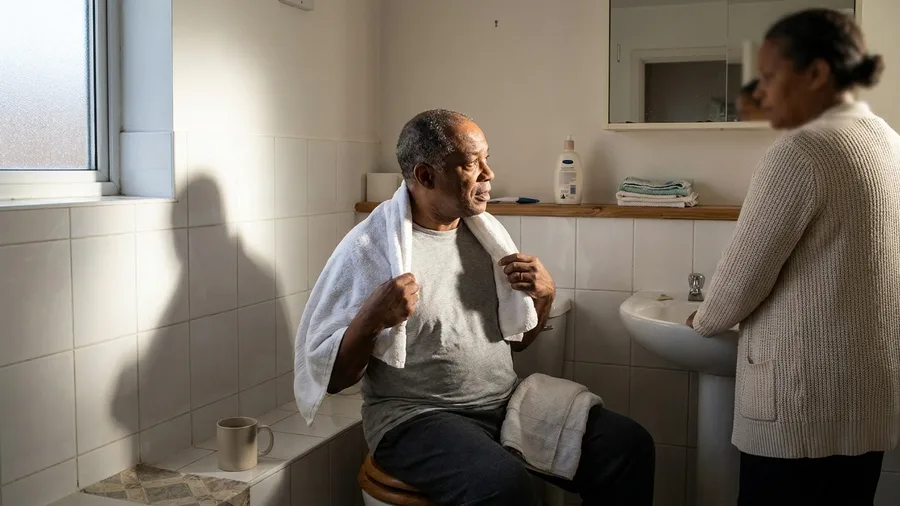
Fourteen pills a day, and by noon I had already helped him undress and get into the shower. Somewhere in that same morning, he asked whether I wanted to eat at the diner, and I heard myself answer in the flat voice I saved for the pharmacist.
That was the strangest part of becoming his nurse: the ordinary wife talk started to sound foreign. What to eat, where to drive, whether to try the diner on Friday. We skipped the fish fries for a while. I could not name then what I was missing, so I called it being efficient and moved on to the next dose.
Ten minutes a day we just talked, no timers, no medication names. Calling the loss what it was, the lost fish fries and the lost unplanned drives, did more for both of us than trying to act like the tasks had not changed anything. I was still his wife. I had just stopped acting like it.
💡 Tip: Put the ten minutes on the calendar like a medication. Mine is 4 p.m., before dinner prep, with phones face down.
The Load, Measured
Two gauges from the first year
5. Resentment is information, not proof of bad love

“I just need to know what time the aide comes.” He asked that same question four times in one afternoon, and the fourth time I snapped. Then I sat in the car in the driveway so I would not say something I would have to walk back.
that if I loved him well enough, the endless questions and the fourteen-pill count would not get to me. So when the anger came, I read it as proof that some love had gone out of the marriage.
It was not the love. Love was the reason the snaps bothered me, not the reason they happened. The anger was pointing at the load: a full day of tasks, a body that needed help, a house that needed the same hands every hour of it, and barely a break in sight.
Once I stopped treating the resentment as a verdict on my character, it started speaking in plain terms. It was asking what I could hand off. I added a $28-an-hour aide for six hours a week, $168 weekly, and the count of questions dropped because someone else was there to answer them and I was not on duty every minute.
I still apologized for the snapped tone. I will still apologize for that. I stopped apologizing for needing relief. I said both things out loud, first to my therapist at the $120 session every other week, then to the free support group at the Area Agency on Aging, and finding that other wives in that room had snapped at the same question made the shame easier to put down.
So the question is not whether you are a bad wife for being angry. It is what the anger is asking you to hand off. When you find the errand or the hour of the day it keeps pointing at, the answer usually turns out to be something a named person could take over.
⚠️ COMMON MISTAKE
Do not apologize for needing relief
Apologize for the snapped tone if you must, but never for arranging help. The guilt you feel about needing a break is not evidence that you should skip it.
6. Intimacy needs a door and a plan

The hospital bed we rented sat in the living room for the first three weeks, in full view of the front window and the mail carrier and the neighbor’s boy on his bike. There was no door between his medical equipment and the rest of our life.
That is what caregiving does to a marriage if nobody plans around it: the equipment takes the open room, the bedroom becomes the clinic, and the couple has nowhere left to be a couple. We moved the bed into the bedroom and put a curtain across the doorway, and I asked the daughter to sit with him Saturday afternoon for four hours so we had the house to ourselves and nowhere to be. The aide’s six hours on Monday covered the errand day. Saturday was for us.
Mild aphasia made the old long talks slow, so we did not try to recreate them. We planned touch instead, and quiet company: his hand on mine on the sofa, the radio low, no timers in the room, no medication list on the table where I could see it.
Privacy and affection were never gone. They needed a door, a standing hour and somebody else in the house for four hours so I could stop being the nurse and just sit beside him.
Help, money and the person doing the caring
7. Vague offers from family evaporate

You hang up the phone and it is Thursday afternoon, and your daughter has just said the sentence again: “Just let me know what you need.” It sounds like help. It is a receipt for nothing.
The obvious advice is to tell your family you need more support, and it fails every time, because “more support” is not a job. What works is a task, a time and a place. My daughter is 40 minutes away in Columbus and my son is 90 minutes away in Indianapolis, and both of them help – but only when the request fits in a sentence they can say yes to. “Can you sit with him Saturday from 2 to 5?” got a yes in two minutes. “I need help” got a sympathy pause and no calendar entry.
So I stopped making offers and started assigning them. My son took the insurance calls; my daughter took Saturday afternoons, written into the shared binder so nobody had to remember it. Friends who said “anything at all” became Tuesday’s casserole or a ride to the pharmacy once I named one. Goodwill is real, but it does not become coverage until it lands on a day and an hour.
💡 Tip: Never accept 'let me know.' Answer with a specific day, time and task. If they cannot do it, ask them to trade with someone on the list.
The Family Help Audit
8. Respite is infrastructure, not a luxury

The conventional advice is to take care of yourself, as if a walk around the block solves this. A walk does not cover a Tuesday morning appointment, and that is the week that breaks you.
look at next week’s calendar and find the hours that belong to nobody’s care but yours. If there are none, relief is not a reward for surviving – it is missing equipment, like a ramp you have not bought yet. Mine costs $28 an hour for an aide, six hours a week, $168. An adult day program runs $65 a day once a week. A two-night respite stay is $290 a night. The free support group at the Area Agency on Aging and a $120 therapist every other week sit in the same budget line, because they are the same thing: breaks with a price tag, booked like a dental visit.
I put the aide’s hours on the calendar weeks ahead and told my daughter the dates so nobody scheduled over them. The weeks with paid breaks, I stayed upright. The week without them, a hospital stay landed and his care nearly collapsed with me.
💡 PRO TIP
Put respite on the calendar first
Schedule the aide and the day program as recurring appointments before you need them. A break that has to be negotiated during a crisis is a break you will not take.
9. My health is part of his care plan

“I’ll see the doctor after his appointments settle down.” I said that for a year, through three hospital stays and two ER visits, and my annual physical and dental visit slipped past without a rescheduling call.
The misread is that skipping your own checkup means you are devoted. What it actually signals is that the care plan has one person in it and no spare. If your back goes out or a screening comes back late, his medication schedule, his bathing, his driving – all of it stops with you. That is not devotion. That is a single point of failure.
So the aide now covers Tuesday morning for my doctor and my therapy appointments, and I told my own doctor plainly that I am a caregiver and asked which screenings and sleep problems could not wait. The backup is written down: my daughter’s Saturday afternoon, the neighbor with a key and the emergency contact listing, my son on insurance calls from the shared binder. His care holds because mine does.
💡 Tip: At your next appointment, say the words 'I am a caregiver' out loud. It changes what the doctor asks you next.
📞 The Backup Plan, In Order
Write it before the first crisis
Build this in the calm weeks. The night you need it is too late to start.
One name per job
Key, Saturday, insurance. Three jobs, three people. If one name covers two, you have a gap.
Say the standing commitment out loud
Saturday 2 to 5 is not a favor to ask for later. Tell her it is hers every week.
Keep the aide's hours untouchable
Tuesday morning is not spare capacity. The week it gets borrowed is the week your appointment goes.
Skip this if he can still drive
While he drives himself to appointments, the insurance calls and the key can wait.
Frequently Asked Questions
How do I ask the hospital for help without sounding demanding?
Ask the case manager for a written discharge checklist and the phone number for the first week. Frame it as ‘I want to make sure I do not bring him back in a week.’ They hear that as a safety concern, not a complaint, and they will give you what you need.
What if we cannot afford an aide?
Call your Area Agency on Aging first. They can tell you what is free in your county, including support groups and day programs. Then price one hour a week, not six. One hour of relief is still relief, and it gives you a place to start negotiating with family.
How do I get my adult children to help without nagging?
Give each one a specific job and a specific time, and write it in a shared binder. ‘Can you sit with him Saturday from 2 to 5?’ works better than ‘I need help.’ If they cannot do it, ask them to trade with someone else on the list.
Is it normal to feel angry at my husband?
Yes, and the anger is usually about the load, not the man. Notice what you were doing when it spiked. If it is the same task every day, that task needs to be handed off or scheduled differently. If the anger comes with hopelessness or thoughts of harming yourself or him, call your doctor or a crisis line that day.
How do we stay a couple when I am also his nurse?
You need a door and a plan. Move the medical equipment out of the shared room if you can, schedule ten minutes a day of non-medical talk, and use any family visit as closed-door time. Intimacy does not disappear; it needs deliberate space away from timers and medication bottles.
What should I do first this week?
Pick the next appointment or crisis point on the calendar. Write down the three tasks that always fall on you. Then ask one named person for one specific block of time. That is the whole first move, and it is enough to start.
The First Move Is a List and a Name
The first year never required perfect care from me. It required a care plan that named the tasks, bought the relief, wrote down the backup and kept my own health inside it. The binder from March 2022 is still on the shelf, but it holds different things now: my son’s insurance calls from Indianapolis, my daughter’s Saturday hours from Columbus, the neighbor’s key and the day the aide comes.
This week, pick the next appointment or crisis point on the calendar. Write down the three tasks that always fall on you. Then ask one named person for one specific block of time, and write their name next to it in the binder.
The goal is not perfect care. It is a care plan that includes the caregiver, because if I am not in the plan, his care sits one illness away from collapse. That is what the three-inch binder taught me, and it is the first thing I would hand you on discharge day.
Do the one-page backup plan tonight
Open your calendar, write the three tasks that always fall on you, and text one named person a specific day and time. Then put it in the binder.