
Seventy percent of what you read today vanishes by tomorrow morning.
That curve of forgetting is steep and predictable. Most students fight it by pouring hours into highlighting textbooks, hoping sheer exposure will make facts stick. It rarely does.
The students who consistently top their cohorts do not spend more time at a desk. They simply exploit the way human memory actually works. Instead of passively feeding information in, they spend all their energy forcing it back out, completely changing how the brain stores the material.
Here is how to structure a study session that demands retention.
The Memory Leak
What happens to a chapter 24 hours after you read it
Rereading Notes Creates False Fluency, Not True Retention
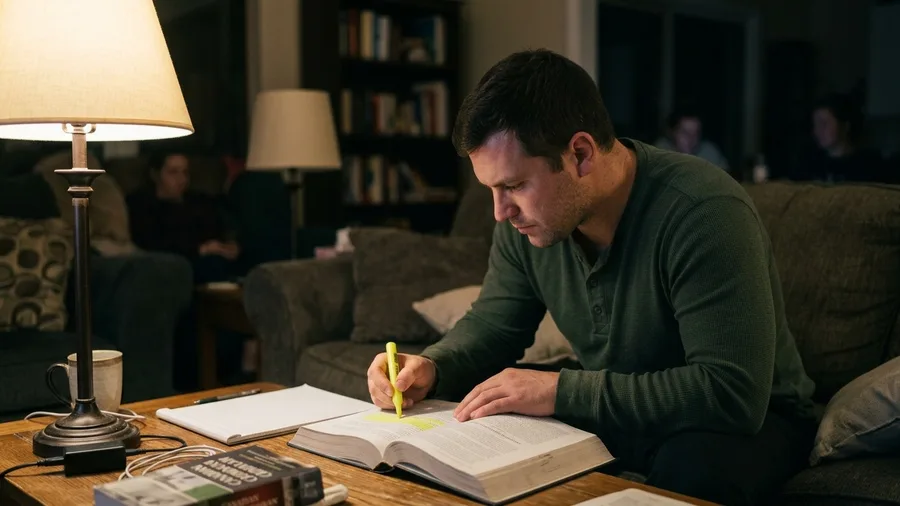
The problem starts with the highlighter and the false comfort of reading a chapter twice. It feels highly productive to drag a neon marker across a paragraph, leaving you with an immediate sense of accomplishment. Your brain registers the bright color and happily logs the action as studying.
But memory researchers consistently find that passive reading creates a dangerous trap called fluency. Because the text looks familiar the second time you scan it, you assume you know it inside and out.
Try this ten-second test the next time you review your notes. Hide the page completely and ask yourself if you could explain the core concept aloud from scratch to someone else. If you hesitate or stumble, you do not actually know the material. You simply recognize the words in front of you.
The fix is to close the book entirely. Pull out a blank sheet of paper and force yourself to write down everything you remember. When you remove the visual cues, the illusion of fluency shatters.
Passive vs. Active Friction
Passive Review
- Rereading the same chapter
- Highlighting printed text
- Watching lecture videos on double speed
- Looking over open notes
Active Retrieval
- Writing a summary with closed books
- Drawing a concept map from memory
- Testing yourself with blank flashcards
- Explaining the idea to a friend
Forgetting Predicts Retention Better Than Immediate Memorization

“I had this perfectly memorized last night.” You stare at the blank page, tracing the ghost of a highlighted textbook paragraph in your mind, but the actual terminology has vanished.
Cramming works just well enough to survive until tomorrow. The information sits in a short-term buffer that feels like mastery but remains incredibly fragile. To build a permanent pathway, you must let the facts slip first. Forcing yourself to recall a fading concept creates the mental strain required to lock it in.
Do not review the same chapter three times in one afternoon. Test yourself today, again on Thursday, and once more next week. Waiting until it hurts to recall the facts guarantees they stay.
⏱️ The Spaced Retrieval Protocol
Day 1: The Initial Output
Write down everything you remember within one hour of learning it.
Day 3: The First Decay
Test yourself just as the details start getting fuzzy.
Day 7: The Deep Strain
Force recall after a week to cement the pathway permanently.
Day 30: The Maintenance Check
Review the concept once a month to prevent long-term degradation.
Explaining Concepts Exposes Invisible Knowledge Gaps Instantly

For years, I survived difficult coursework by reciting textbook definitions perfectly in my head, totally convinced I had mastered the material. I was actually just wearing someone else’s knowledge.
Researchers who study how adults acquire complex information consistently observe the exact same trap. We instinctively hide our confusion behind heavy academic jargon, assuming that if we can reproduce the vocabulary, we understand the mechanics. But reciting a formal definition flawlessly proves nothing about actual comprehension.
The real test is forcing yourself to explain the concept out loud to an imaginary smart teenager. You have to strip away every technical term and rely entirely on plain English.
When you enforce that strict rule, the invisible gaps in your understanding surface immediately. You will stumble and stall exactly where your actual knowledge stops. That hesitation is the point of the exercise. Note where the breakdown happened, return to the source material to patch that specific hole, and start the explanation over.
⚠️ COMMON MISTAKE
Do Not Perform This In Your Head
Thinking through an explanation lets you skip over your own knowledge gaps silently. You must speak the words out loud or write them down to expose exactly where you stumble.
Isolated Facts Fail When Broad Context Is Missing

Why do you know every definition perfectly, yet still freeze when you read the exam prompt? You assume that mastering isolated facts means you understand the whole system. Flashcards are excellent for memorizing vocabulary, but they fail completely when a real test demands that you apply a concept to a new scenario.
To fix this, you must mix your subjects together. Instead of studying one chapter for three straight hours, tackle three different chapters for an hour each. Never organize your flashcards by category.
Jumping between topics forces you to practice identifying which tool to use, not just how to use it. This constant switching feels deeply frustrating, which most people mistake for failing. That friction is actually the exact feeling of your brain building contextual awareness.
Anatomy of an Effective Flashcard
🎯 The Front
One specific question, never a vague topic
📝 The Back
The answer in your own words, not textbook quotes
🔗 The Connection
A single note tying it to the previous chapter
🖼️ The Visual
A rough sketch or diagram to trigger spatial memory
Testing Requires Cognitive Friction That Passive Reading Skips

The standard advice for studying is to eliminate all distractions and find your flow state, that magical zone where hours vanish and the material feels completely effortless. But if pulling new information out of your head feels smooth and easy, you are almost certainly doing it wrong and building a false sense of security.
True active retrieval is a fiercely physically and mentally exhausting process.
When you sit down with a blank piece of paper to reconstruct a difficult concept from scratch, the immediate problem you face will not be the material itself. It will be the fatigue.
Within three minutes, your brain will start negotiating with you to escape the cognitive friction. The internal script is incredibly persuasive, whispering at you to just open the book, glance at the highlighted section, and confirm what you already know. You have to refuse to give in to the comfort of the text.
That deep mental resistance is not a sign that you are failing at the task. It is the exact mechanism of long-term storage doing its heavy lifting, forging the permanent pathways you actually need.
The fix is to strictly limit these high-friction sessions to twenty-five minutes at a time. Set a timer, stare at that blank page, and fight for the missing details until the alarm rings. Then you must walk away completely, doing absolutely nothing demanding, to let your nervous system fully recover.
The Optimal 45-Minute Output Block
The First Five Minutes After Class Determine Long-Term Storage

Three hundred seconds is the exact window you have before the forgetting curve begins erasing a lecture.
The instinct is to close your laptop and walk away the moment the speaker finishes. The context feels incredibly fresh in your head, but the details are already evaporating. You buy yourself a tiny head start today, but that immediate exit quietly guarantees you will spend hours relearning the same material later.
Before you stand up from the desk, write down the three most important concepts covered. It feels redundant in the moment, but that immediate recall cements the foundation for your next study session.
Frequently Asked Questions
Does this work for math and equations?
Yes, but you apply it differently. Instead of recalling facts, you recall steps. Close the textbook and solve a complex problem from scratch. When you get stuck, note exactly which step stopped you, then check the solution.
How do I recall things if I do not know anything yet?
You have to read the material first. Retrieval practice does not replace your initial learning; it replaces the hours you would normally spend rereading your notes trying to memorize them.
What if my blank page stays completely blank?
That is normal at first. Open the book for exactly thirty seconds, read the specific section you forgot, then close it again. The struggle to remember is what signals your brain to keep the data next time.
Is this the same as the Pomodoro technique?
No. Pomodoro is a time management system that dictates how long you work. Retrieval practice is a cognitive method that dictates what you actually do with that time.
How many days should I wait before testing again?
The rule is to wait until recalling it feels slightly difficult. Usually, this means reviewing on day one, day three, day seven, and then extending the gap by a week each time.
Your Effort Belongs On The Retrieval, Not The Review
You arrived believing that studying means getting information into your head.
That belief turns you into a passive reader, pouring time into highlighting text and hoping the facts stick through sheer repetition. It is an exhausting way to learn.
True mastery happens in reverse. Your brain only holds onto the details it is forced to produce, which means your effort belongs entirely on the act of output. Close the book, stare at the blank page, and make the memory work for its place.
Run The Blank Page Test Right Now
Close this tab and write down the three core memory concepts you just learned. See what actually stuck.