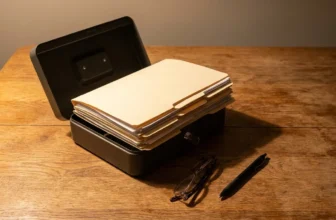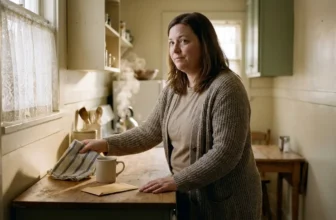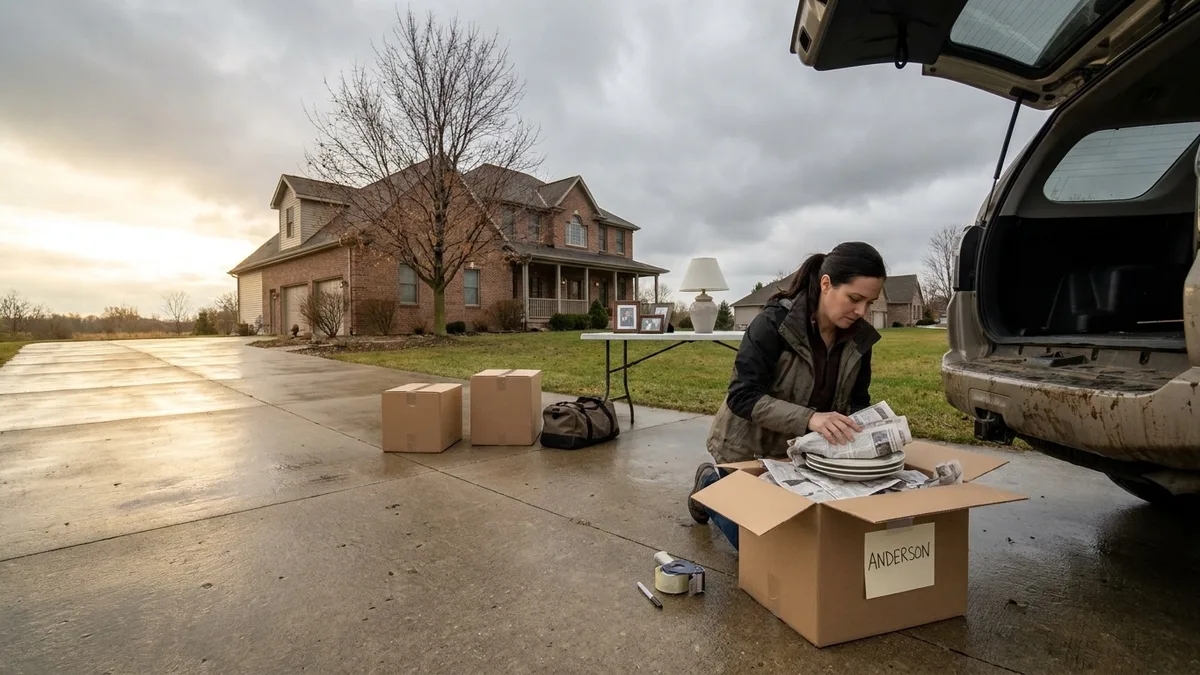
The mistake is waiting for the kids to change their minds. They won’t, and every month you wait turns a plan into a crisis somebody else has to run.
Your daughter has 900 miles and a two-bedroom apartment. Your son has 2,100 miles and a garage already full of his wife’s grandmother’s dishes. Neither one is being cruel. They are being honest about square footage, and you can work with honesty.
Here is the shape of the thing: a 2,400-square-foot house, 41 years of accumulation, two adult children far away, and a 14-item yes-list between them. That list is the whole negotiation. Everything else in the house needs a different address.
Roughly 40 pieces fit on one closet shelf and a 6-by-4-foot wall. The other four decades go out through a photo book, a delivery trip, an $85 shipping box, a tagged table at a reunion, a two-day estate sale and a charity pickup. Sorted, dated, done.
So the work ahead is not sorting feelings. It is assigning addresses. Photograph the cabinet before it leaves. Wrap plates on edge in a 20-pound box. Write a name on a sticky tag. Book the pickup for the Wednesday after the sale.
You do not have to do all eight at once, and you certainly do not have to keep everything. Take the keep pile first, take the exits in whatever order your house demands, and let the dates do the deciding.
Quick Tips Before You Start
Measure the shelf first
One closet shelf and a 6-by-4-foot wall, no more. Take the measurement before you touch a single piece.
Name names now
Every item on the 14-item yes-list gets a name written next to it today, so nobody renegotiates a clock in November.
Put dates on paper
Sale weekend, pickup day, delivery trip. A decision without a date is a storage unit waiting to happen.
Cap the box at 20 pounds
Above that, ground shipping stops making sense and furniture routes take over.
Skip the storage unit
At about $180 a month it buys nothing but a postponement and a monthly reminder of it.
1. The Keep Pile That Fits One Closet
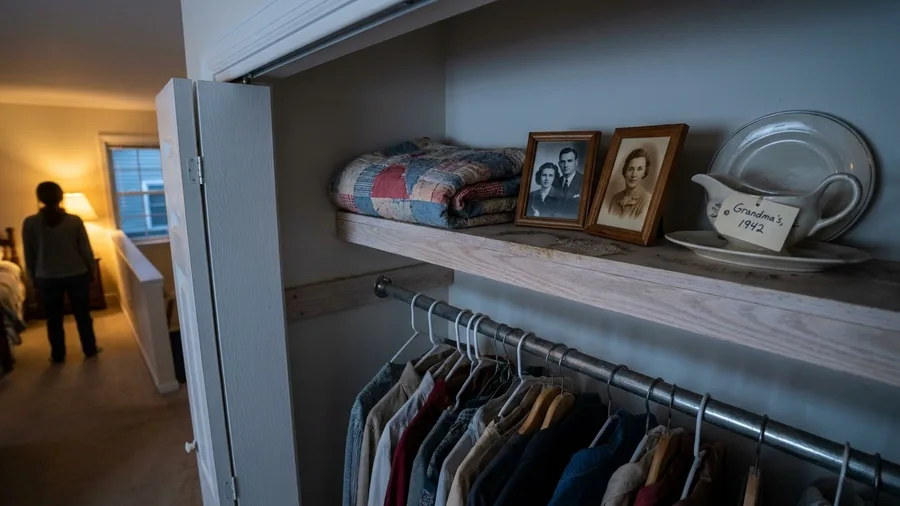
The smell of a closet that has not been emptied in four decades is cedar and dust and the ghost of a wool coat, and the morning light through a west-facing bedroom window is when it reads clearest: what is actually here, shelf by shelf.
Six in the morning before anyone else is up is the hour that works, because the decision is quieter before the phone starts and before the light gets warm enough to make everything look worth keeping. One shelf, about eight feet of rod with the 6-by-4 wall above it, holds roughly 40 pieces out of 41 years. The length of the shelf is the number that counts, not the feeling about the shelf.
The 14 items the two kids said yes to get a name written next to each one now, in ink, on paper, so nobody renegotiates the clock or the gravy boat in November when the house is already half emptied and everyone is tired.
Anything else on the shelf faces three questions: is it used, is it displayed, or can someone in the family tell its story out loud without notes. One yes out of three is enough. A piece that misses all three and still cannot go into the truck gets a box with a date written on the lid in marker, and that box gets a reopen date on the calendar, so the decision is deferred, not hidden.
The shelf is the piece’s next address. Anything that does not fit has just been told it needs a different one, and that is the work waiting in the pile on the floor.
💡 Tip: Photograph the shelf when it is full. That photo is the standard everything else gets measured against.
| Route | Best for | Typical cost | What comes back |
|---|---|---|---|
| Ground shipping box | Small dishes and letters to a faraway kid | About $85 for 20 lb; about $12 for a small parcel | A named address for 20 pounds |
| Hand-delivery trip | The clock, the letters, two items max | $340 fare plus three nights at about $145 | A weekend with grandchildren and two handovers |
| Photo scanning and book | The memory of what the cabinet held | About $0.40 a print; roughly $600 for 1,500 photos; $45 for a 20-page book | An archive in two other houses |
| Tagged reunion table | Cousins, grandchildren, the wider family | $95 a night lake house split four ways | About 30 items claimed in one afternoon |
| Two-day estate sale | Clearing a whole house without pricing plates | 35% commission; nets about $3,200 | Empty rooms and a deadline |
| Consignment of one good chair | The single genuinely valuable piece | About $180 back on a $450 sale | Cash and a buyer who wanted the chair |
| Charity and furniture bank | Everything left after the sale | Free; 30 boxes picked up | An empty garage and a receipt |
| Storage unit as stopgap | Nothing. This is the one to refuse | About $180 a month | A $2,160 annual bill and no decision |
2. The Photo Book That Replaces the China Cabinet
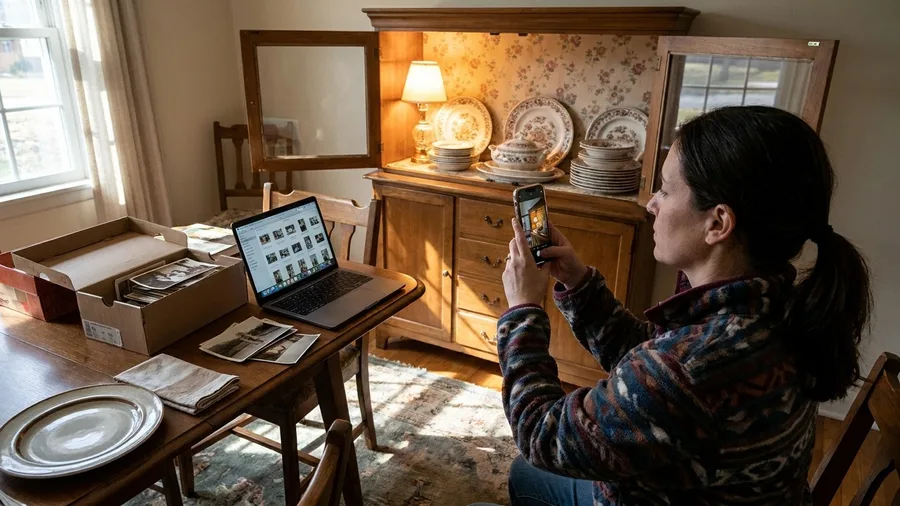
Do the math before the boxes come out of the closet, because the numbers decide what you can afford to remember: scanning runs about $0.40 a print, so the 1,500 family photos stacked in the shoeboxes and envelopes come to roughly $600. That is the single biggest line in the whole plan, and the one that gives the most back.
The rest is cheap. A 20-page photo book ordered online costs about $45, and one heirloom takes a page: the story typed underneath, who bought it, the year, what it was used for, which Thanksgiving it came out for. Take the folder of cabinet snaps before you get out the furniture dolly, not after, and shoot the cabinet where it stands with the doors open and a lamp burning inside. The picture is the dining room light and the wallpaper behind the wood, not the wood alone.
The taking-apart is the story worth getting right, and the cabinet is the one that usually needs it: forty-one years it held the good china, and on the day the truck arrives someone has to lift the doors off and hand the plates down one at a time to a person on the floor with bubble wrap. Here is the part nobody tells you – the book is not a consolation prize for the china. It is the china’s next address, and the difference is that it can sit on a shelf in two houses at once.
Send the digital file to both kids, at 900 and 2,100 miles, before the hard drive goes in a drawer and stays there. Two copies in two kitchens, and the archive does not die with one phone in one pocket, one dropped bag, one upgrade cycle.
The cabinet leaves the room and the record stays, on a shelf in a house nine hundred miles west and another twenty-one hundred miles east of the dining room where the plates were bought.
💡 Tip: Type the stories into the book order the same week you shoot the photos, while you still remember the year.
⚠️ COMMON MISTAKE
Don't scan after the sale
The photos and the cabinet shots have to happen before the estate company walks through, not after. Once the room is emptied and repainted, the picture you wanted no longer exists.
3. The Hand-Delivery Trip With Two Carry-Ons
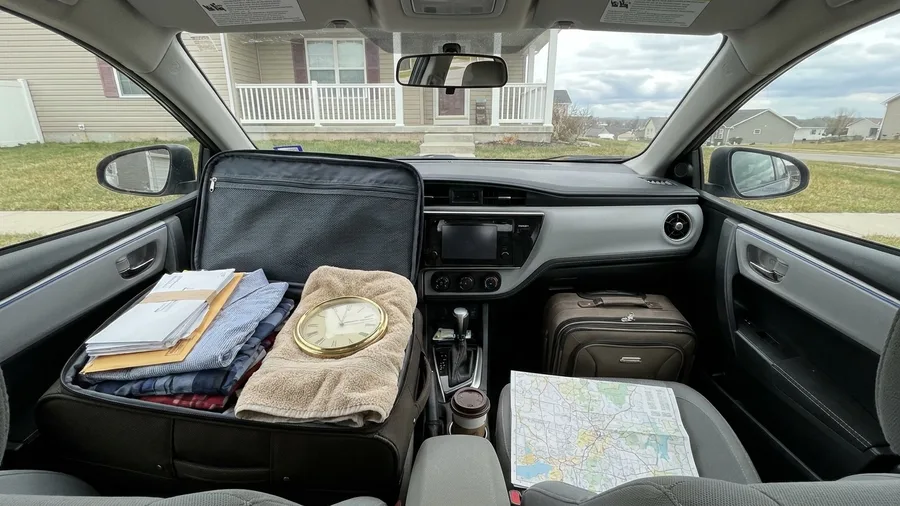
Compared with a $600 scan and a $45 book that ship in a padded envelope, two round-trip fares at about $340 and three nights at roughly $145 a night are the largest single spend in the plan – and the only one that ends with a clock on someone else’s table.
Book the trip in the shoulder season when the fare dips, carry the clock and the letters in the cabin bag and never in the hold, and keep the handover to 20 minutes of a three-day visit: coffee, the clock in the middle of the table, the letters read once out loud, then the weekend belongs to the grandchildren. Anything that will not fit in a carry-on ships ahead so it is standing in the hallway when the car pulls up, because arrival should not be a second errand. Two objects get a hand-delivered address and a booked date – more than anything on the shelf can claim.
📋 The working order, start to finish
Name the keep pile
The 14-item yes-list plus the shelf and wall test, done in one sitting.
Shoot and scan
Photograph the cabinet in place and send the 1,500 prints for scanning.
Book the trip
Two carry-on items, three nights, a handover date on the calendar.
Ship the small things
Under 20 pounds per box, notes taped inside the lid, tracking sent to both kids.
Run the reunion table
Thirty tagged items, one afternoon, table empty before the last car leaves.
Sale and pickup in one week
Two-day estate sale, charity truck on the Wednesday, no storage unit.
Tape the provenance cards
Four lines under every chair seat, drawer and frame that stays.
4. The $85 Box to the Faraway Kid
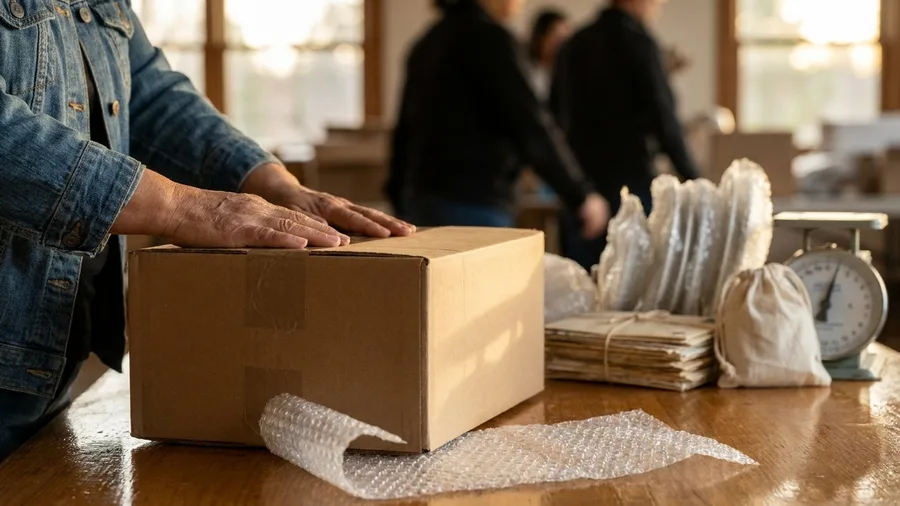
The tape gun is heavier than it looks, and the first strip always goes on crooked. Somewhere east of the Mississippi, a kid in a third-floor walk-up is waiting on a box of plates; two thousand miles of interstate stand between the plates and their new cabinet, and the postage scale is already telling you how much of the house is going to fit. Ground service is the answer: a 20-pound carton of dishes crossing the country sits near $85, while a padded envelope of letters or a small jewelry box lands closer to $12. The mail decides the size of the gift before you have wrapped a single piece of newspaper. Anything that needs a pallet has just been assigned to a different exit.
Pack the plates standing on their rims, not stacked flat, and wind each one in the bubble wrap so the weight rides the edge and not the face. Keep every carton at or under 20 pounds, because the rate climbs and a mover’s back is not a packing material, and leave out anything already cracked or chipped – a hairline fracture will be a pile of shards when the box opens in a stairwell. Send the small things first: the letters in a bundle with a rubber band, the rings in a little drawstring bag, the photographs between two sheets of cardboard. The heavy furniture and the dining set never go into cardboard at all; they were always going to the tagged table, the sale, or the furniture bank. Before the flaps fold, write a note and tuck it under the top layer – where the piece came from, whose hands it passed through, the year, and one line about what it was used for. That note is the short version of the story the object will carry once it has a new address, and it travels lighter than the object does.
💡 Tip: Tape a note inside the lid with the piece's origin before you seal it. Cheaper than a provenance card and it travels free.
What the whole plan costs and returns
The numbers that decide each route
Figures are typical, not quotes. Get current rates before booking anything.
5. The Tagged Table at the Family Reunion

One table, one weekend, and 11 relatives in a rented lake house is the cheapest distribution channel this whole plan has. At $95 a night split four ways, the house costs less than a shipping container, and it puts cousins and grandchildren in the same room as the things you no longer have space for. About 30 items go out on the table – the good plates, the serving bowls, the small clocks, the wedding glass. Nobody ships anything. Nobody has to fly out to pick up a box.
The mechanics are one sticky tag per piece with a name in ballpoint, first come, no bidding. Someone walks to the table, reaches, and the reaching is the ceremony – the good plates go to whoever crosses the room first, and that is the whole point. The invitation carries one line that matters more than the rest: take what you will use, leaving it is fine, nothing on this table is a test of how much you loved anyone. The rule is settled before the weekend, not at the end of it. Whatever is still unnamed when the cars load goes into the donation pile, and the table is empty before the last tail lights pull out of the drive.
Who this suits: families with cousins, grandchildren and in-laws within driving distance, the ones who can spend a weekend on a lake. Who it does not: small families, scattered families, families with a fresh grievance still setting like concrete. If the group is two adult children and nobody else, the table has nothing to distribute and the shipping cartons do this job instead. Thirty pieces pick up named addresses in an afternoon, no postage paid, nobody wounded over the good plates.
A named address versus a maybe
Do
- Write a name on the tag or the yes-list today
- Book the sale weekend and the pickup in the same week
- Photograph the cabinet and scan the photos first
- Ship under 20 pounds; back up the scans twice
Don't
- Leave a piece marked maybe for a sibling to settle
- Pay $180 a month to store a decision
- Pile 60 pounds in a box to save one shipping fee
- Let the reunion table stay loaded past Sunday
6. The Two-Day Estate Sale With a Deadline
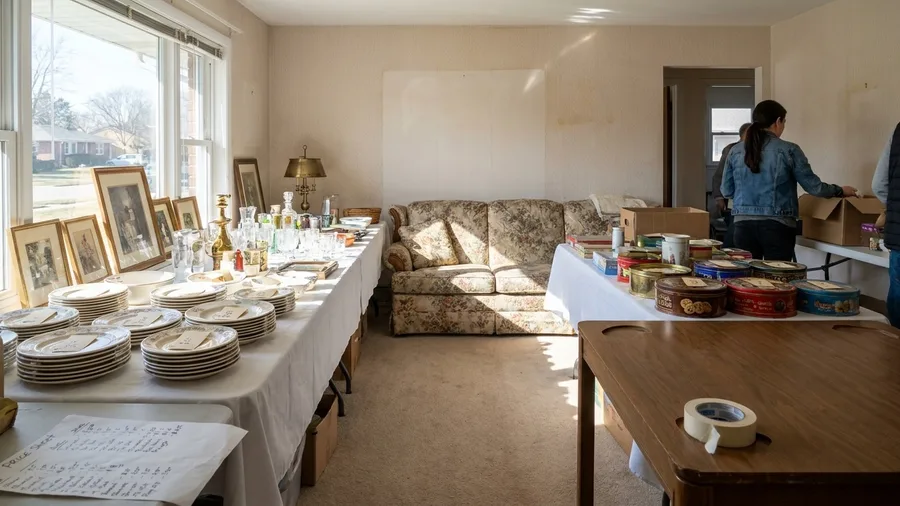
It is a two-day estate sale, and what is left behind on the second afternoon is a house rather than a life.
Whatever the family gathering did not claim has stopped being a sentimental question and become a volume question, and volume is what a sale is built for. A two-day sale typically nets around $3,200 after the company takes a 35 percent commission, so the number on the check is smaller than the rooms it empties. The clearing is the point, not the money.
The company walks the house first, room by room, and tells you what will sell and what will not. A professional no about the particleboard shelving in the basement is easier to accept than your own no, because it is not the voice of someone who has lived with them for 41 years. When one piece has real value – the mid-century chair everyone has always liked – it goes its own way on consignment and returns about $180 on a $450 sale, sold to a buyer who wanted that chair and not the house around it.
The sale gets two weekends out on the calendar, and that is what makes it final: the market sets the price, you set the date, and neither one is open for a sibling vote in November. That deadline is the only thing that has ever divided an estate sale from another ten years of maybe later.
The early hours of the first morning are the busiest, and the first ten people in the door are resellers with cash. Let them in. The second afternoon is when the remainder gets priced by negotiation, and by the time the truck leaves, the rooms are empty and the calendar has a hand on it.
💡 Tip: Walk the house with the estate company and a notepad. Their 'not worth selling' list is your charity pickup list, written before the sale even opens.
7. The Charity Pickup That Empties the Garage
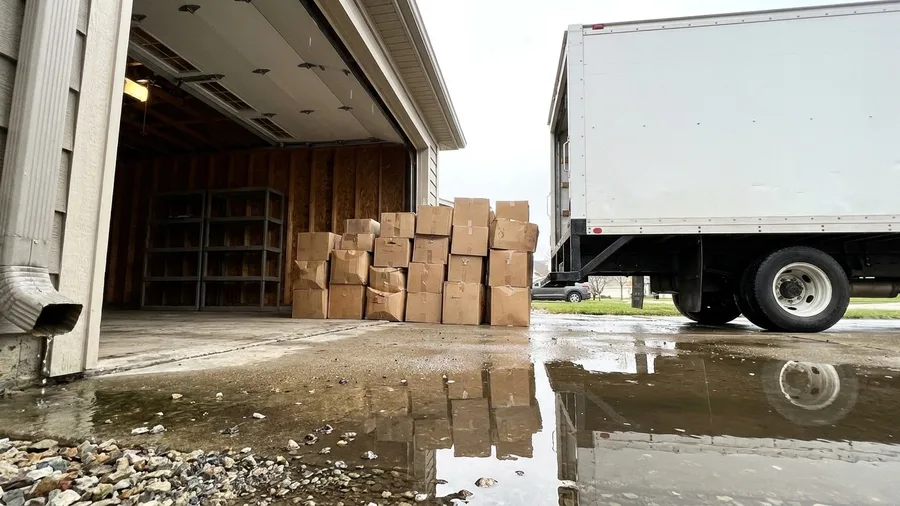
Thirty boxes leave the driveway for free. The pickup is not the reward for clearing the house; it is the trap door that catches whatever the sale leaves behind, and it is why the call gets made before the sale weekend, not after it.
A two-day sale empties the rooms and leaves exactly what no buyer wanted: the garage, the off-tag boxes, the bedroom set with no bid on it. Book the pickup in the same week the sale ends and the residue is gone before it settles into a corner and starts looking like furniture again. When the bedroom set and the sofa never sell, a furniture bank sends a truck and two people, and hands back a receipt instead of a listing you would retype for three weeks. Keep one itemized sheet of what left and where it went: thirty boxes to the charity, the set and sofa to the bank, the sale inventory to the company. That sheet is the whole argument, in one page.
One move is worth refusing flatly, and it is the 10×10 unit at about $180 a month. That is $2,160 a year for a heated room to store a decision you have not made yet, and the bill arrives every month as a reminder that you rented a delay. Still, keep the reservation honest: a free pickup takes what it takes on its schedule, and a garage full of doors and shelving may not clear in one morning the way the boxes do.
💡 Tip: Call the charity two weeks ahead; pickup slots fill around sale weekends, and you want Wednesday, not the following month.
8. The Provenance Card Taped Underneath
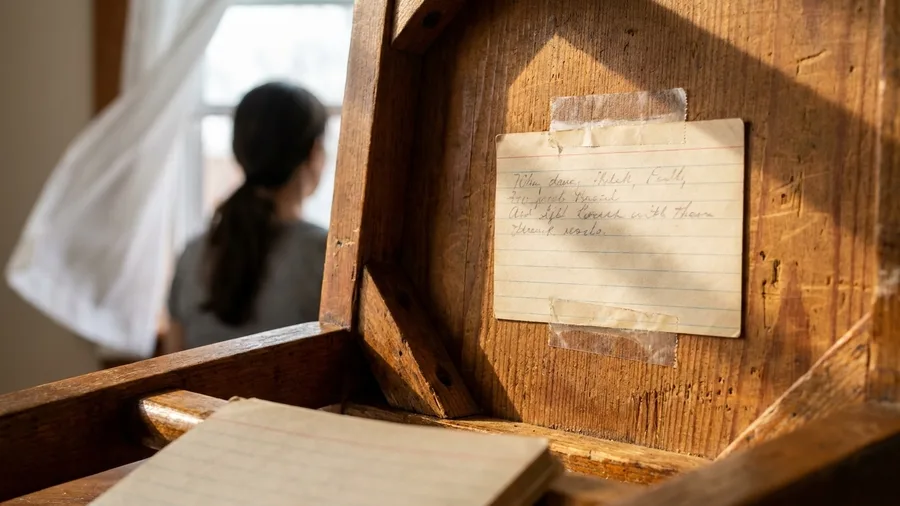
A card the size of an index card, taped where the next person will find it, costing nothing but an evening at the kitchen table. Four lines go on it, in pencil: who bought the thing and in what year, what the household actually did with it, and one sentence of story — the Thanksgiving the plates came out, the move the chair rode through in the back of a truck, the uncle who always claimed that end of the sofa. Thirty seconds of handwriting per piece, times forty kept pieces plus the thirty on the reunion table, and the whole archive is done before the trucks arrive. Tape it under the chair seat, drop it inside the drawer, tuck it behind the picture frame; a card in an envelope gets thrown out, a card on the wood gets read.
The pieces that never leave your house get cards too, so the story does not live on anyone’s memory of a Tuesday in 1979. Then the one line at the bottom, given away with every piece that goes: please send back one photograph of it in its new home. You will get a phone picture of the plates on a cousin’s table, the chair in an apartment you will never visit, and no letter is owed and none expected. The object leaves and the record stays attached to it, on a shelf or on a truck, and that is the only address a thing like this ever needs.
💡 PRO TIP
Ask for the photo, not the thanks
One photograph of the piece in its new home is worth more than any thank-you note, and it takes the recipient eleven seconds to send.
Frequently Asked Questions
How much am I allowed to keep?
As much as fits one closet shelf and a 6-by-4-foot wall, which works out to about 40 pieces. The limit is physical on purpose: a number in your head will always expand, a shelf will not.
What if the kids want some of it but live across the country?
Use the shipping box. Twenty pounds of dishes runs about $85 by ground and a small parcel of letters about $12, so small pieces travel and furniture does not. Tape a note inside the lid before you seal it.
Is it worth paying for an estate sale?
Yes, for a whole house. A two-day sale nets about $3,200 after a 35% commission, which is less than the rooms are worth in your head but more than you will clear alone. What you are buying is a deadline and a professional no.
Should I rent a storage unit while I decide?
No. About $180 a month is $2,160 a year to postpone a decision and nothing else. Book the sale and the charity pickup instead, and let the dates make the decision.
How do I stop a sibling argument over one clock?
Write a name next to every item on the yes-list today, before anyone has time to reconsider. A name written down in advance settles in one sentence what a maybe drags out for a year.
What do I do with the things nobody wants and I can’t sell?
The charity and the furniture bank. A local charity picks up 30 boxes free and the furniture bank takes the bedroom set and sofa, which empties a garage in one morning with a receipt in your hand.
The Shelf Comes First, the Truck Comes Last
Work the order, not the feelings: keep pile first, photo book and delivery trip second, the estate sale and the charity pickup run as one weekend, provenance cards last, once you know where each thing is going.
This week, one move. Write a name beside each of the 14 items and clear the closet shelf to hold about 40 pieces out of 41 years. Nothing else gets decided until that shelf is empty and full again.
Then read your own house. Grandchildren nearby but uninterested in the china: the reunion table and the delivery trip carry it. Children far off who want a few small things: the $85 and $12 boxes. A whole house to clear: the sale plus the charity pickup, and skip the storage unit.
The 14 items were never the measure of the house. The shelf and the wall, with cards taped underneath and a calendar of dates hanging beside them, are what the place turns out to have been worth – and the clock can go to the grandson who asked, wound once, on a Tuesday.
Measure the shelf this week
Write the 14 names on the yes-list, tape a reopen date on the first box, and the rest of the plan has somewhere to land.