
Two wives in the same subdivision, husbands retiring a month apart. One calls the first year the best of her life. The other stood in the cereal aisle crying because her husband read the back of the box aloud while she balanced a client’s ledger. Same event, different doors.
Sixteen months ago our garage door went up at 8:10 every weekday, and that sound, not an alarm, started my workday. I’m sixty-three, I keep books twenty hours a week, and my husband retired after thirty-six years of regional sales travel. Now the door stays down and the house has no edges.
I expected more time together to be the reward. What I got was 1,550 square feet, a ten-by-eleven office, and a man at the kitchen counter at 6:40 asking what’s for lunch.
What follows is seven changes I made in this ranch outside Columbus, every one priced, none of them asking him to disappear. Pick the one that matches your worst hour, and expect the first week to feel rude before it feels normal.
Quick Tips Before You Start
Say the hours out loud
A door with no posted schedule reads to him as a mood. A door with a card taped up reads as a workday.
Pick a start time you can keep
Nine to one is easier to defend than 'whenever I'm busy,' because it has edges he can plan around.
Buy the lock first
A $140 keyed knob costs less than one argument that gets dragged through a whole weekend.
Write alone time like an appointment
If it only exists in your head, it does not survive the first unexpected drop-by.
Keep the signal in one room
Headphones on the couch mean nothing. Headphones behind a closed office door mean do-not-disturb.
1. A Door That Closes on Your Workday
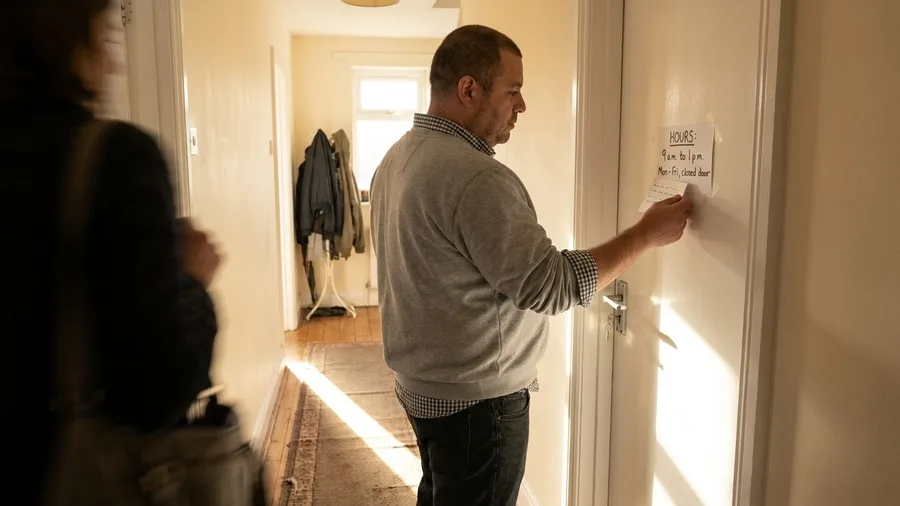
The door I shut that first Monday was the wrong tool, and it cost me the morning I was trying to protect. No hours on it, no lock, just a closed slab of painted wood and a woman inside who assumed the meaning was obvious. He was through it four times before ten, once holding the kitchen trash bag aloft to ask whether I wanted it out.
For three and a half decades, the boundary had built itself. The 8:10 lift of the garage door marked the transfer of the whole house to me, and I got to be alone with a ledger and a cup of coffee until 5:30 without ever once having to say the word aloud. When a person works a room for a living and a house has only ever been theirs to come home to, no one has taught them what a workday sounds like from the inside. I had to teach it, and I had not, so the job of explaining fell to a $140 lock and a card I taped at eye level on the office door.
The card says the hours in black marker: 9 a.m. to 1 p.m., Monday through Friday, closed door. Underneath it, we wrote the exception in his own words, because I made him say them out loud so they would be his rule and not mine. Fire, blood, or a confirmed delivery. That was the whole list.
The lock is not aimed at him, and the posted hours are what make that clear. A door that closes on nothing tells a man he has done something wrong, but a door with its hours printed beside the handle tells him he is not the thing being shut out, only the day waiting on the other side. That is the whole distance between a boundary and a banishment, and it cost less than the shoes I wore to the hardware store.
💡 Tip: Print the card. Handwriting on the back of an envelope reads like a note; a typed card taped at eye level reads like a schedule.
⚠️ COMMON MISTAKE
The Lock Without a Schedule
A locked door with no hours on it is a mystery he will solve by knocking. Hours do the explaining so the lock doesn't have to.
2. The 7 A.M. Out-of-the-House Commute
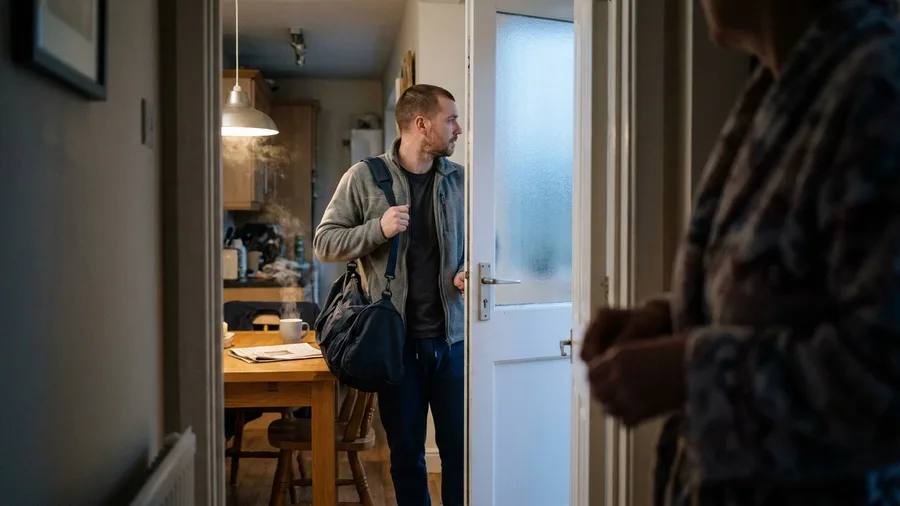
A locked door solves the hours between nine and one, but by half past seven the day had already been decided against me. The mornings used to run themselves, back when he was backing out at 6:30, and the kitchen belonged to me and the newspaper and whatever I was thinking about until I chose to start work. The first retired weekday he was at the counter at 6:40, before I had located my glasses, asking how the day looked.
So we built two departures instead of one. His is a $42-a-month gym membership with a lap pool that opens at six. Mine is a back table at the diner and a $3.50 coffee I pay for slowly. Both of us are out by a quarter to seven, both of us are home by 8:30, and the ninety minutes in between belong to neither of us as a couple.
What that quietly spends is the looseness of a morning unplanned. Some days he does not want to swim and I do not want the diner, and we go anyway, or the whole thing sags. We put one rule on it to keep it honest: no texts during those ninety minutes unless something is actually wrong. The first Tuesday I broke it myself, over a dentist appointment that could have waited until 8:45, and he read the message at the pool and spent the day thinking a tooth had turned bad.
I called it a commute, and that is what it is. Work used to hand me ninety minutes of separation at the start of every day, and then work took them back, and I had not noticed until I did not have them. Rebuilt on purpose, they are the reason the rest of the day has room in it.
The script is small, and it is the part worth getting right. He says: 6:40 is the pool, so I will be gone by a quarter to seven. She says: I will be at the diner with the paper. Neither says: I need space from you. The first week it felt like sneaking, and the second Monday it was simply what we did.
For me, this is the change I would fight hardest to keep. It is not romance and it is not therapy. It is ninety minutes of the morning when nobody is watching the clock for the other one, and it buys the rest of the day its patience.
💡 Tip: Agree the return time, not the departure time. Knowing the house is yours until 8:30 is the part that relaxes you.
How Crowded the House Feels, and What Cools It
Place each symptom on the scale, then reach for the cheap fix
- Door opens during client calls: Lock, posted hours, and a spoken knocking rule
- Surprise drop-bys and plumbers: The $18 wall calendar with three colors
- Radio, TV, speakerphone bleed: $249 headphones and the $35 white-noise machine
- Irritations held all week: The 20-minute Sunday reset with a visible timer
- Projects on the dining table: $350 of garage shelving and pegboard
Scale is how much this one thing crowds my workday, not how bad the marriage is.
3. A Garage Workbench of His Own

You walk through at 8:35 with your coffee, and there is a cabinet door lying on the dining table with a palm sander still humming next to it, a drill charging on the kitchen counter, and a half-finished birdhouse parked where you eat lunch. The morning has already gone quiet, and the retirement of the man you married is now on every surface of the house.
The commutes and the lock bought the edges of the day, but from 8:30 on the retirement had no address, so the whole house quietly became its workshop. We emptied the one-car garage bay and spent $350 on shelving and pegboard. The car went out to the driveway and stayed there, which he grumbled about for nine days and then forgot.
The bay is his, and nobody else’s. The Christmas boxes came out of it and stayed out, and he noticed the storage reclaim within a week. We wrote a rule on both sides: I ask before I walk out to the bay, and he keeps his house projects away from my office. The first time I knocked and asked instead of walking in, he stood taller and answered me like a man with a job.
That is the point. None of this is a shed to put him in. It is the one place in the house where he is plainly needed and plainly of use, which a man 36 years into being needed stops getting when the title goes. The bay is not storage. It is the seat he did not know was missing.
💡 PRO TIP
What Tuesday Actually Proves
A day apart only holds if neither of you texts before four. The first break is usually yours, and the second Tuesday is where you find out whether it was a plan or a mood.
4. The Shared Paper Wall Calendar
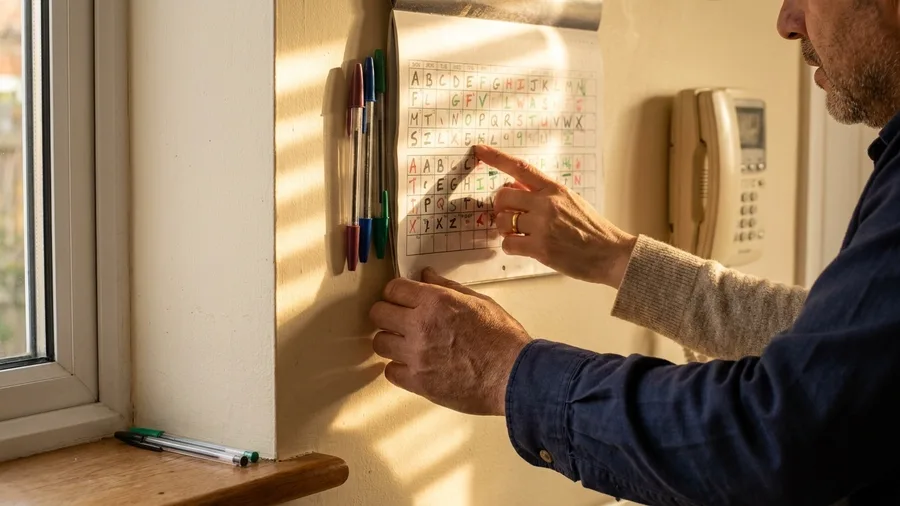
The tidy advice is that a shared calendar fixes the problem, and for us a shared calendar made it worse. I put ours on my phone first, and it ran for a month before I understood what I had built: a record he could not read, updating in a pocket across the room. The ambushes stayed small and constant. His friend knocked at 10 while I was on a client call, a plumber arrived I had never heard of, and a doctor’s appointment surfaced the night before it happened.
Then $18 changed the traffic in this house. A large paper grid went up on the kitchen wall by the phone, where either of us can stand and read it without asking permission, and at the table we settled on three colors: his appointments, my work hours, and each person’s alone time. Alone time got the same treatment as a dentist visit, because a thing nobody writes down does not survive a retired man’s open Tuesday.
We look at it every Sunday before we sit down to talk. A calendar nobody reads is wallpaper, and I have hung wallpaper before.
💡 Tip: Write your alone time in the same pen as his golf. Different colors is fine, different seriousness is not.
📅 How We Rolled Out the Calendar
Week one: pen only
For the first seven days the calendar hung blank. Add nothing until you have both stood at the wall and read it once.
Fill it together, not alone
Sit at the table with two pens. If one of you writes the whole month, the other keeps checking a phone.
Give alone time a color
Mine is teal, 9 to 1 on weekdays. His is yellow, and he picks his days first. Nobody's block looks like leftovers.
Leave one column for surprises
A friend at the door, a plumber, a rescheduled appointment. One blank lane for what nobody knew to write.
Sundays: read, then decide
The 20-minute reset happens after the calendar, never before. Read every square out loud, then talk. Two minutes, no more.
5. The 20-Minute Sunday Reset

I did not start with a timer. I started with a mental ledger, and every entry in it was true: the chewing at breakfast, the radio left on in the empty kitchen, the questions that arrived at 9:15 while I was three columns into a ledger that actually balanced. By Sunday the list had stopped being a list. It was a case, and I was building it the way you build a case against someone you have decided to leave.
What replaced it is twenty minutes at the kitchen table every Sunday with a timer set where he can see it and three questions written on an index card: what felt crowded this week, what helped, what is on the calendar. It is genuinely fine to skip a Sunday when the week was easy. The tell is whether you are skipping because nothing crowded you or because you are saving it up.
The first attempt ran seventy minutes and ended in an argument about his mother from 2019. The timer and the ban on relitigating old fights came out of that afternoon, and when the timer goes the meeting ends, even mid-sentence. That rule is why he came back the next Sunday. Small irritation in week one beats a verdict in month eight.
The Sunday Reset: What Works and What Turns It Into a Fight
Keeps it a reset
- Same two seats every week – kitchen table, timer between you
- Each person names one crowded thing, then hands over
- A miss gets logged out loud, not banked
- He picks which calendar item he wants first
- Ends with one thing each of you will do differently
Turns it into a trial
- Three crowded things each – the pile becomes the point
- Whoever speaks last wins the week
- Letting a skipped week roll into a double sit-down
- Explaining why the other person's item is not fair
- Leaving the table with no name attached to a change
6. The Closed-Door Headphones Rule

Three sounds got to me before any conversation could: the TV carrying from two rooms away, a phone call on speaker in the kitchen, and the garage saw starting up at 9:40 on a Tuesday while I had a client on the line. I heard myself snap about the radio before I had decided to be irritated, and that frightened me more than the noise did. The snapping was not about the radio. It was about not having any way to say quiet that did not sound like an accusation.
So the noise got a signal instead of a conversation. $249 bought a pair of noise-canceling headphones, $35 bought a white-noise machine, and both live in the office and are used only there.
The signal works like this. Closed door plus headphones on means do not disturb, and the exceptions are the same three we agreed on for the door: fire, blood, or a confirmed delivery. Those are his words, from the afternoon we wrote them down.
What I got wrong first: I wore the headphones into the kitchen to finish chopping an onion, and he came in, said my name twice, and decided I was ignoring him. The signal only reads correctly inside the room it was invented for.
That is the whole reframe. The headphones are not a wall between us. They are how I stay someone who answers him kindly at 1 p.m. instead of someone who has been gritting her teeth since breakfast. He is not being snapped at, and I am not becoming a woman who snaps.
💡 Tip: Put the white-noise machine on your side of the door, not his. The point of the signal is that he can still hear the house.
7. A Standing Day Apart Each Week

“I just need some time to myself” sounds like the first line of a fight, and the first time I said it I made it one. I took the car to the library and never said when I would be back; he sat in the kitchen with the clock and by the time I walked in he had already decided what the afternoon meant.
So we put it on the calendar in pen: Tuesdays, nine to four. He is at the food bank stacking cans; I am at the library with a $12 lunch and no phone on the table. The rule is no check-ins until four, and the first Tuesday I broke it at eleven over a furnace filter that could have waited.
when you picture him gone for a whole day, does your chest loosen or tighten? If it tightens, you are not done mourning the retirement you imagined. If it loosens, schedule the day and both of you get something ahead to look forward to.
The Boundaries We Built, Cheapest First
Sixteen months in, the cheapest items are the ones still doing the most work.
Frequently Asked Questions
What if he refuses to leave the house on the Tuesday apart?
Then start with the door and the posted hours instead, and revisit Tuesday in a month. A day apart only works when both people have somewhere to be. The gym solved that for us — $42 a month bought him a 6 a.m. lap pool and a reason to be out the door.
Isn’t a lock on your own office a bit much?
It would be, if the door went with it. The lock only ever backs up the card on the outside: 9 a.m. to 1 p.m., Monday through Friday. He knows when I reopen. That is what keeps it a workday instead of a mood he has to guess at.
He keeps bringing up projects on the dining table. What do I say?
Say the garage bay is his, and mean it. We spent $350 on shelving and pegboard and the car now sits in the driveway. Nine days of grumbling and it stopped. Ask before you walk into the bay, and the trade holds in both directions.
How long before the closed-door hours actually stick?
For us, about three weeks, with two or three knocks in the first one. The knocking rule helped most: fire, blood, or a confirmed delivery, and he wrote those exceptions himself. A rule he authored is a rule he can keep without feeling like he lost.
We already fought about the phone calls on speaker. Now what?
Move the fight into the twenty minutes with the timer. One week only, no history, three written prompts. Then buy the headphones and agree that behind that door they mean do-not-disturb. The snapping stops being the signal, which is the part that wears a marriage down.
What if the house is just too small to pull any of this off?
Ours is 1,550 square feet with a one-car garage and no basement, and the changes still fit. The smallest of them — the $18 paper calendar by the kitchen phone — solved more weeks than anything except the lock. Size of the house matters far less than having somewhere the time itself is posted.
Which Door to Close First This Week
Start with your flashpoint, not the whole list. If you work from home, the office comes first: the $140 keyed knob, a card at eye level with your hours, the three exceptions said aloud so he can repeat them. If he’s underfoot before you’ve found your glasses, start at 6:45, two departures back by 8:30. If noise is what makes you snap, start with the headphones and keep them where the signal lives.
Heads up: the first week feels rude, and mostly to you. I felt like I was evicting him every morning. By the third Sunday it was simply the schedule, no more charged than trash night.
The garage door still goes up, at 6:45 and again at 8:30. The click of my office lock at nine replaced the sound his leaving used to make.
Eight hundred and some dollars in one-time costs, and not one of the seven made him smaller. Two wives in that subdivision, husbands retiring a month apart, ended somewhere different. Start with your worst hour this week, and find out which one you’re going to be.
Pick One Door Before Monday
Go stand in your office doorway right now, or at the kitchen calendar, and name which of the seven you'll do first. Then put the start time on paper where he can see it.