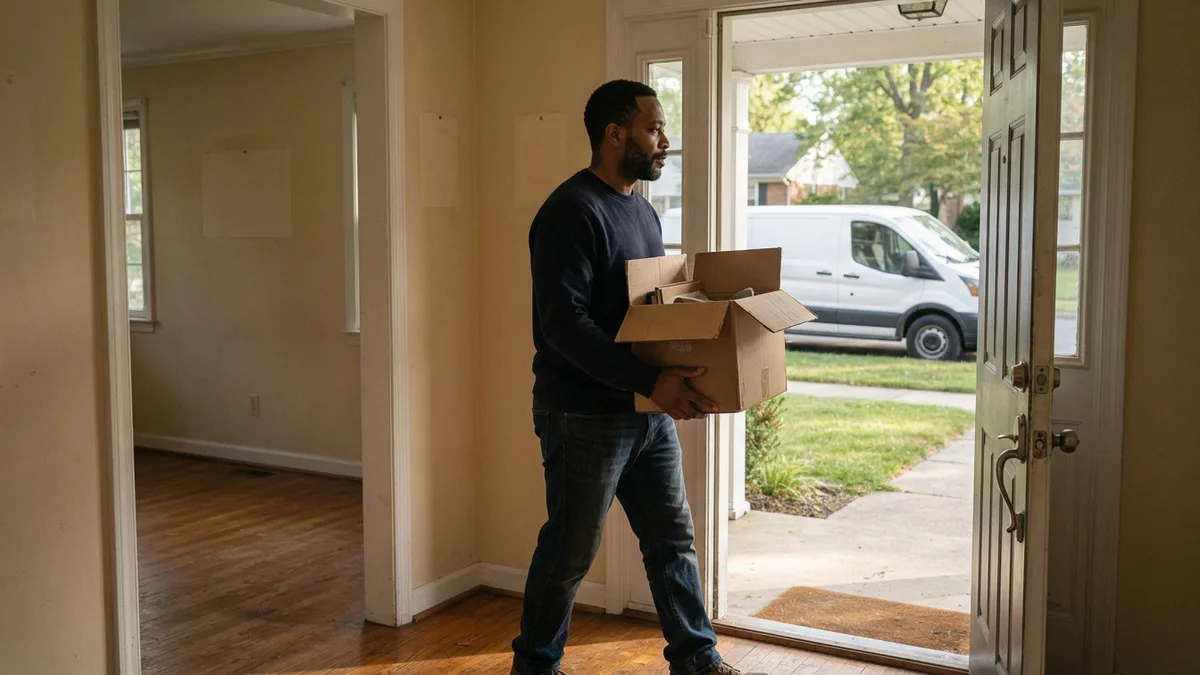
Most people assume the hard part of a late-life move is the house itself: pick a realtor, price it right, and the rest is boxes and tape. Then you walk through a 1,050-square-foot condo twelve miles from the colonial you have lived in for forty years, and the second bedroom measures nine by eleven – a desk or a bed, not both. You drive home without saying a word. Nobody warned you the hard part would be the two of you.
We had agreed on the condo. Standing in that small room, I understood we had agreed on nothing else. Everyone assumes the risk in a move like this is square footage, going from 2,400 square feet down to 1,050. It is not. The risk is the deadline. Six months turns every object into a verdict, and hands two people who had never divided anything the job of agreeing on all of it.
We did not know to book storage and an organizer before the listing went up. That order – unit first, neutral third party second, sign third – is the whole fix. If you are staring at forty years of house, start there, and know when you need a referee.
The order we should have used
We agreed on the condo and nothing else
We fought because wanting the same town is not the same as wanting the same rooms, and we had only ever agreed on the town.
The January conversation took about twenty minutes. Four bedrooms and a two-car garage on a quiet street since 1984, and we said the words downsize and stay near our friends, and that was the whole plan. It felt like one decision. It was closer to forty, and we had discussed exactly one of them — the address.
The rest stayed in our heads, unspoken. I had a picture of a workbench against a wall. She had a picture of her mother’s china laid out in a real dining room. Neither picture had ever been described out loud, so neither of us knew the other’s was different from our own.
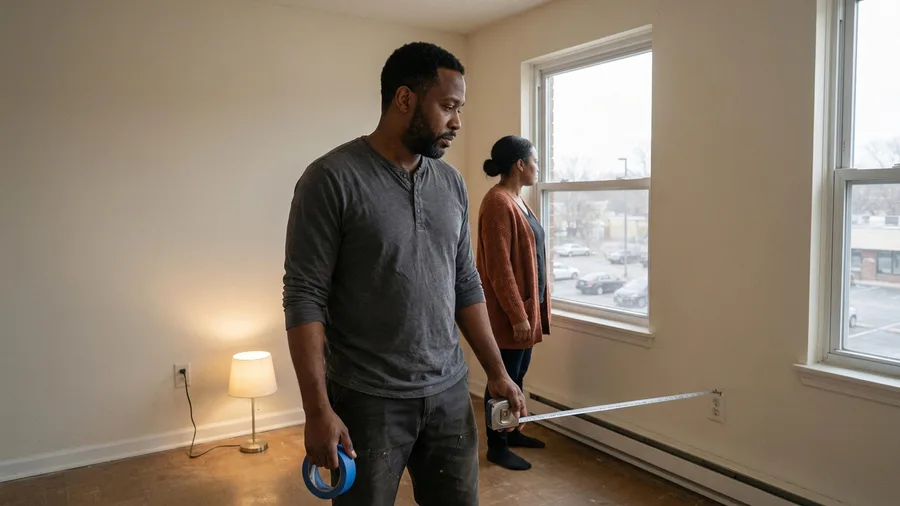
Then the realtor walked us into the second bedroom of a 1,050-square-foot condo. Nine by eleven. The tape measure said a desk or a bed, not both. She looked at the window. I looked at the outlet placement. Nobody said anything.
We drove the twelve miles home without a word, and we had not even made an offer. That silence is the tell. The fight had not happened yet, but the split had — and it ran straight down the line between the square footage and the marriage.
| Item | What we planned to spend | What we actually paid |
|---|---|---|
| Movers | $3,000 | $4,200 |
| Estate-sale company | Nothing — we’d sell it ourselves | $2,100 |
| Dumpsters | $300 | $900 |
| Professional organizer | Nothing | $85 an hour, four sessions |
| Two 10×10 storage units | Nothing | $380 a month |
| Second 4×8 unit for the tools | Nothing | $95 a month |
| Condo HOA | Not checked carefully | $340 a month |
Forty years of stuff isn’t forty years of memories

It feels like a betrayal because most of it was never ours together — it was mine or hers, and neither of us had ever been given the right to decide for the other.
Count the hidden space: basement, attic, garage — call it 1,900 square feet of storage behind the 2,400 we lived in. I had a table saw, band saw and jointer in the garage. She had her mother’s 1968 dining set and twelve place settings of china wrapped in newspaper. We had 47 boxes of photographs that no one had opened since 1998. Almost every object in that house had exactly one owner.
What we never set was the rule underneath the sorting: who decides, and what the other person is allowed to say while they decide. So a box of grade-school drawings came out of the attic, and it turned into an argument about whose life counted. It was never about the drawings.
Here is the part that took me months to see. The one who did not own the thing had no standing to put it in the dumpster. I could not throw out her mother’s china. She could not throw out my jointer. Sorting together was not a bond; it was a stalemate with a deadline attached.
That fight looked like memory. It was ownership wearing memory’s coat.
Did we ever actually agree? A scorecard
The house sold faster than we could sort it

Six months, in our case — and that was the mistake, because the house set the pace and the sorting never caught up.
We made the call in January. The listing went up in March. We closed in June and moved in July, and the attic was still half full when the closing papers were signed. The estate-sale company could only give us one weekend, so two dumpsters landed in the driveway the week before, and we finished the attic at midnight the night before closing because the calendar would not move, not because we were ready.
What would it have taken to do this without shouting? About three more months, or half as many rooms to empty. We had neither, so every ordinary decision — keep, sell, toss — turned into a deadline decision. Nothing could be set aside and slept on. Every box demanded its answer that night.
That is when the two questions merged. Is this worth keeping became is this marriage worth keeping, and there was no way to tell them apart once the clock was running.
The three mistakes that cost us the most
The workshop tools were the first casualty
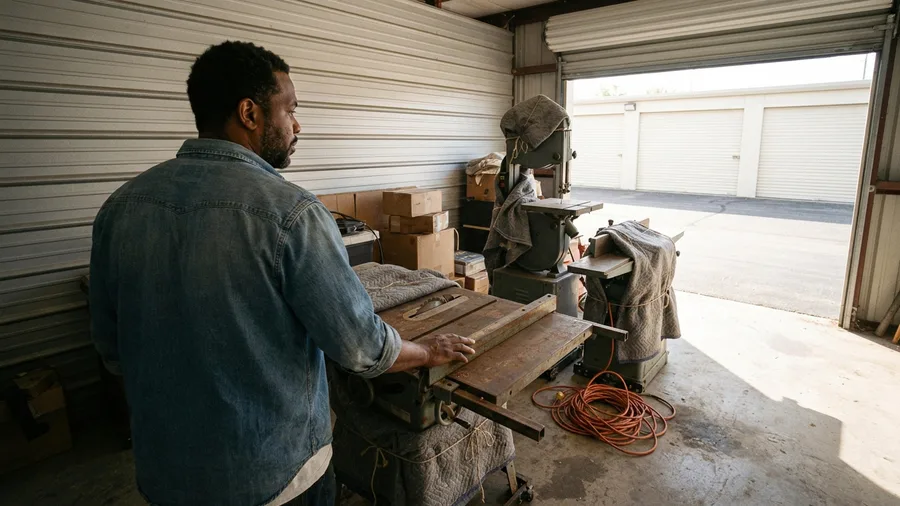
The things that could not fit anywhere in the condo went first, and mine went before hers. For four decades I had spent my Saturdays in that two-car garage, and the saws were part of the room the way the workbench was. The table saw sat nearest the door because that is where the outfeed needed to be. The band saw and the jointer lined up along the back wall, each with its own outlet, each with a burn mark on the floor from where it had stood.
The condo offered one assigned spot, no garage, no basement, no shed.
I measured the tools against that spot anyway, as if the answer might change if I got the numbers right. It did not. We signed for two 10×10 units at $380 a month, and most of what filled them was mine. Later, once the shock wore off, the saws went to a 4×8 at $95 a month and a shared workshop twenty minutes away that I could rent by the hour.
That is what you do with the things that do not fit: you pay for them to live somewhere else, and then you decide whether the payment is worth it. What I had not counted on was what $380 a month does to a man who can no longer walk out back and cut a board on a Sunday. The argument was about square footage. The wound was about a life I had built a room at a time, and whether it still counted for anything once the room was gone.
💡 PRO TIP
Split the storage before you split the furniture
Two 10×10 units at $380 a month in April became one 10×10 and one 4×8 at $95 as the boxes left. Rent the smallest unit the day you decide to sell, not the day the garage becomes impossible. You can expand later. You cannot get the six weeks back.
Her mother’s dining set was a debt, not furniture
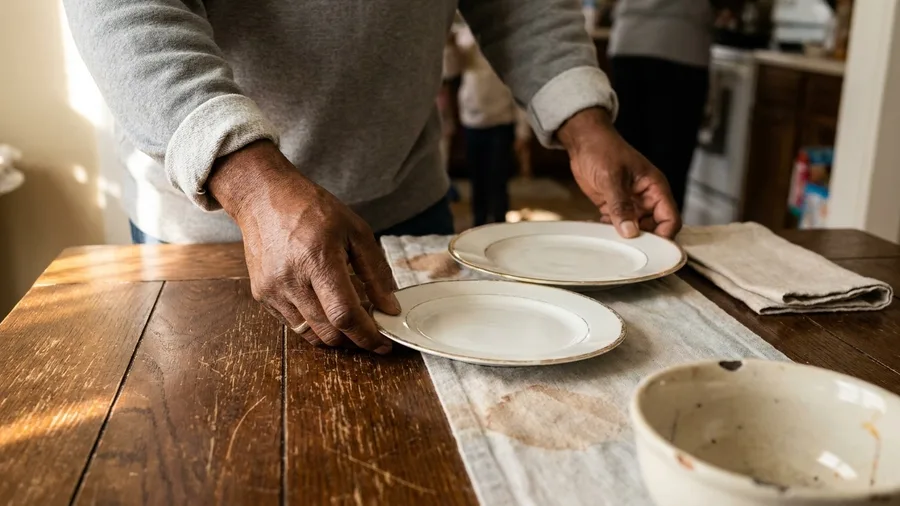
My wife’s dining set had been a promise before it was a piece of furniture, and the condo had no room for a promise. Her mother bought it in 1968 and told her, in so many words, that it was hers when the time came. The time came in 1994. In the years since, the twelve place settings of china had left the box perhaps three times, all of them Thanksgivings we hosted before the grandchildren started traveling.
The condo had no dining room to put it in.
So the set sat in the storage unit we were paying for and became, in her mind, a thing I was trying to get rid of. I was not, or not exactly. I was trying to get rid of the question, which is a different thing, and the question would not go. In September the set went to our daughter’s apartment, which has a table long enough to seat eight. We kept eight place settings anyway, and they sit in a cabinet in the condo.
No measurement of square footage could touch the promise. When your spouse cannot let go of something, the object is rarely the reason and the room is never the argument. It is a debt owed to someone who is no longer there to forgive it, and you cannot win that argument on the object’s terms. You can only hand it to someone the debt still means something to, and let it be paid.
We fought about 1987 tax returns at 11 p.m.
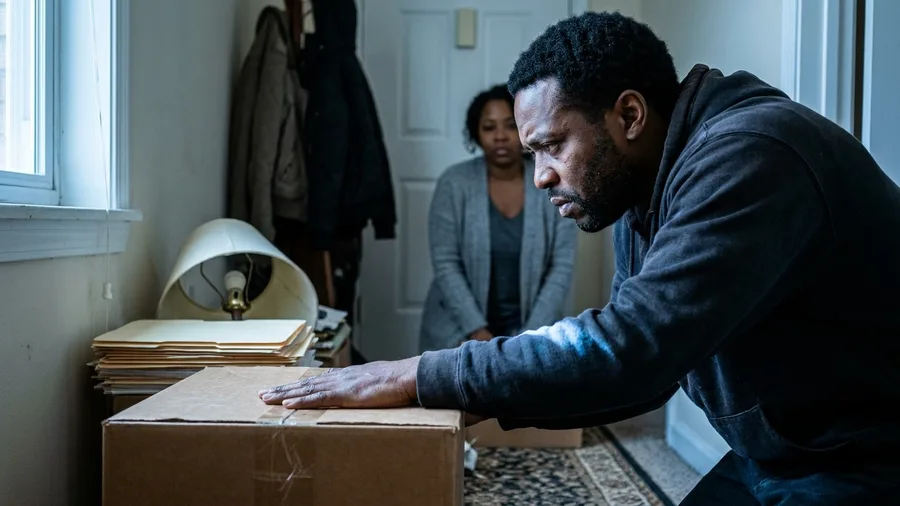
By week nine we had a box of 1987 tax returns and a broken lamp, and at 11 p.m. on a Tuesday those two things were enough. My wife said I never threw anything away. I said she would throw me away. The box went up to the 10×10 unit the next morning, unopened, and stayed there a year, and neither of us ever went back to look at it. It settled nothing.
A small thing sets off a huge fight because by then the small thing is not the thing. Every box in that apartment had become a vote on whether the marriage was worth what it was costing to save. The 1987 returns were mine. The lamp was hers. Neither of us cared about either one. We cared about who had the right to say what forty years added up to, and by 11 p.m. in a place with one walk-in closet and a second bedroom that held a desk or a bed but not both, we were both sure the other one was deciding without us.
Notice what we were fighting over: a box nobody had touched since the first Bush administration and a lamp with a cracked base. The size of the object is not the size of the fight. The fight is proportional to what the object is standing in for, and during a move, everything small is standing in for something enormous.
📦 The six months, as they actually ran
January — the decision
We agreed on the condo and the budget and nothing else.
February — the offer
The condo was bought for $410,000, twelve miles from the old house.
March — the listing
The house went on the market before the sorting was half done.
April — the estate sale
One weekend for forty years of accumulation, with two dumpsters behind it.
June — closing
Sold for $615,000; I finished the attic the night before.
July — the move
$4,200 in movers and two 10×10 units receiving what would not fit.
September — the reckoning
The dining set went to our daughter and eight place settings stayed.
The condo was too small for separate rooms
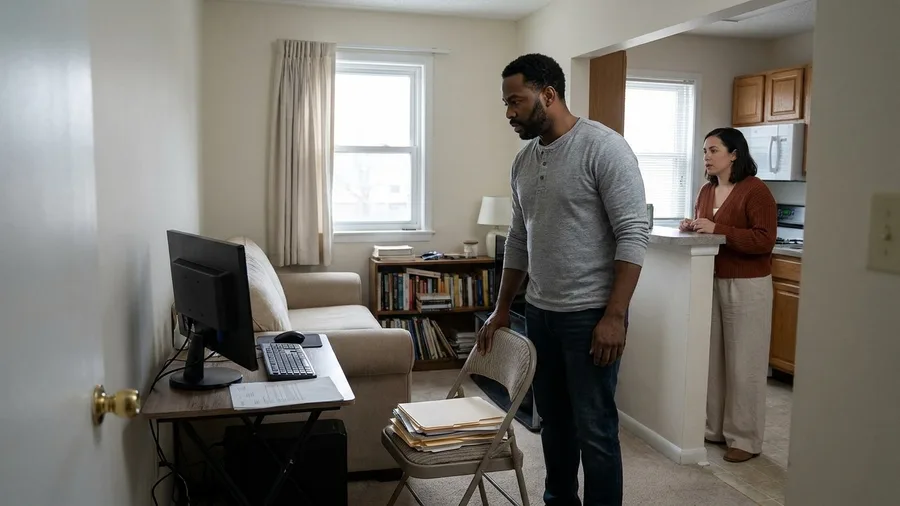
The number that tells you it’s too small is not square footage. It’s whether the second bedroom holds two desks or one desk and a bed. Ours was 9 by 11, and it held his office and nothing else, so her desk went into the living room corner by the window, and from then on neither of us had a door to close.
One walk-in closet served us both. Two people who had spent decades retreating to separate rooms after a hard conversation now had nowhere to retreat to. The verdicts from the boxes had to be absorbed somewhere, and there was no wall left to absorb them.
Some of it worked. The elevator made the second floor fine at our age, and the $340 a month HOA bought us a building that stayed quiet. But one assigned parking spot and no garage meant every errand ended in a shared space and every arrival came with a negotiation about who moved what.
The part nobody warned us about was the twelve miles. We left a neighborhood where people dropped by, and in the condo the doorbell mostly rang for deliveries. The social buffer thinned at the same time the walls did, so the two things that used to give us room from each other, other people and square footage, were both gone in the same move.
So here is the honest limit. If two people are used to separate rooms, the second bedroom needs to hold both a desk and a bed, not an either-or. At 1,050 square feet, no layout was going to give us that. The condo could hold our furniture. It could not hold our habits.
The organizer was worth more than the counselor

Four sessions at $85 an hour bought us a rule we should have written down in January, and it cost less than the movers’ deposit.
She worked at the basement table with a clipboard and a notebook, not a clipboard of forms but a running list. She held each thing up at eye level and asked one question: whose is this? Then she wrote the answer down and set the object in one of three piles, and the whole sorting slowed to something two people could stand.
The rule that did the work came first. The owner of an object decides what happens to it, and the other person gets one veto per room, saved and spent like a card. That is not a compromise, it is a division of authority, and it settled in ten minutes what nine weeks had not.
Neither of us could be the one who threw the other’s things away. A stranger can take that blame and walk out with it, and the marriage stays clear of it. The 1987 tax returns went into a box on her say-so, and I did not have to be the husband who did that.
This is no use to a couple who wants a referee to declare a winner. We did not, which is the only reason it worked, and we wanted the decisions off the marriage rather than a ruling about who was right.
Two orders, two outcomes
What we did
- Listed in March before a single box was sorted
- Booked the estate-sale weekend first, storage second
- No rule for who decides, so every box was a negotiation
- Moved 11 p.m. fights into a smaller space with no doors
- Paid $380 a month for two units built out of panic
What we'd do next time
- Rented one 10×10 storage unit the week we decided
- Booked the organizer for four sessions before the listing
- Set the rule: owner decides, one veto per room
- Waited to list until the attic and garage were decided
- Kept the overflow in storage for twelve months, not forever
We should have rented storage before we sold

The order that works is storage, then estate sale, then pack, then list. Rent the space first and let it absorb the overflow, sell what you can, pack what’s left, and put the house on the market last, when the rooms are empty and nothing in them is still undecided.
We did it in reverse and paid for it twice. Two 10×10 units at $380 a month for six months, then a 4×8 at $95 after the tools moved, and the attic still wasn’t empty until the night before closing. The storage cost wasn’t the expensive part. The expensive part was what the calendar did to decisions that were made in the wrong order.
Week nine was the peak. The listing prep, the estate-sale weekend, an attic I had not finished, and the 1987 tax returns on the floor at eleven at night. A unit rented in January and one organizer session that week would have moved that box out of the room and the decision off our hands. Instead it sat between us on the floor, and it wasn’t a box, the way it isn’t a box for you.
One step has to come before the photographer pulls in, not after: rent the storage and move the overflow out. Once the listing is up, every unresolved object turns into a countdown. A camera in the corner does not make the argument clearer.
We kept half and miss almost none of it

It gets easier, but only after the deadline lets go. The fights thinned after month four, and the difference was not that we had gotten better at agreeing. It was that by then most of the boxes had already been answered, and the ones left no longer had a closing date pushing on them. Nothing about us changed in month four. The calendar did.
A year on, what sits in the condo and in the storage unit is a short list. Eight place settings of china, because the full twelve had nowhere to live and half of them never got used anyway. Three thousand photographs scanned onto a drive, and the tools in a shared workshop he drives to on Saturdays. That is the inheritance of forty years in a house, and it fits in 1,050 square feet.
The rest went and I have not once gone looking for it. The 1987 tax returns, which caused the worst night of the whole move, are gone and nobody has asked about them since. The second sofa, the 47 boxes reduced to scans.
Two people can do the exact same move and keep different things, and that is the part I did not expect. My wife would still take the full twelve-place-setting set back if she could. I would not take the tax returns back for anything. Both of us are right about our own boxes, and the marriage held because we stopped asking the other to be wrong.
Frequently Asked Questions
Why did we fight so much when we both wanted to move?
Because wanting the same address is not the same as agreeing on what the next twenty years are for. In our case we had settled exactly one of forty decisions — the condo — and let the shared goal cover the rest. The fights started the moment the uncovered decisions landed on a calendar.
How long does downsizing from a forty-year house actually take?
We did it in six months, and six months is where it went wrong. The people who come out of this calm tend to give themselves three more months or cut the rooms in half. If you cannot get either, rent storage and buy yourself the time that way.
Should we hire a professional organizer for a move this size?
Hire one before the listing, not after. Ours charged $85 an hour for four sessions and did more for the marriage than any conversation we had on our own, because she could carry the decisions neither of us wanted to be remembered for making.
How small is too small when two people work from home?
Too small is a second bedroom that holds a desk or a bed but not both. We had a 9×11 room and one walk-in closet between us at 1,050 square feet, and it left no door to close. Measure your desks and walk the second bedroom with a tape before you make an offer.
What do you do with furniture nobody can use and nobody can throw away?
Offer it to family first, and be specific about who. Our daughter took the dining set in September, which ended a fight that square footage could never have touched. If no one takes it, store it for a year and decide then — but decide, and put a date on the calendar.
Does it get easier after the move?
Yes, and later than you want. Our fights thinned after month four, once decisions stopped being made under a deadline. A year on, we do not miss the house or most of the boxes, and eight place settings of china are more than enough.
The condo didn’t nearly end it — the six months did
The condo did not nearly end my marriage. The six months did, and the assumption under them: that two people who had never divided anything would agree on forty years of objects, on a schedule, with no help. So do one thing before the listing goes up – rent the smallest storage unit you can and book four sessions with a professional organizer, in that order. The storage buys time. The organizer takes a blame the two of you cannot afford to hand each other.
Some couples should not attempt this without a neutral third party at all: the ones who have never once sorted a closet together, and who will not let a stranger referee. Those are the boxes that get opened at eleven at night. We got there anyway. It cost us nine weeks, and it left us eight place settings of china and forty years intact.
The nine-by-eleven room still holds a desk or a bed, not both. The $615,000 house and the $410,000 condo were never anything but addresses. The marriage was the item that had to survive the sorting, and the order you do things in decides whether it does. Book the unit, book the organizer, and let the house wait its turn.
Before the sign goes in the yard
Rent one storage unit and book the organizer this week, before the photographer schedules. Come back to the cost table above and add those two lines to your budget now — they are the cheapest part of this move.