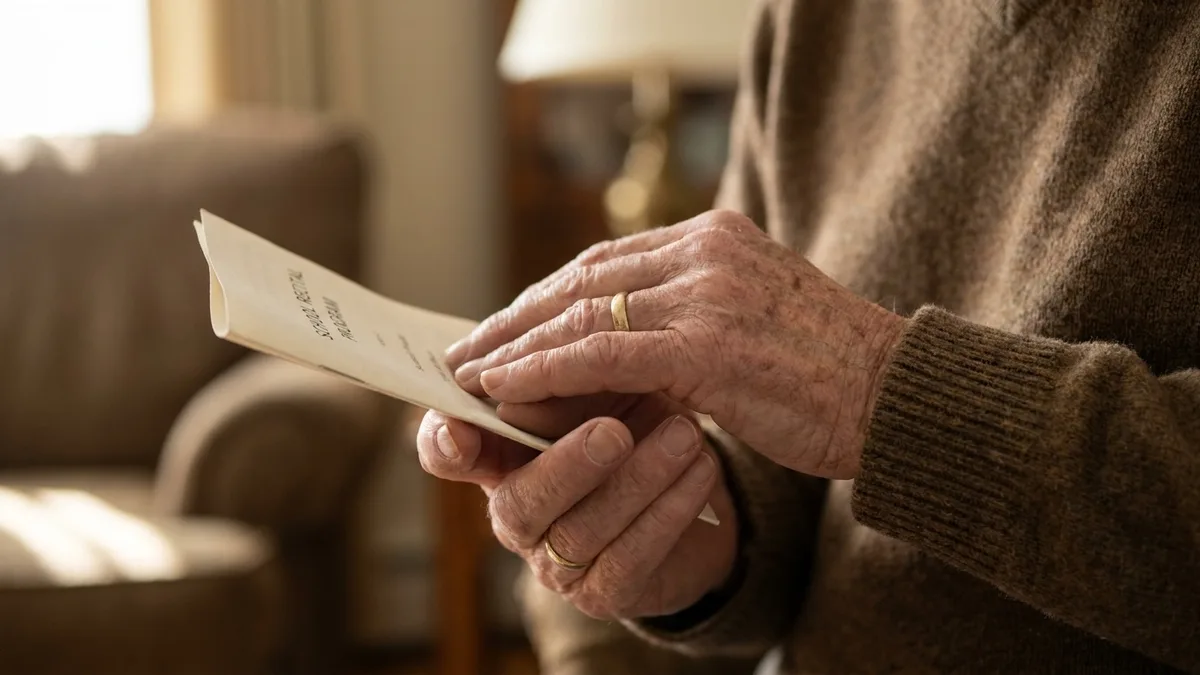
Why is my husband suddenly so emotional in his 70s? He tears up at a commercial, snaps over a burnt piece of toast, holds your hand through a grandchild’s recital the way he once only did at funerals. The man who used to leave the room to avoid a complaint now goes glassy-eyed at a school choir, and you are watching him wondering who this is.
Most of that softening is ordinary. Retirement, grief, quiet days, a changing body, tenderness around grandchildren – any of them can lower the threshold. The same tears can also be the face of depression, hearing strain, medication effects, or something new that a doctor should see.
So the useful question is not why is he crying. It is what changed, when it started, and whether the pattern stays tied to ordinary triggers or breaks away from them. That question you can actually answer.
By the end you will be able to name the ordinary causes, spot the ones that need a clinician, and open the first conversation calmly – asking what the feeling is about, then tracking timing and triggers instead of tallying tears. Ordinary or clinical, what you are watching is a man whose guard has come down, and the way you respond to that decides whether it stays down.
Quick Tips Before You Start
Keep a small note
Jot down when the tears happen and what came before: a song, a phone call, a Sunday evening. Patterns will emerge faster than you think.
Ask before you fix
Try 'What did that bring up?' before offering a tissue. The question opens more than the tissue closes.
Check the calendar
Look back at the past three months. A change that started after a new pill, a funeral, or a hospital stay points to a different cause than one that's been building for years.
Learn the depression signs
Persistent low mood, lost interest, poor sleep and appetite, and hopelessness are not ordinary softening. Learn the list before you need it.
Call the doctor together
If something feels off, book a joint appointment. Two sets of ears catch medication side effects or hearing loss one set misses.
The role and routine shift
1. Retirement strips away the routine that steadied him

The easy answer is that he has too much time on his hands, and it turns out that is only half true. The other half is what the time used to be attached to. Work handed him a shape for the week: a reason to shave, a place to be at eight-fifteen, a roster of names that expected him. Retirement takes the roster away.
What is left is not idle hours so much as unclaimed emotional room. The phone stops ringing with people who need his answer on something. Nobody reviews his work, nobody asks where he has been. A Tuesday that once had a meeting now just has a Tuesday.
The change often runs late. A man who clocks out in April can coast through a steady summer and then, in November, look up from the kitchen table on a Sunday evening and find his eyes stinging, or hear an old song from the plant floor and have to leave the room. His wife notices the tears first and the calendar second, and the two do not seem to connect, because by then the last shift is months behind them.
That lag is worth knowing, because the same tears are not always retirement. Ones that start eight years after the last shift, with no other change, are not an old schedule missing him. Those point somewhere medical, or to grief that has finally arrived, or to hearing, or to depression, and the questions to ask are different.
The fix that matches the ordinary version is not cheer-up advice; it is a replacement frame. A standing Tuesday breakfast with two men he used to work beside, a volunteer shift on the same weekday every week, a fixed morning walk that someone else is expecting him at. Small, claimed hours that give his feelings a place to land instead of a vacuum, and that keep an ordinary retirement trigger from being read as a medical one.
💡 Tip: A husband who retired two years ago and cries at commercials is a different story from one who retired eight years ago and suddenly cries at the mail. Track the gap.
2. Health problems lower the threshold for tears

The common advice is to get him out of the house and lift his mood, and that advice will walk straight past the joint pain that wakes him at two, then four, then six. Before mood comes a body, and a body in pain or on a new pill lowers the whole threshold.
A ten-second self-test: does the crying trace back to an ordinary trigger, or has it been leaking out at small frustrations all week? Tears at a funeral or a grandchild’s wedding belong to the first answer. Tears at a spilled coffee and a stuck drawer, on top of nights broken by bad sleep and a new prescription, belong to the second.
If it is the second, the next stop is a clinician, not a pep talk. A new prescription, a stopped pill, a sudden loss of appetite, or a nagging symptom that has never been reviewed is a medical question, and it gets looked at by someone with a stethoscope.
One line needs care. Ordinary worry after a diagnosis is not the same as sudden confusion, a shift in personality, or not knowing where he is, and those need urgent attention the same day. And not every tear is disease; crying at the funeral itself is ordinary, and treating every feeling as a symptom hides the man inside it.
💡 Tip: Bring a list of every medication to the next appointment, including over-the-counter pain pills and supplements. Changes in any of them can shift mood.
The Numbers Behind Late-Life Tears
What to keep in mind when you are worried
The role and routine shift
Start with the shape of the day, because that is where most of these differences live. What fills the morning, who is expecting him, how he slept, who he has buried lately, how much silence the afternoon holds. Those four things decide how much room a feeling has to reach the surface without anything being wrong with him.
A wife can look at the clock and see them. Take the Tuesday morning that used to be a shift and now has nothing in it, or the night he was up three times with his hip, or the month two old friends and a brother died, or the long grey stretch after lunch with the television low. These are not proofs of anything by themselves, but they are places to look first.
None of this is a character judgement on him, and it is not a verdict on the marriage either. It is a change in circumstances, which is easier to see and easier to talk about than a change in the man. That is the value of starting here: it turns a vague worry about his feelings into a specific question about his days, which is more useful to both of you and more honest.
3. Grief accumulates as friends and siblings die

The cost of carrying several losses at once is that each new funeral is charged to an account that is already deep in debt. By his 70s a husband may have buried parents, a sibling, old friends, and each new death reaches back and reopens the earlier ones. A lab value can be checked and set aside; a ledger of losses cannot.
At a friend’s service he may cry harder than the friendship alone would explain, because the tears are partly for a brother who died five years ago and were never quite spent. If there have been no losses at all, recent or old, that explanation does not fit, and the tears need another source.
Naming the accumulation does more than telling him to move on: ‘you have buried your mother and two friends in three years’ says out loud what he may be carrying without a word.
A husband who can say the names is not past his grief. He is carrying it in company.
4. Quiet days let old memories surface
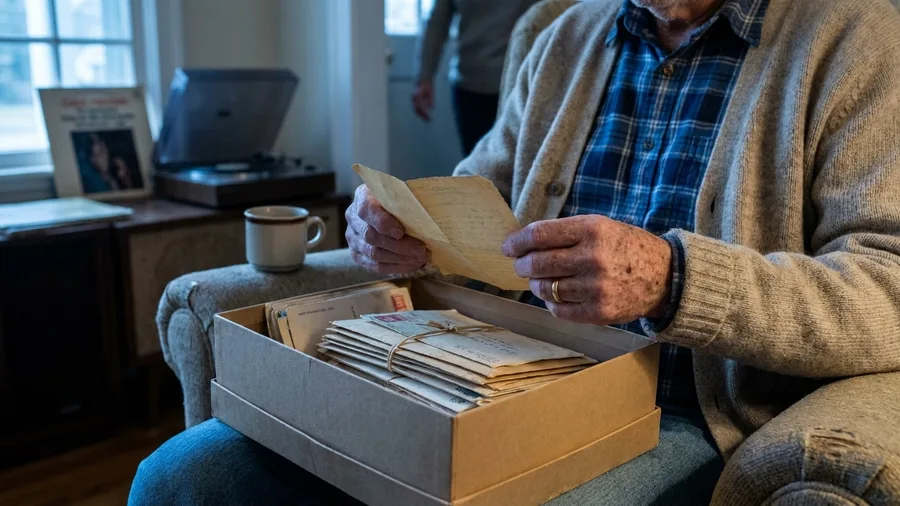
Old memories surface when the days stop being full, because an unclaimed hour leaves room for whatever arrives in it. A song from 1968 comes on the kitchen radio, a box of letters gets opened looking for a tax form, a chair sits empty at the holiday table, and the feeling is there before he has decided anything about it.
The obvious fix is to keep him busy, and it is the wrong one. Busy people cry too, and a full calendar proves nothing about well-being except that the hours were filled. Emptying his schedule cannot heal what the schedule was drowning out.
Companionship works better than noise. A shared walk, a repair job on the back porch, a standing weekly visit gives the time a shape without requiring him to talk, and the feeling can come and go in a room where someone else is present.
💡 Tip: Instead of filling every silence with television, try a shared project. A repair job in the garage or a weekly walk gives structure without noise.
⚠️ COMMON MISTAKE
Don't confuse busy with fine
A full calendar is not proof of well-being. Some of the saddest men you know are the ones who never miss a meeting or a tee time. Busyness can bury a feeling as effectively as silence, and it can make the tears feel like they came from nowhere when they finally surface.
The people and body around him
The next group of reasons is about the people in his daily life and the body he lives in. Closeness, hormones, caregiving, and family tenderness all shape what he shows at home. The question for each is the same: is this ordinary softening, or a signal that needs a clinician?
5. More togetherness makes home the safe outlet
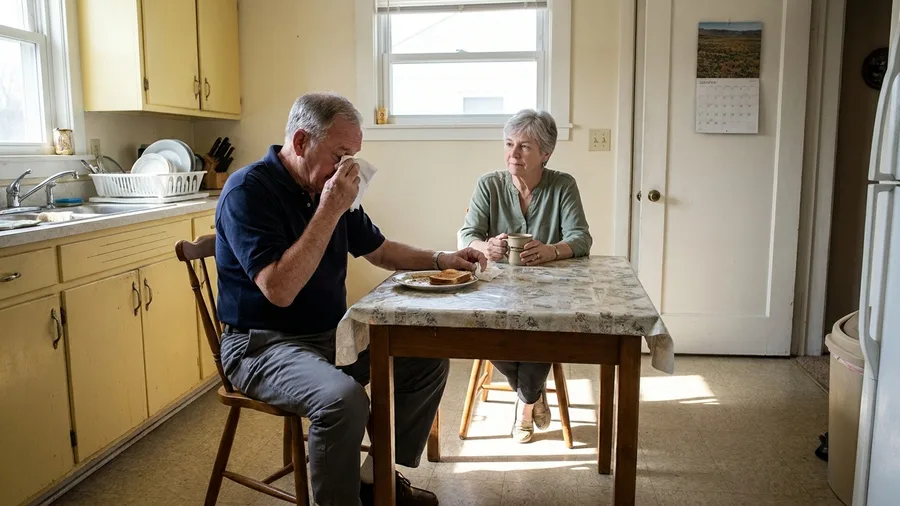
Because home is where the mask comes off. The wife’s steady presence invites a kind of expression that decades of workdays and coworkers never once saw, and it is not weakness that it happens in front of her.
The closeness cuts both ways. If she straightens his collar at the door or answers for him when the pharmacist asks a question, he may snap before he tears up, because feeling managed and feeling safe are close neighbors at that table. That irritability is worth reading as a signal, not an insult.
This does not hold in a house that has gone hostile or contemptuous. More togetherness there is not an outlet; it is just more exposure, and the answer is different from the one below.
Respond to the feeling before you correct the words. ‘That sounded sad’ before ‘don’t say it that way’ keeps the door open; the correction first teaches him to close it.
He is not crying because she is watching. He is crying because she is the one person he does not have to pretend around.
💡 Tip: Respond to the feeling before correcting the words. 'That sounded sad' before 'don't say it that way' keeps the outlet open.
6. Hormonal and sleep changes can sharpen mood
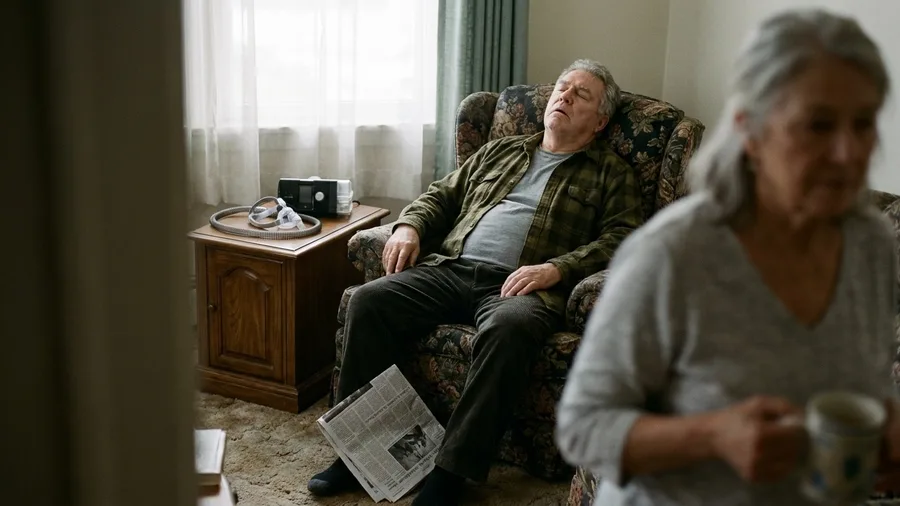
It’s 3 a.m. and you’re awake because he’s awake, propped against the headboard, and then the snoring stops mid-breath – a pause that goes on long enough to turn your head – before he gasps and settles again. Next morning he falls asleep at lunch and snaps at you over the wrong mug.
Broken sleep like that wears a man down to the nerves. So does a testosterone level that has drifted low over years. Both are body-level influences a doctor can look at, and both can put a normally even husband closer to tears and anger. The older phrase for it – male menopause – isn’t a diagnosis and won’t explain every tear in the house.
What matters is the pattern. Sudden changes in sleep, appetite, or energy deserve a clinician’s look, especially if they arrive with low mood or a man who has stopped calling people back. A blood test may point to a contributor or rule one out. It won’t account for everything, and grief and the empty space of retirement still count.
Ordinary Softening vs. a Clinical Signal
Ordinary softening
- Tears come at funerals, weddings, or an old song.
- He can name what brought it up.
- Sleep, appetite, and interest stay steady.
- The feeling passes and he returns to his day.
Needs a clinician's review
- Tears start suddenly or last for weeks.
- He cannot say why and seems confused.
- He stops seeing friends and loses interest.
- Sleep, appetite, or hope for the future drop.
7. Caregiving reverses the old stoic bargain
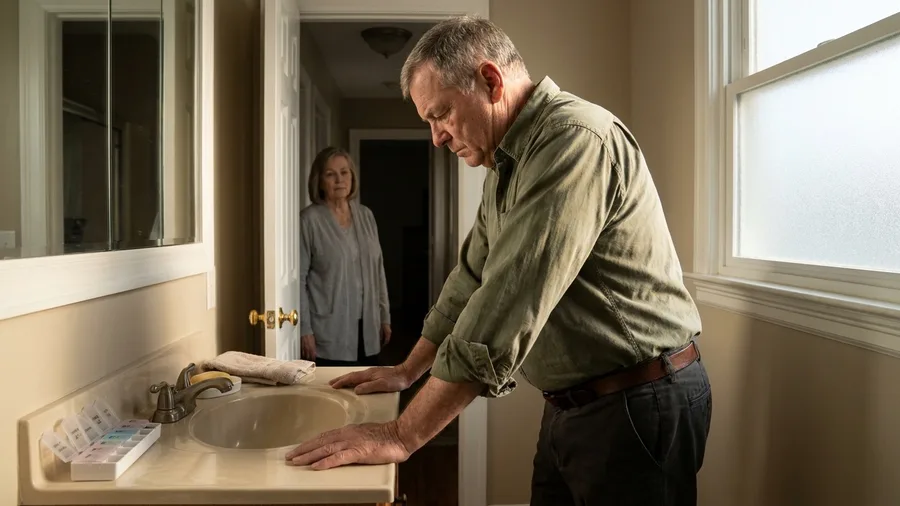
Two years. That is often how long a wife’s illness runs before the tears show up in the man who is carrying her oxygen tank to the car.
By then the house has changed hands. He who never knew where the bills were kept is now counting pills into a Monday-to-Sunday box and writing down what the visiting nurse said, and the person he would normally tell about a hard day is the person he is being strong for. So the crying happens away from her – in the garage, over the recycling, with the door shut.
Some of what looks like breaking is ordinary tiredness, and it is worth saying so aloud. Not every man in a caregiving house is falling apart; plenty manage for years without a visible crack, and a husband who is worn thin by broken nights is not the same as one who is drowning. The question is whether rest puts him back together.
What lightens it is help he can name and schedule – a son who takes Thursday evenings so he can sleep, a neighbor who sits with her for two hours on Saturday, an aide who comes for the shower and the dressing, or a caregivers’ group where nobody flinches at the details. If the tiredness holds even after a real break, that is a reason to have his own doctor look at him.
8. Grandchildren and mortality bring tenderness

“I don’t know why I’m crying, I’m happy.” That line, or something close to it, gets said at a lot of graduations.
A granddaughter crosses a stage and he is undone by it – and by a second thought he may not say out loud, which is that he missed his own son’s Saturday games during the years he was traveling. Love, pride and a bill for time not spent can arrive in the same minute. What people who study later life describe is not a single feeling but a blend: grandchildren and anniversaries press a man to count what he has and what he let go, and the two counts rarely match.
That regret is worth hearing rather than correcting. It is one strand of the tenderness, not a flaw in it.
The culture’s habit is to read mortality into every misty moment, and it often overshoots. A man can be moved at a wedding simply because the room is full of people he loves and the band is playing the song from his own reception. Not every tear at sixty-nine is a reckoning with the end; some are the ordinary overflow of a good afternoon, and telling him what he is really feeling misreads the moment.
What helps is warm and unremarkable. Sit down beside him at the reception and let the silence do its work; put a hand on his arm and say nothing; pass him a napkin as though it were the most ordinary thing in the room. Teasing him back to composure – not now, Dad, everyone’s watching – tells him the feeling is a spectacle, and a feeling treated as a spectacle tends not to return.
💡 Tip: If you want to ask about the tears, wait until you are alone in the car. A quiet question lands better than a public one.
What Else Is Going On in His 70s
What the change means and when to act
The final group of reasons asks the question that matters most for a wife: is this ordinary late-life softening, or a sign that something needs a clinician? The answer usually comes from timing and triggers, not from counting tears. The sections below show you how to sort the two.
9. A looser generational script gives permission
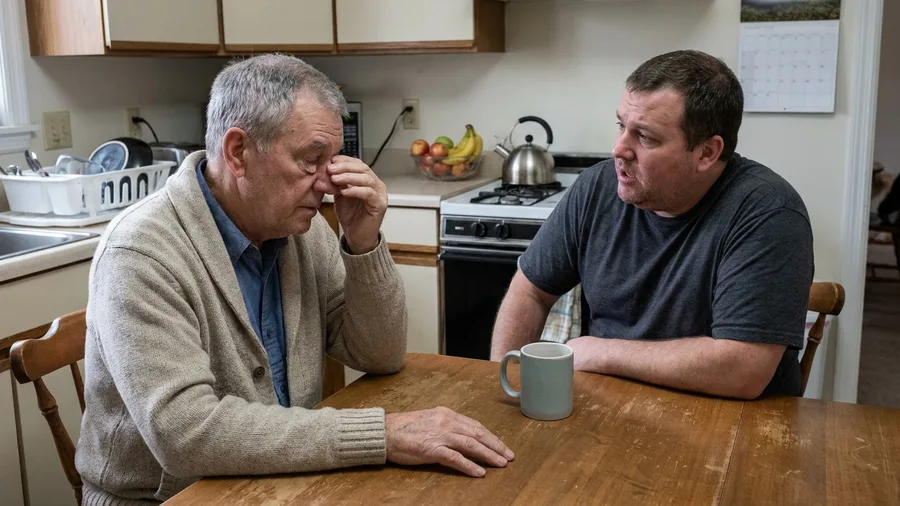
You hear it at the anniversary party: ‘Let the man cry, it’s good for him, times have changed.’ Times have changed, and it still isn’t the whole story. Your husband can feel permitted to say the affectionate thing out loud, to tear up in the kitchen in front of his son, in a way his father would have swallowed and taken to the garage. A wider script has loosened, one that treats a man’s tenderness as ordinary rather than shameful. That is real. It simply isn’t the only thing going on in the room.
Permission is not pressure. Nothing obliges him to perform the openness, and a quiet husband who does not cry at the recital is not failing some new standard of feeling. The change is that the option is there now, where for his father’s generation it was not. Watch what he does with the option when it’s offered.
Now the part that matters for you. A script does not shift over a single winter. If the man who has been steady at every funeral and every milestone suddenly tears up in the checkout line, or grows tearful and withdrawn across a few weeks when nothing in the family has changed, this is not culture catching up with him. A change that arrives in weeks rather than years is a clinical question, not a generational one.
So welcome it, and skip the part where he becomes the family show. No audience, no gentle teasing at the dinner table, no story told at his expense next Thanksgiving. Sitting beside him while the feeling passes keeps the openness his, and stops permission from hardening into performance. After a lifetime of being the one who never cracked, being watched is the surest way to close him up again.
💡 PRO TIP
Welcome it without an audience
When he tears up in front of family, do not make it a teaching moment. A quiet hand on his arm and a change of subject when he needs it keeps the permission from turning into performance. If you want to talk about it, wait until you are washing dishes together or driving home.
10. Depression can masquerade as irritability or tears
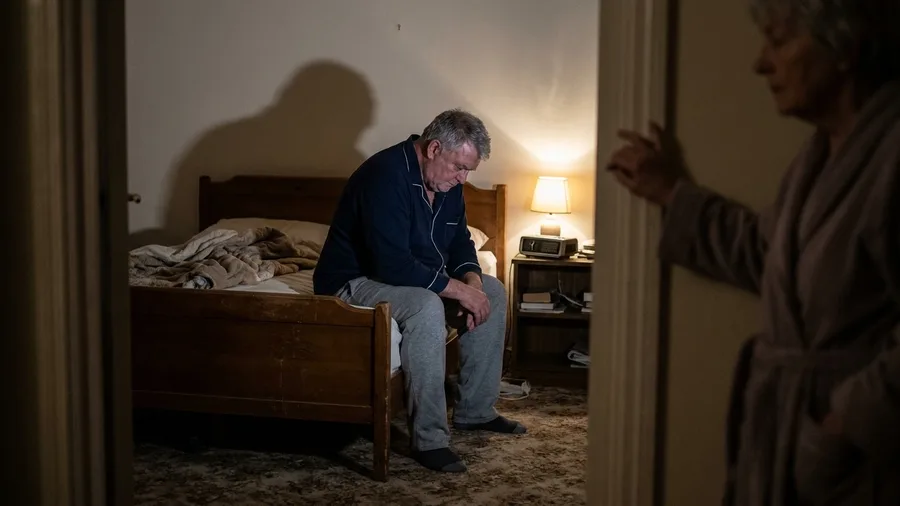
The first time a husband went quiet and short in his answers, it looked to me like ordinary tiredness, and I treated it that way for weeks. That misread cost time. The irritable man at the breakfast table who snaps over the newspaper, who has stopped calling his brother, who says nothing matters much anymore, may be showing sadness on a face that never learned to wear it. Men often wear anger instead. The tears and the snapping are both possible, sometimes on the same afternoon.
The question is what happens between the sad events. Crying at a funeral, at a diagnosis, at a grandchild’s departure, and settling within days is ordinary. So is a good week after a hard one. What you’re watching for is a mood that darkens and stays dark, that takes interest and appetite and sleep with it.
When it lasts, a doctor or a mental-health professional is the next step, not the last resort, and a crisis line is there for any safety concern. Don’t wait for the tears to become dramatic before you pick up the phone.
💡 Tip: Ordinary tears after a sad event are not depression. A funeral, a diagnosis, or a grandchild's departure can bring tears that settle within weeks.
🩺 How a Clinical Question Unfolds
Notice the pattern
Write down when the tears started and what changed in the same month.
Check the basics
Look at sleep, appetite, interest in friends, and any new medication.
Book the appointment
Call the doctor and describe the change, not just the tears.
Go with him
Two sets of ears catch hearing loss, side effects, and symptoms he would not mention.
Follow up in two weeks
If nothing has shifted, ask about a mental-health referral or a hearing test.
11. Hearing loss turns frustration into emotion

‘He’s just getting emotional in his old age.’ You will hear that at family tables, and it is the most common thing said about a teary husband, and often the wrong conclusion. Before you file it under age or mood, consider his ears. A man who mishears the dinner order, laughs to cover it, then snaps at the waiter is not being difficult. He is straining, and the strain comes out sideways, sometimes as tears.
Untreated hearing loss turns ordinary places into daily failures. The restaurant where he can’t follow the table, the family gathering where he nods at what he thinks he heard, the television turned up until the room empties. Each one costs him a little more, and the cost shows up as isolation and a short temper that has nothing to do with his character.
A hearing test is concrete, takes an afternoon, and tells you something either way. If it finds loss, a hearing aid or a better seat at the table can take the strain out of the day and the shame and anger that rode in with it. What’s left after that is worth looking at again on its own.
But don’t lay every tear at the feet of his ears. A man with perfect hearing can still be grieving a friend, low with depression, or unwell from a medication or an illness not yet named. Hearing is one door to check, not the only one.
💡 Tip: Not every emotional change is hearing-related. A man with normal hearing can still be grieving, depressed, or medically unwell.
12. Treat it as a change to understand, not fix

You stay in the room and get curious before you get busy. The television is still on, he has turned his face toward the window, and your instinct is to say ‘it’s fine, don’t cry.’ Instead: ‘What did that bring up?’ That question opens a door that ‘don’t cry’ quietly closes, and it costs you nothing but a few seconds of sitting still.
Ordinary softening is not a problem to be solved. A man who wells up at a grandchild’s wedding or an old song is having a human moment, not a symptom, and the right response is to sit beside him rather than tease him back into silence. What does need a professional eye is the pattern that breaks: a sudden change, confusion, withdrawal, hopelessness, trouble with money or memory, or a lasting shift in mood, sleep, appetite, or interest.
So keep notes, not a tally of tears. Write down when it happened, where, and what came just before, because a clinician can do far more with ‘he has cried every morning for three weeks since the new pills’ than with ‘he cries a lot now.’ And it gives the two of you something to look at together.
💡 Tip: Track timing and triggers rather than tallying tears. A note of when, where, and what preceded the tears is more useful to a clinician and to the couple than a count.
Frequently Asked Questions
Is it normal for a man in his 70s to cry more often?
For many men, yes. Retirement, accumulated grief, quiet days, and family tenderness can all bring feelings closer to the surface. The key is timing and triggers: tears that come at a funeral or a grandchild’s wedding are ordinary, while a sudden change that lasts for weeks deserves a doctor’s look.
How do I tell ordinary softening from depression?
Look at sleep, appetite, interest in friends, and hope for the future. If those have dropped and stayed down for two weeks or more, that is a reason to call the doctor. Ordinary tears after a sad event usually settle within weeks, while depression tends to tighten its grip and pull him away from people.
Could his medication be making him emotional?
It is possible. A new prescription, a stopped pill, or an added supplement can shift mood within weeks. Bring a list of everything he takes, including over-the-counter pain pills, to the next appointment and ask the doctor to review it.
What should I say when he cries?
Try ‘What did that bring up?’ instead of ‘Don’t cry.’ Let the silence sit for a moment after the question. If he cannot name it, that is fine; the offer of curiosity is the point, not a full explanation.
When should I insist on seeing a doctor?
Insist if the change is sudden, if he seems confused or disoriented, if he withdraws from friends, or if he talks about hopelessness. A crisis line is for any safety concern. Do not wait for the tears to become dramatic before making the call.
The Part of This You Can Leave for Later
The verdict comes in two parts. Softening at this stage of life is real, and often worth welcoming: the tears at a grandchild’s wedding, the hand that stays on yours through an old song, the affection that no longer needs a cleared throat first. Something sharper is a different matter. When his mood, his nights, his appetite, or his interest in things drops and stays down for weeks, that belongs in front of a doctor rather than on a list of what being older does.
Go back to the recital. The man who once said little now tears up in the second row, and the question was never whether tears are weak or strong. It is what they are attached to.
So make the first move small. Stay calm, ask what the feeling is about before you reach for a fix, and keep a plain note of when it happens and what came just before it, rather than a tally of how often he cried. Curiosity, with a clinical check when the pattern breaks, will hold up longer than either teasing him back to silence or reading every tear as a diagnosis.
Start the Notebook Tonight
Before the next tearful moment, put a small notebook and pen on the coffee table. Write down the time, the trigger, and what he said. You will have a clearer picture within a month.