Most people give downsizing a few weekends. In practice the sorting alone runs closer to the 10 weeks you would plan for it, and the decisions start long before any box does.
It is easy to believe the hard part is the hauling, the sorting, and the $4,800 mover quote. So the for-sale sign goes up before the grief has a name, and the two get confused.
The actual task here is a 2,400-square-foot four-bedroom owned for 28 years, a 1,150-square-foot two-bedroom condo 12 miles away, and roughly 3,000 visible items in the main rooms alone, each needing a route.
What stalls it is not clutter. It is eight predictable losses, each with a grief side and a practical side, and the point is to name the loudest one, then book a single 30-minute sorting session with a neutral helper before you call a mover.
Quick Tips Before You Start
Set the 10-week clock
Write the sort-out window on the fridge; it is the one deadline everything else hangs from.
Get the mover quote early
A $4,800 quote covers muscles, not decisions; the earlier you have it, the sooner you stop treating it as the hard part.
Photograph before you clear
One photo of a room or an object takes the memory load off the physical thing.
Name one neutral helper
Someone who is not a child, not a spouse and not emotionally invested in the china.
Price the storage unit
A 10-by-10 unit at $180 a month is a $2,160-a-year deferral, not a solution.
The losses inside you come first
Before a single box is packed, the move asks you to give up a version of yourself. The house has been the stage for roles, routines and a scripted future. Selling it feels less like a transaction and more like a verdict.
Start here because the later costs—objects, neighbors, independence—only make sense once you see that the first losses are about who you are, not what you own.
1. The house holds your identity, not just furniture

Twenty-eight years is long enough for a house to hand you a set of roles and let you get comfortable in them. You are the one who hosts the holiday meal for eight. You are the house on the block where the neighbors know someone is home. You are the person with the big kitchen, the one who grows the tomatoes and lends out the ladder. None of that is written on the deed, and all of it is real.
So when the for-sale sign goes up, the sign is not reading as a transaction. It reads as a verdict. Every showing asks a stranger to walk through and decide what your years here are worth, and every offer asks a quieter question underneath the number: can you still run this place? That is why an offer can land like a judgment on your competence rather than a price for a house.
The stall shows up in the small delays. The porch rail that needed paint for two years suddenly needs three more quotes. A showing gets pushed to next month because the garage is not ready. Each step is a small confirmation of the shift from owner-host to seller, and the mind keeps finding reasons to postpone the confirmation.
The grief here has a name: role loss. Naming it changes what you do next, because the fix is not to argue with the feeling but to move the roles first, before the house sells. Book the holiday meal for eight into the rented clubhouse room now, while the old dining table is still standing. Set up the kitchen routines in the 1,150-square-foot condo before the move, so the cook who lives in you has somewhere to land.
A date on the calendar does two things at once. It lets the host role survive the move instead of being cancelled by it, and it turns the vague dread into a task with a deadline. The grief is the loss of a role you played for decades. The blocker is a schedule, and the schedule is the part you can actually control.
💡 Tip: Write down the three roles the house lets you play. For each one, name where it happens in the new place before you list the old one.
Downsizing is not a decluttering contest. It is a grief process with a moving date.
— The thread running through all eight costs
2. Every room triggers a specific memory
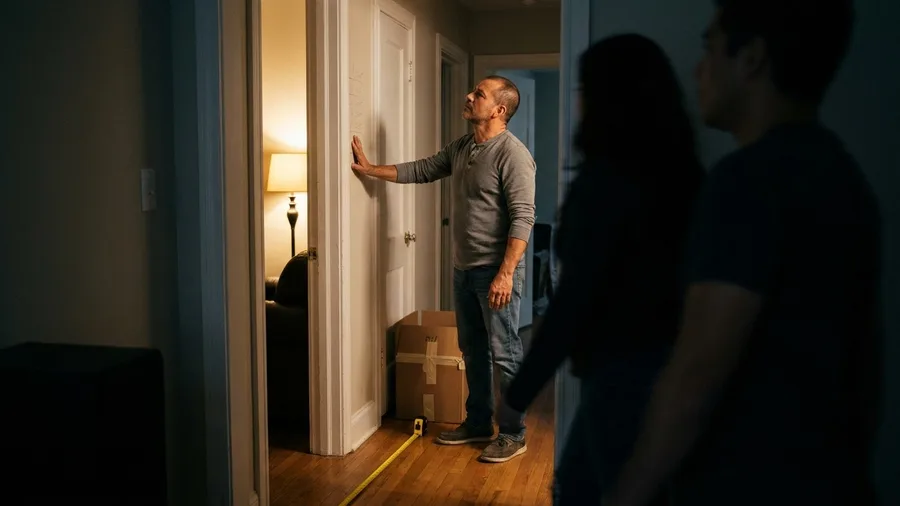
Memory attaches to places, not to categories, which is why a ruthless sorting plan runs aground in the doorway with the pencil marks on the frame.
The kitchen table where homework got done is not a piece of furniture filed under dining. It is the marker for a room and a stretch of years, and clearing it is not decluttering but erasing the scene. This is why well-meant advice to be brutal fails at a place marker: there is nothing neutral to be brutal about.
The cost is visible in the schedule. Rooms get half-sorted, boxes get re-opened, and the ten-week window stretches as the same hallway gets walked through a third time. Researchers who study how memory works keep finding the same thing, that place and event are bound together in recall, so the room is doing its job when it pulls you back.
The workaround is a completion rule. Photograph the room, keep one small marker, then clear it. The grief is witnessed as what it is, place-bound memory. The blocker is a rule that lets the room close.
Three mistakes that stretch the 10 weeks
3. You grieve an imagined future, not just the past

Because part of what sits in that house has not happened yet, and selling cancels scenes that were only ever imagined there.
The house holds a scripted future. Grandchildren at the table. Aging in place, with the stairs still manageable and the garden still yours. The holiday meal for eight, in the same room it has always been served. None of those scenes has a date, which is exactly why they feel so solid, and why a floor plan can leave you numb when it was only ever supposed to be a drawing.
That flatness, or the snap at the mover quote, is anticipatory grief doing its work. The mind is not pricing a move. It is mourning a future it had already furnished. The same pull that keeps you paying for a house you already regret is the sunk cost fallacy in action.
The reframe is straightforward once you see it: the tradition is the meal and the people, not the room. Book the clubhouse for the eight, plan a corner of the 1,150-square-foot condo with a place for grandchildren to sleep, and design the new ritual before the old house sells. You are not giving up the future. You are writing it in a new location, and the grief eases when the script exists.
💡 PRO TIP
Separate the grief from the logistics
For each stall, ask one question: is this a feeling that needs naming and pacing, or a practical blocker that needs a rule? Grief gets a date on the calendar. A blocker gets a checklist.
The weight of belongings
Objects carry obligations. The inherited dresser, the grandchildren’s art, the gifted china—they arrive with people attached, and discarding them feels like betraying the giver.
This theme covers the costs that live in the objects themselves and in the people who gave them. The practical sorting plan fails here because it treats a responsibility as clutter.
4. Belongings feel like responsibilities, not clutter

The well-meaning version of this advice is to be ruthless, and it fails the moment you pick up the cut-glass bowl. A gifted thing is not a thing. It is a person who chose it, wrapped it, and handed it over, and setting it in a donation box feels like handing that person back.
The inherited dresser, the grandchildren’s drawings taped inside a cabinet door, the china from a wedding forty years gone – each arrives with an obligation attached, to a person and to the family line. Skip the decision and the cost is steady: a 10-by-10 storage unit runs about $180 a month while the grief and the choice both sit there, deferred rather than resolved.
Handing the whole job to a local estate-sale company, which takes 30% commission, is often practical and sometimes the right call. It can also be the exact moment the limit arrives, when a stranger turns the china over, writes a price on a sticker, and sets it on a folding table.
💡 Tip: Ask recipients first, photograph what is released, and route the 40% of furniture that fits the condo against what is sold, given away, or stored.
5. Your children’s no thanks lands as rejection

The standard advice is to pass the good pieces down, as if the offer were the easy part. Then the dining set meets a one-bedroom apartment and a taste for something modern, and a sentence like we just can’t fit it lands on the parent’s side of the table as your life doesn’t matter.
The constraint is real. Adult children live in smaller rooms, choose differently, and genuinely do not need another hutch. Two meanings sit inside the same polite refusal, and each side quietly protects the other from the cost of saying so: the set goes into storage instead of into a life.
What tends to work is a negotiated transfer, not a verdict. One small item per child, agreed out loud, and a photograph of everything else before it leaves.
What to pass on first
From smallest and most personal to largest and most practical
6. The endless decisions exhaust you before packing

The exhaustion that arrives before anything is packed is not weakness. It is the cost of volume, and it deserves to be named before the encouragement starts.
Count what sits in the main rooms of a 2,400-square-foot house: roughly 3,000 visible items across ten weeks, each one asking keep, sell, give, or store. With about 40% of the furniture expected to fit the condo, most of the big pieces need a route. The $4,800 mover quote buys muscle for the lifting. It does not touch the 3,000 small verdicts.
So the advice to just do a little each day collapses, because a little each day still asks the same tired brain to decide every object in turn. Decision fatigue shows up as an argument over a bookshelf, tears in the garage, a bedroom left half-sorted with boxes open for a week.
The fix is a rule for the category, set once. One box for keeps. One for photographs. One for donation, out the door by a date you write on the calendar. Furniture runs on the 40% line: what fits, what is sold, what is given away, what is stored.
A category rule turns the grief of choosing into a route already decided, and the tiredness eases because the question stops being asked. Put the rule on paper before the first box, so the afternoon you open the closet you are following instructions, not weighing a life.
💡 Tip: Set a timer for 30 minutes and sort by category, not by room. One category per session keeps the decision count down.
📆 The 10-week downsizing timeline
Week 1: Name the eight costs
Write down which of the eight reasons is loudest for you, and which is a practical blocker.
Week 2: Book the neutral helper
Schedule one 30-minute sorting session with someone who is not emotionally invested.
Week 3: Photograph the rooms
Take one photo of each room and each object that carries a memory before you clear it.
Week 4: Set the category rules
Decide the route for each category: keep, sell, give, or store, with a date for each.
Week 5-6: Move the roles first
Book the clubhouse room for eight and test the kitchen routines in the condo.
Week 7-8: Hold the handoff conversation
Agree to one small item per child and photograph the rest.
Week 9-10: Finish the rooms
Clear each room once, with the photo as the witness and the marker as the keep.
Social ties and independence
The last two costs are the ones people underestimate most. The house is a social web and a proof of independence, and leaving it can feel like losing both at once.
This theme covers the losses that show up after the boxes are gone: the neighbors you no longer wave to, and the fear of needing help that kept you postponing in the first place.
7. Leaving means losing neighbors and daily rituals

“I don’t know why I’m this upset. It’s the neighbors I keep thinking about, not the rooms.”
What surprises people mid-sort is that a home runs on small daily contact: the wave from the driveway, the mail carrier who knows the dog’s name, the same cashier at the same coffee shop. A 12-mile move to the 1,150-square-foot condo barely changes the map, but it breaks the routines that produced that contact, and the nodding acquaintance you never counted as a friendship turns out to be what made the day feel seen.
The practical side is a calendar, not a feeling. Join something at the new place and put one weekly coffee in writing before the move, so you arrive with a time and a name already set. Left alone, the grief shows up as a living room full of boxes and no one to wave to.
Staying vs. moving: what each protects
Staying in the house
- Keeps the familiar roles and routines visible.
- Preserves the social web of neighbors and daily nods.
- Requires maintenance: stairs, yard work, gutters, night driving.
- Can narrow life quietly as the body negotiates the tasks.
Moving to the condo
- Ends stairs and gutters; keeps independence longer.
- Forces new rituals and new ties to be built.
- Requires a plan for the roles, the objects, and the neighbors.
- Keeps a 12-mile link to the old neighborhood if you schedule it.
8. Fear of needing help makes you postpone

It is a Tuesday and the gutters need clearing again. You know the number of the man who does it and you do not call, and you tell yourself it is the cost, or the scheduling, or that you will get to it Saturday.
Ask one question and answer it in ten seconds: when the stairs, the yard, and the night driving get harder, do you want to be choosing where you live, or having that chosen for you? If the honest answer is choosing, the house on paper is already trading independence for maintenance it quietly demands.
Staying can feel like proof you still run the place, even as the yard and the one-car garage narrow what you will actually do. A rushed move later, after a fall or a sold-as-is listing, carries less choice and more grief. The 1,150-square-foot condo with no stairs and no gutters, 12 miles from the old streets, is not a retreat from independence. It is what keeps it longer.
💡 Tip: Write down the three maintenance tasks you now dread. If any of them is on the condo's HOA list, you have just named a reason to move.
The emotional costs at a glance
🎭 Identity roles
Host, anchor, gardener
📍 Place memory
Height marks, kitchen table
🔮 Imagined future
Grandchildren, aging in place
📦 Object obligations
Inherited dresser, gifted china
👋 Social ties
Neighbors, mail carrier, coffee shop
🪜 Independence
Stairs, gutters, night driving
What this means
Each cost needs a name and a rule before the 10-week clock starts, or the practical plan will stall on the emotional one.
Frequently Asked Questions
How long does downsizing actually take?
The sort-out window in a typical move is around 10 weeks, but the emotional work can run longer if you treat every object as a decision. The practical pace depends on how early you set category rules and name the losses.
Is it normal to cry over a house I am choosing to leave?
Yes. The house holds roles, memories, and a scripted future, and leaving it is a real loss even when the move is sensible. Naming it as grief, not weakness, makes it easier to pace.
What if my children do not want any of my things?
Their no is usually about space and style, not about you. Agree to one small item per child, photograph the rest, and let the photos carry the continuity.
Should I put things in storage to decide later?
Storage at $180 a month for a 10-by-10 unit costs $2,160 a year and defers the decision without resolving it. Use storage only for a short, dated overlap, not as a permanent pause.
How do I stop feeling like I am giving up my independence?
Reframe the condo as the thing that keeps independence longer: no stairs, no gutters, and a 12-mile link to the old neighborhood. The risk trade is real, and naming it out loud helps.
Name the loudest cost, then book the first session
Name the loudest cost, then book the first session. The move is a grief process to be paced, not a decluttering contest, and the eight reasons are normal costs until one of them goes unnamed and turns into the practical blocker.
So before you call anyone, say which of the eight is loudest for you: identity, place memory, imagined future, obligation, the children’s no, decision load, social ties, or independence. Then book one 30-minute sorting session with a neutral helper, someone who is not a recipient and not a co-owner. One session tests the loudest reason against a real decision.
The for-sale sign and the $4,800 mover quote come after the grief has a name. The 10-week clock starts with that one 30-minute session, not a dumpster.
Which of the eight is loudest for you?
Write it down, then book one 30-minute session with a neutral helper this week. The 10-week clock starts when you do.