
Why won’t he just ask for help? That question – typed into a search bar, said out loud to a friend, or just sitting quietly in the back of the mind – is exactly what this article is here to settle.
A man in his late 60s sits with a bad knee for six weeks. His partner notices. His adult daughter asks twice. His doctor has not been called. And everyone who loves him arrives at the same word: stubborn.
Stubborn implies a choice being made in the present. What is actually operating here is closer to a reflex – automatic, pre-conscious, and installed decades before this man had any say in the matter. The wall was not chosen. It was built.
Eight distinct forces built it: explicit correction in childhood, conditioned self-worth, shaming language, silent modelling, peer punishment, identity construction, control treated as dignity, and a plain skill gap. They are not all the same problem, and they do not all have the same solution.
What follows maps all eight – moving from what he was told out loud, to what he absorbed by watching, to what the identity he spent decades building now requires him to protect. By the end, the right response – patience, a reframe, or a different kind of offer altogether – becomes a matter of knowing which root is actually in the room.
Quick Tips Before You Start
Read the Layer First
Each of the three themes — what he was told, what he watched, what his identity demands — calls for a different response. Spot the layer before you act.
Name It Without Diagnosing
Saying 'I think this is hard because of how you were raised' lands better than 'you have a problem asking for help.'
Small Asks First
If he has never practised receiving, start with stakes so low the reflex doesn't fire — a recommendation, a direction, a second opinion.
Some Roots Need Time, Not Talk
Identity-based resistance rarely shifts from a single conversation. Repeated low-pressure experience does more than explanation.
Frame Help as Contribution
Help he can receive while still contributing something — even small — is far less threatening than help that replaces him entirely.
What They Were Told Out Loud
Some of the forces that shape help-seeking were delivered as direct instruction — rules stated by parents, coaches, and teachers, repeated often enough to become internal. This first theme covers three of them: what happened when emotions showed, what earned praise, and what words were used to describe a boy who asked.
These are the roots most likely to respond to naming. When a man can hear the original message described back to him plainly — not as a diagnosis, but as a fact about his upbringing — something often shifts. Not always quickly, but it starts there.
1. Crying Was Punished, Not Comforted

The cost of this one shows up early and fast: a man starts to look upset – jaw tightens, eyes go somewhere else – and before anyone can respond, he has already left the conversation. Not physically. Just gone. The window closes in under two seconds, and whatever was almost visible disappears.
For boys growing up in the 1960s and 1970s, the instruction was not subtle or occasional. ‘Don’t cry’ came from fathers, coaches, gym teachers, and uncles, repeated across years – part of why men suppress tears as though it were simply a fact of the world rather than a rule anyone had chosen. That kind of consistent correction does not remain a rule the adult consciously retrieves. It becomes a reflex, firing before the emotion fully surfaces. The shutdown does not look deliberated because it is not being deliberated. It was automated decades ago.
distress and need are not identical, but they are wired together. To ask for help, a person first has to register that something is wrong – that the knee is bad enough, the task is too much, the situation has exceeded what one person can handle alone. That internal signal is distress. If distress itself was trained out of visibility before it could be acknowledged, then the chain breaks right there, before any request ever forms. The block is not at the mouth. It is further back.
Ask yourself this honestly: when you picture him accepting help with something difficult, can you imagine him looking comfortable? Or does something in the picture feel wrong even before he says a word? If the second one is closer, the brake is probably old and deep – not a choice about this moment, but a 50-year-old instruction running on its own schedule.
Men whose fathers openly visited the doctor, or whose coaches let players sit out without shame, did not receive the same correction and do not carry the same reflex. The variable is not being male. It is being corrected, repeatedly, in a specific direction, early enough that the correction became architecture rather than memory.
💡 Tip: When he shuts down, matching his silence for a moment — rather than filling it with reassurance — gives the brake time to release without adding another layer of pressure.
2. Self-Reliance Was the Only Praise Available

He is standing in the driveway at 7 p.m., third attempt at the lawnmower, and someone comes out and asks if he wants help. He waves them off without looking up. Not irritably – almost automatically. And later, when the thing finally starts, there is something in his face that is not just relief. It is closer to vindication.
That moment was rehearsed across an entire childhood, just with different props. The praise in those years went to the solo version: finished the homework before anyone knew it was hard, fixed the bike chain without asking, handled the problem before it had time to become visible. The child paying attention absorbed the rule – needing someone is not neutral, it is evidence that you came up short. That is not an introvert’s preference for working alone. It is a self-worth equation, and the distinction matters because an equation is not about style, it is about identity.
The cruelty in this particular root is what time does to it. The proof of worth was always built on capacity – physical, cognitive, practical. Aging removes capacity on a schedule no one controls. The equation does not become less demanding as the evidence gets harder to produce. For a man who spent four decades collecting ‘you handled that yourself’ as his core measurement, each new limitation tightens the equation rather than loosening it.
Parents who also praised knowing when to ask, or who treated calling a professional as competence rather than defeat, produced men with a different internal ledger. The generation did not cause this. The specific praise loop did. An offer of help lands as a challenge to the only self-concept this man was ever given the materials to build.
What People Get Wrong About This Resistance
3. Asking Was Named Laziness or Weakness Directly
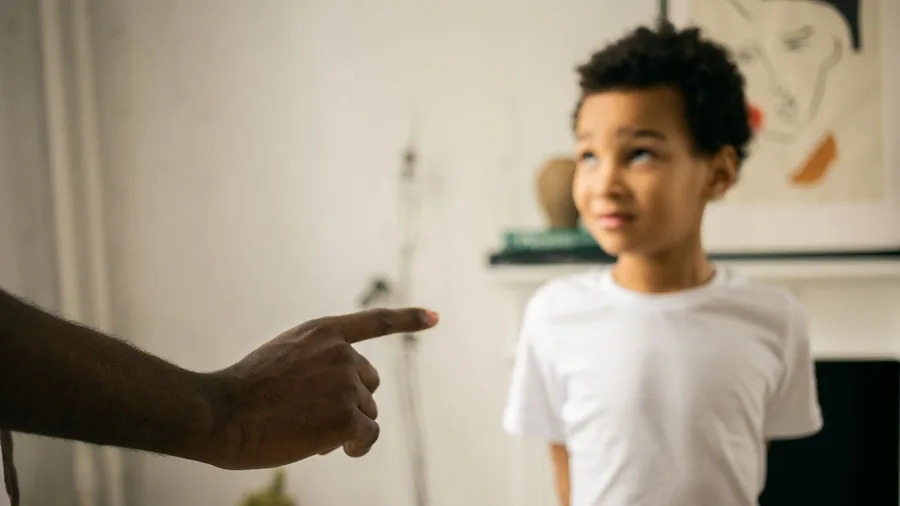
‘Figure it out yourself.’ ‘Stop being helpless.’ ‘Don’t come running to me every five minutes.’ Those lines were not delivered once. They were delivered in a voice, by a specific person, in a room the child could not leave – and that specificity is exactly why they lodge differently than an unspoken expectation ever could.
Where a gradual praise loop shapes a self-concept over years, explicit verbal labels do something sharper: they attach a moral verdict to the act itself. Researchers who study how early criticism shapes adult behaviour find consistently that language delivered by authority figures in childhood tends to replay internally in the original voice – not as a memory the person retrieves, but as an automatic first response. When a man considers asking for help, what arrives before any feeling is a verdict. Lazy. Helpless. Weak. Delivered as if the speaker were still in the room.
That is why the shame on his face appears before anyone has reacted – before a response could tell him how the request will land. The verdict has already come from inside. The man who grew up hearing ‘sure, here’s how’ when he asked something did not build this critic; the critic is not a standard feature, it is the residue of specific words from specific people.
Arguing with the present-tense request – explaining why asking is fine, reassuring him that no one thinks less of him – addresses the surface while the actual obstacle runs underneath it. What is visible on his face is not embarrassment about this situation. It is a decades-old judgment playing on cue, and it finishes before the conversation has properly started.
⚠️ COMMON MISTAKE
Arguing With the Present-Tense Request Misses the Obstacle
When he shows shame about needing help, explaining why help is reasonable or logical does not reach the critic that formed decades ago. The critic is not listening to your argument — it already has a verdict. Naming the old message calmly ('I wonder if someone told you this made you weak') is more likely to create a pause than any amount of present-tense reassurance.
What They Watched Without Being Told
Observational learning requires no instruction. A boy watching a respected man manage everything alone absorbs a template for what competence looks like — no rule is needed, because no rule needs to be stated. The second theme covers the two most powerful silent teachers: the father in the house, and the peer group at school.
These roots are often harder to name than the spoken ones, because the man himself may have no memory of being taught anything. ‘Nobody ever told me not to ask for help’ is a true statement — and also completely consistent with having learned, thoroughly, not to.
4. Their Fathers Never Asked for Help Either
The easiest assumption is that this is simply generational – men of a certain era were all built this way. That framing is too broad to be useful, because it skips the actual mechanism.
The fathers of men in their 60s were shaped by the Depression and the war – periods when managing everything alone was not a philosophy but a practical requirement, and silence under pressure was the visible proof of being capable. A boy watching that man handle a bad diagnosis, a broken furnace, or a financial scare without once asking another person for help did not receive a lesson. He received a template. No punishment required, no praise loop, no shaming words – only the daily demonstration of what a competent man simply does.
That is why asking ‘what did anyone ever tell you about asking for help?’ often produces nothing. Nothing needed to be said. The instruction was entirely visual, which makes it almost impossible to locate or argue with. Men whose fathers called the doctor without ceremony, borrowed a neighbour’s ladder, or sat with a pastor when something was hard absorbed a different picture – one in which asking was unremarkable. The template, not the generation, is the operative variable.
💡 Tip: If he draws a blank when asked about rules around help-seeking, try asking about his father's behaviour instead — the model is often more accessible than the lesson.
The Silent Template — At a Glance
👁️ How it was learned
Observation, not instruction
🕰️ When it was installed
Childhood through early teens
💬 What he can point to
Often nothing — no rule was stated
👴 Primary model
Father's behaviour under stress
🔄 What changes it
A different model, seen repeatedly
Key distinction
The template is visual and total — arguing with it in words reaches it less than showing a different model over time.
5. Boys Who Asked Lost Social Standing Fast

The hesitation looks like excessive concern about what people will think.
It is not calculation – it is closer to alarm. Social rejection in childhood is not processed as feedback the way an adult might receive criticism; it is processed as threat. A boy who asked for help in the wrong moment, in front of the wrong people, and paid for it in real social currency did not simply learn a lesson. He formed an association between asking and danger, and that association can surface decades later in situations that share almost nothing with the original moment – a doctor’s office, a neighbour’s doorstep, a passenger seat where he needs directions repeated.
The disproportionate feeling is the clue. When the stakes are genuinely trivial and the reaction still looks like near-fear, the reaction is not about what is happening now. It belongs somewhere else entirely. Men whose peer groups ran on reciprocity – where admitting difficulty was ordinary rather than costly – did not wire the same connection, even growing up in the same era. Applying more pressure when this response is active does not reassure him. It confirms that the threat was real.
What the Identity He Built Now Requires
The first two themes are about things that were done to him — messages delivered, models demonstrated. This third theme is different: it covers what he built out of those materials over forty or fifty years of adult life, and what that construction now demands he protect.
Identity-level resistance is the hardest to shift, because naming the cause does not dissolve the structure. It took decades to build. The right response here is rarely conversation — it is architecture: offers framed to preserve enough of the identity that the man can accept them without losing himself.
6. The Provider Role Leaves No Room for Visible Need

Because the role he played in that family was not just a function – it became the thing he was. Thirty or forty years of being the one who fixed, funded, and absorbed the family’s hard moments does not leave a man who provides; it leaves a provider. Those are different things, and the difference matters when the direction of help reverses.
Aging creates that reversal precisely. The people he spent decades protecting are now offering to protect him, and the script does not read that as love – it reads it as the end of the position that made him legible to himself. Men who built more reciprocal family cultures, or stepped back from the fixer role before declining health made the choice for them, tend to move through this with less resistance. The identity was never entirely fused with being the strong one.
The framing of any offer of help does most of the work here. ‘Let me drive you so you can concentrate on the paperwork when we get there’ leaves him a role. ‘We’ll take care of you’ confirms the loss. One works with the identity; the other lands directly on the thing he fears most.
How You Frame the Offer Changes Everything
Works With the Identity
- Links help to a continued contribution he can make
- Offers choices within the help, preserving some control
- Names the specific task you are taking, not his whole situation
- Treats the help as practical, not emotional rescue
- Asks what he would prefer rather than deciding for him
Triggers the Resistance
- Frames help as something he now needs to receive
- Removes all decision-making from his hands
- Expresses worry about his overall capability
- Repeats the offer immediately after a refusal
- Involves others without asking him first
7. Accepting Help Means Handing Over Control
Decades is the right unit here – not years, and not a single hard lesson, but 30 or 40 years of managing the details of a life entirely on his own terms.
When a man has spent that long as the person who decides, who coordinates, who says yes or no to every significant choice in his household and his work, accepting help stops being a simple transaction. It becomes a handover. Someone else now drives the car, calls the doctor, decides which specialist, chooses the appointment time. Each of those small transfers is also a transfer of authority, and for a man whose sense of dignity has always been inseparable from holding that authority, the transfers feel like subtraction – not of tasks, but of himself.
This is not a mood or a preference. The link between personal control and personal worth was laid down across decades of professional life, domestic responsibility, and the daily experience of being the one others deferred to. By the time those decades have passed, the equation is not something he consults – it is structural, the same way a load-bearing wall is structural. You cannot remove it without consequences for everything around it.
What makes this worse, not better, is that physical decline is already doing the dismantling before any helper arrives. Pain narrows what he can reach. Memory becomes unreliable in ways he notices before anyone else does. Strength goes, slowly at first, then faster. Every offer of help lands on top of losses already accumulating – and so each new offer reads as confirmation of a process he is already losing ground to. The resistance grows precisely when the need is greatest, and this is why.
The exception matters here. Men who spent significant time in genuinely collaborative environments – a business partnership where decisions were shared, a marriage built on real negotiation, a workplace that ran on actual teamwork – often carry evidence that shared authority does not mean absent authority. They have felt the difference. For those men, accepting help registers differently, because experience has already broken the equation between ceding control and losing standing.
The practical consequence of all this is that the architecture of an offer matters more than the offer itself. ‘Do you want me to call the office, or would you rather do it and I’ll wait?’ gives him a position inside the help – he is still deciding, still directing, still the one whose choice shapes what happens next. That small shift in how the offer is framed can lower resistance that no amount of reassurance will touch.
💡 Tip: Never announce help while doing it. Ask first, pause for an answer, and accept a 'not right now' without pushing — the asking itself is the intervention.
8. He Never Learned the Words or the Moves
The standard advice is to explain, reassure, and make the case for why asking is fine. That approach assumes the man knows how to ask and is simply choosing not to. For some men, the actual situation is different: help-seeking is a learned behaviour with its own specific vocabulary and social steps – how to frame a request without it feeling like a confession, how to receive something without immediately deflecting it back, how to sit in the discomfort of someone else doing something for you – and a man who had no practice in any of those moves across sixty-plus years is genuinely unfamiliar with the choreography, not just resistant to it.
This is different in kind from every other root in this article. Shame, identity, control anxiety, silent templates absorbed from a father – those are obstacles built on top of a capability that is present but blocked. A skill gap is the absence of the capability itself. It looks identical from the outside, and that is exactly the problem: explanation and reassurance are the right tools for a man who knows the steps but is afraid to take them. Applied to a man who never learned the steps, they spend months producing nothing – and the window for building the habit quietly closes.
Small, low-stakes moments are the remedy: asking a stranger for a restaurant recommendation, letting someone carry the second bag without offering to take it back, saying ‘I don’t know, what do you think?’ in a conversation where it genuinely costs nothing. Each one is a brief, undramatic practice of the act. Over time, the move becomes less foreign. Not fixed in a conversation – built in repetition.
🪜 Building the Skill From Scratch
Ask for something trivial
Start with a request so low-stakes the reflex barely notices — a recommendation, a direction, a second opinion on something inconsequential.
Accept without deflecting
When help is offered, practise receiving it without immediately offering something back — sit in the discomfort for thirty seconds.
Name what you needed
After accepting help, say plainly what you needed and that it helped — one sentence, no elaboration, no debt language.
Repeat in a slightly higher-stakes context
Once low-stakes asking is familiar, move one level up — a practical question to a doctor, a favour from a neighbour.
Notice what did not happen
The threat the reflex predicted — judgement, loss of standing, loss of control — did not materialise; registering that fact is the learning.
Frequently Asked Questions
Is this resistance something he can change, or is it too deeply set?
It depends which root is driving it. Skill gaps respond well to low-stakes practice. Identity-level resistance — especially the provider role and control — shifts slowly through repeated experience, not through conversation. The brake installed by childhood punishment of emotions is the most automatic and the hardest to interrupt quickly, but even there, named recognition of the original message can create enough distance for reflection.
What is the most useful thing to say to him directly?
Name the old message without diagnosing him. Something like: ‘I wonder if someone told you early on that asking for help was a weakness’ tends to open a pause rather than a defence. Follow it with a genuine question, not a reassurance. Then let him sit with it — the pause is where the shift begins, not in what you say next.
Should a therapist or men’s group be involved, and how do you suggest it?
Roots one, two, and three — the spoken instructions of childhood — are the ones most likely to respond to named conversation, either with a trusted person or a therapist who works with older men. The identity-based roots (six and seven) are often better reached through a men’s group, where watching other men receive help without losing standing provides the counter-model that argument cannot. Suggest it as something peers do, not something he needs.
Is this pattern unique to men, or does it appear across genders?
The specific combination of explicit instruction (‘boys don’t cry’), observational modelling from a stoic father, and a provider identity is more concentrated in men of this generation than in women of the same cohort, largely because girls of the 1960s and 1970s were socialised differently around interdependence. The underlying mechanisms — conditioned shame, identity protection, skill gaps — are human, not male, but the content and intensity of the conditioning differed.
How do you tell if it is resistance or something clinical — depression, for instance?
If the resistance to help is accompanied by withdrawal from activities he previously enjoyed, persistent low mood, sleep changes, or statements about being a burden, those are signs that a professional assessment makes sense before anything else. Resistance to asking for help and clinical depression can look similar from the outside, and the approaches that soften one are not always right for the other. One plain sentence to him — ‘it might be worth talking to your doctor about how you have been feeling’ — is enough.
What if he has already refused help several times? Is it too late to try a different approach?
Previous refusals are not a permanent record — they are information about which framing did not work. Most of the time, a refusal is responding to how the help was offered, not to the help itself. Going back with a different architecture (a choice within the offer, a lower-stakes entry point, a framing that preserves contribution) is not repeating the conversation — it is a genuinely different offer. The timing matters too: immediately after a refusal is the worst moment; a day or two later, without reference to the earlier exchange, tends to land differently.
Which of the Eight Roots Is Actually in the Room
Not all eight roots respond to the same approach. The ones most accessible through naming and conversation are the suppressed distress reflex, the shaming internal voice that still calls asking a character flaw, and the plain skill gap. Putting words to the mechanism can interrupt it. A partner or adult child saying ‘I wonder if asking feels like it says something bad about you’ can open a door that pushing never could.
The self-worth equation, the father’s silent template, the old peer-threat response, and the provider identity respond less to talk and more to repeated small experience. A man does not revise a 40-year identity in a single conversation, but he may quietly revise it across dozens of unremarkable moments in which asking for something minor produced no verdict, no loss of standing, and no shift in who he was. Control as dignity, and the deeper layers of those identity roots, are often where a therapist or men’s group can reach further than a family member – because the family is structurally part of the equation in ways an outside relationship is not.
The man with the bad knee is not a mystery and not a lost cause. He is the precise, predictable product of a specific set of forces. Knowing which of those forces is most active in the room with you right now is not just useful background – it is where any response that actually reaches him has to start.
Start With the Root, Not the Request
Before the next offer of help, scan the three themes in this article and identify which layer you are most likely dealing with. The framing that works for a skill gap is different from the one that works for an identity threat — and getting it right starts with knowing which one is actually in the room.