
The casserole arrives three weeks after the funeral. He answers the door clean-shaven, thanks her warmly, and closes it behind him – on a kitchen where an overdue electric bill sits open on the counter and the fridge holds almost nothing.
He said he was fine at the funeral. He said it at the one-month check-in. He said it again last Sunday at dinner, and everyone around him exhaled a little and moved on.
That is the problem. Reassurance, for a man in grief, is a social reflex – something offered to the room so the room will settle. It is not a status report. The people closest to a widowed man are often the last to know something is seriously wrong, because he is the one telling them otherwise, and he is very good at it.
What follows are eight behavioral shifts – not feelings he reports, but things you can actually watch for. His words will say one thing. His routines, his body, and the small decisions he makes when no one is asking will say another. When those two accounts stop matching, the second one is the one worth trusting.
Quick Tips Before You Start
Watch Behavior, Not Words
What he does across a week tells you more than any single conversation about how he says he is feeling.
Look for Change From His Baseline
A naturally quiet man going quiet means less than a sociable man suddenly going quiet. Compare him to himself.
Count the Signs, Not Just One
One sign alone is rarely enough to act on. Two or three from different categories is when concern becomes warranted.
Offer Logistics, Not Worry
He is more likely to accept help framed as a practical task than as an expression of concern about him.
Four to Six Weeks Is the Threshold
One bad week is not a pattern. A clear and continuing slide over a month or more is different — that is when to act.
1. He Says He’s Fine While His Routines Collapse

‘I’m fine’ – said at the door, said over the phone, said again at Sunday dinner until everyone stops asking.
For many men, that phrase is not a report. It is a way to close a conversation that feels too exposing to finish. The words are doing social work, not describing an interior state, which means they carry far less information than they appear to.
The more honest readout is the kitchen with almost nothing in it. The stack of mail on the counter that includes something overdue. The house in a state his wife simply would not have left it. None of that requires him to say a word.
Those habits – shopping, meals, keeping on top of things – were often co-managed for years, and he may not have registered that they have quietly lapsed. When what he says and what his surroundings show are pointing in opposite directions, the surroundings are the more reliable signal.
2. Relentless Busyness Is Keeping Grief at Bay

Keeping active after a loss is often framed as the healthy response – staying busy, staying useful, not letting yourself sink. It can be. But there is a version of busyness that is not health; it is distance.
When grief surfaces, it needs attention and space to do so. Constant activity occupies exactly the cognitive and emotional bandwidth that grief requires, which is why it works in the short term – from inside, it genuinely feels like coping. He picks up extra projects at work. The weekends fill with repairs, errands, commitments. He is never just sitting.
Watch what happens when the schedule empties.
A man who is genuinely moving through loss can tolerate an unscheduled afternoon. He might not enjoy it, but he can sit with quiet without immediately reaching for something to fill it. A man using activity as avoidance cannot. The stillness becomes urgent – he needs to be somewhere, doing something, right now.
The harder truth is that deferred grief does not quietly resolve. It accumulates, and it tends to surface with more force precisely when the external support has thinned out – months after the loss, when the calls have slowed and people assume he has found his footing. That is a particularly bad moment to be blindsided by it.
The sign to look for is not how much he is doing. It is whether he can stop.
💡 Tip: Ask him to lunch with no agenda and nothing to do afterward. How he responds to unstructured time tells you something his productivity cannot hide.
What 'Doing Well' Can Actually Mean
3. He Is Quietly Pulling Away From Shared Friends

You invite him to dinner – the same table he sat at with her for fifteen years, the same friends who were at their wedding. He says he will try to make it. He does not come. A month later, you realize you have stopped expecting him.
Ask yourself honestly: when did you last see him with people who actually knew her? If the answer is getting hard to remember, that gap is worth paying attention to.
Shared friendships carry weight that newer, more neutral ones do not. A table that used to seat four, an old in-joke that included her, a friend who asks ‘how are you doing’ with the emphasis that means something real – all of it lands differently when he has no capacity left for that kind of contact. It is easier to be around people who did not know her, because they do not accidentally remind him.
The result is that his deepest support – the people with the most history and the most genuine concern – quietly becomes the support he is least willing to reach for. It almost always happens gradually, with plausible explanations on both sides. He has been busy. It is a long drive. He will call next week. Neither side pushes, and suddenly months have gone by. The friends most positioned to help are the ones who have heard from him least.
⚠️ COMMON MISTAKE
Don't Let 'He Needs Space' Become an Excuse
Respecting his privacy is right. Using it as a reason not to check in for three months is different. The friends who matter most to him are the ones most likely to wait politely until it is too late to help.
4. Irritability and Anger Are Doing the Work of Sadness

When a man pulls back from the people who knew them as a couple, the sign that tends to replace visible sadness – the one that reaches whoever does still see him – is a short fuse.
Grief and anger are not opposites. They draw on the same physiological arousal, and for men who absorbed the message early that showing sadness is a weakness, distress reroutes through the channel that carries less social cost. The irritability does not feel like grief to him. It just feels like the world is getting things wrong.
It looks like this: he snaps at a grandchild over something small during a visit he used to look forward to, his voice going sharp in a way that leaves the room quiet. A wrong coffee order, a slow cashier, an offhand comment – any of it can land harder than it should.
The people closest to him catch the most of it. Proximity is activating when someone is carrying unprocessed grief – the people most likely to say something that grazes it are exactly the people trying hardest to help. Which means the sharpness is not random; it maps almost perfectly onto who cares most. He is not aware of this. That matters for how you respond: calling out the anger tends to produce a wall, whereas saying ‘I’m worried about you’ – naming concern for him, not about his behavior – tends to open something instead.
Normal Adjustment vs. A Sign Worth Acting On
Normal Adjustment
- Sad or quiet in the first weeks, then gradually reengaging
- Mentions her sometimes; can also talk about other things
- Skips one or two social events, then shows up again
- Tired but sleeping and eating at a recognizable level
- Accepts help when it is offered as a practical task
A Sign Worth Acting On
- Sustained withdrawal lasting four-plus weeks with no reversal
- Total silence about her, or unable to complete any conversation without her
- Visible physical change — looser clothes, flat affect — over weeks
- Skipping prescribed medication or canceling medical appointments
- Cannot tolerate an unscheduled afternoon without visible distress
5. Sleep and Appetite Have Quietly Deteriorated

Four to six weeks is about the window. Before that, disrupted sleep and a changed appetite are expected. After that, a pattern that keeps going is a different kind of signal.
The visible markers: trousers that have gotten loose, a face that looks puffy or hollow in a way that is new, a tiredness that does not match what he has actually been doing – nodding off in the chair at seven, moving slowly, answering questions with a flatness that was not there before. Or waking at three in the morning and not getting back to sleep, which he may mention once and then not bring up again. He is unlikely to connect any of it to grief. He may put the weight change down to cooking for one now, the fatigue down to something else, without registering that the pattern began when she died. What prolonged sleep loss does, though, is make everything else harder to manage – it narrows emotional range, sharpens anxiety, and takes away the cognitive steadiness that processing grief requires. If someone asks how he is sleeping and he deflects with ‘fine, I just wake up early sometimes,’ that deflection is itself worth noting.
💡 Tip: "You look tired lately — are you sleeping?" lands softer than a direct challenge and opens the door without putting him on the defensive.
6. He Has Stopped Maintaining His Own Health

Yes – and that is exactly the problem.
The visible version of this looks like a pill bottle on the counter that has not been opened in two weeks, a cardiology follow-up he mentioned cancelling back in the spring, a tightness in his chest he brought up once over dinner and deflected when someone asked about it the next time. He is not being reckless in a way he would recognize as reckless. He just is not doing the things he used to do, because someone else used to be the reason he did them.
In a long marriage, the work of managing a man’s health often lived almost entirely with his wife. She was the one who noticed the cough that had gone on too long, who called the office to reschedule rather than just letting a missed appointment disappear, who sat across from him at breakfast and said ‘you need to refill that today’ in a tone that made it happen. That whole system – the noticing, the prompting, the mild but persistent pressure – ended when she died. He did not inherit it. It simply stopped.
The stakes are not abstract here. Widowed men in the first year carry measurably higher cardiovascular risk, and a condition that was stable while monitored – blood pressure, blood sugar, a heart issue – can shift significantly over a few months without anyone checking. Grief already stresses the body; an unmanaged chronic condition running quietly in the background makes that harder.
There is something concrete a person watching him can do, and it works better when it sounds like logistics rather than alarm. Offer to drive him to the appointment. Ask, on the next visit, if you can take a look at his prescriptions just to make sure nothing has run out. Bring a pill organizer and help him fill it for the week. He is more likely to accept that kind of help than a conversation that sounds like worry – the task gives him somewhere to put his cooperation that does not feel like admitting he is not managing.
Health Warning Signs — What to Check
💊 Medication
Prescription lapsed or unfilled
📋 Appointments
Check-up cancelled, not rescheduled
⚖️ Weight Change
Visibly looser clothes over weeks
😴 Sleep
Waking 3–4 a.m., flat affect by day
❤️ Risk Window
Elevated cardiac risk in year one
Act After
Four to six weeks of a continuing pattern — not a single bad week — is when a doctor's visit moves from optional to necessary.
7. He Never Mentions Her, or He Can’t Stop
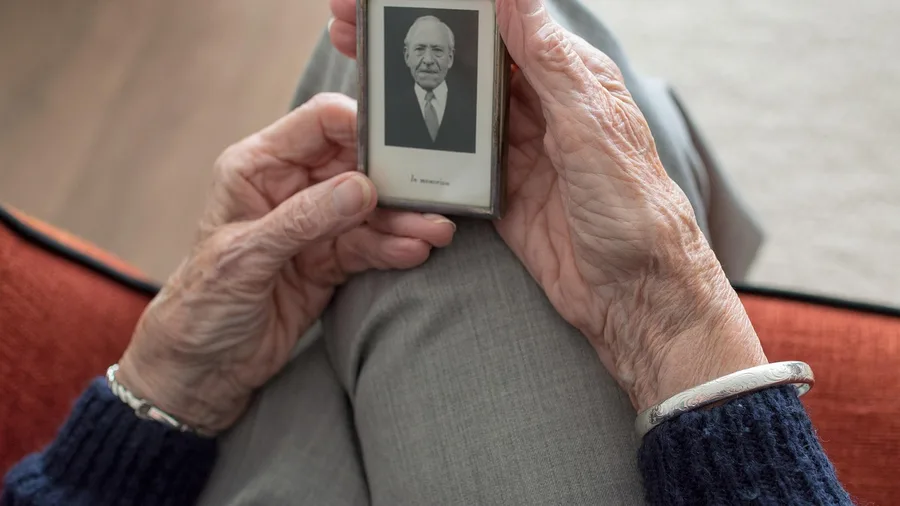
Both patterns carry a cost, and the instinct to treat silence as respect and constant mention as healthy expression is almost exactly backwards in practice.
The silent version: a conversation drifts toward a memory, and he smoothly redirects it, never says her name, has quietly moved the framed photos somewhere less central. It can look like composure. What it may actually be is a man who has decided that if he keeps her out of language, he can keep the loss at arm’s length – because once it is spoken, it becomes more real. The people around him often cooperate without meaning to, reading his deflections as a wish not to discuss her, and so the avoidance becomes a shared project.
The constant-reference version is its own signal. Every story arrives back at her preferences. He mentions what she would have ordered, what she would have thought of the film, whether she would have approved. He is not moving through grief – he is circling the same moment, again and again.
Neither pattern is automatically a crisis. The meaningful question is whether it represents a change. A man who was always reserved is different from a man who used to tell stories about her freely and has gone quiet. The rigidity is the sign, not the style.
One Year of Quietly Not Managing — What Accumulates
8. Her Belongings Are Cleared Out Immediately or Frozen in Place

The instinct is to read speed as denial. A wardrobe boxed and collected before the thank-you notes are written looks like he is running from it; a coat still hanging by the door six months later looks like he cannot let go. The easy assumption is that one is worse than the other.
Both readings miss the actual question, which is not how fast but why. A man who spent a sleepless night sorting her clothes because having them there was physically unbearable and he could not get through a morning otherwise is doing something categorically different from a man who cleared the room because he needed to make it his again and felt ready to do that. The same wardrobe, the same week, two entirely different things happening inside it.
What tends to look like adjustment is a process that has room to be uneven – he donates the coats but keeps a cardigan on the chair, he clears the nightstand but leaves one photograph, and he changes his mind twice about the reading glasses before finally putting them somewhere he chose. That kind of ambivalence is the thing to look for, because it means he is making decisions rather than being driven by them.
This sign is the one most likely to be misread in isolation. Taken alone, it tells you almost nothing about how he is doing. Its meaning only sharpens when it sits alongside the other things you have noticed – the missed meals, the cancelled plans, the name he no longer says out loud.
🕐 When to Move From Watching to Acting
Weeks 1–3: Give space
Early grief is chaotic — hold back, show up practically, and observe without pressure.
Week 4: Note the pattern
If the same sign has been present for four consecutive weeks without any reversal, it is now a pattern, not a bad week.
Two or more signs overlap
When behavioral withdrawal, physical change, and health neglect appear together, the concern is no longer speculative.
Have one direct conversation
Name what you have noticed specifically — not 'you seem down' but 'I noticed you haven't eaten much the last few times I visited.'
Three or more signs, or any health risk
This is the point to contact his doctor directly, or to ask a grief counselor what a first step looks like for someone in his situation.
Frequently Asked Questions
How long is it normal to grieve before these signs become a concern?
There is no fixed timeline, and grief researchers are careful not to set one. What matters more than duration is trajectory — is he slightly more engaged this month than last, or is the slide continuing? A clear and continuing pattern over four to six weeks with no sign of reversal is the practical threshold, regardless of how long it has been since she died.
He insists he does not need help. What can you actually do?
Offer something concrete and logistical rather than emotional support in the abstract. ‘I’m going to the pharmacy on Thursday — write down what you need and I’ll grab it’ is harder to decline than ‘let me know if you need anything.’ Practical help sidesteps the resistance that open-ended concern tends to trigger.
Is it appropriate to contact his doctor without his knowledge?
Doctors generally cannot share information without consent, but there is no barrier to you calling and sharing what you have observed. A GP who knows a patient is showing multiple signs of deterioration — missed appointments, medication lapses, visible weight loss — can follow up on their end in ways that feel less intrusive to him than being confronted by family.
He cried a lot in the first month and now seems calm. Is that a good sign or a bad one?
Visible grief in the early weeks followed by gradual steadying is, for most men, a healthy trajectory. The version worth watching is a sudden flatness — not calm but flat, a drop in affect and engagement — which can signal that he has moved from processing grief to suppressing it. Calm that comes with renewed appetite, better sleep, and some reengagement with people is different from calm that comes with nothing.
Which of these eight signs is the most serious on its own?
Skipping medication or medical appointments for a managed health condition is the one that carries the most immediate physical risk and the one that warrants the most direct action. Grief is painful; an unmonitored cardiac condition or unmanaged diabetes is dangerous independently of the grief. That sign does not need to be part of a cluster before it deserves a direct response.
When Watching Has Done All It Can Do
One sign on its own, appearing briefly, sits inside the range of normal adjustment. Three or more signs present at the same time – or any single sign that is severe and has not improved over four to six weeks – moves outside that range. That is when watching becomes waiting, and waiting is no longer the kind thing.
What you do next depends on what you can actually see. If the physical signs are the most visible – disrupted sleep, missed meals, medication he has stopped taking – the call goes to his doctor, and offering to make the appointment or go with him will get further than asking him to go alone. If the signs are primarily behavioral, the first step is a direct private conversation that names something specific: not ‘I’ve been worried about you,’ but ‘I’ve noticed you haven’t been eating much and you cancelled on the Hendersons twice – I want to ask you straight, how are you actually doing.’ If that conversation surfaces more than either of you can handle in an afternoon, a grief counselor with experience in male bereavement is the referral to make.
The man who answered the door three weeks after the funeral and said he was fine meant it as a kindness. The signs in this list are not failures on his part – they are what grief looks like when it has nowhere obvious to go. Naming what you have noticed is not a judgment. It is the other kind of kindness, the one that does not take the reassurance at face value, because the overdue bill on the counter is the more honest answer.
Use the Timeline as Your Guide
The five-step timeline in this article gives you the exact sequence — from observing a pattern to making a direct move. Scroll back up and match what you are seeing to the step that fits.