Most people assume the problem would be fitness – that a few weeks in the gym, or reasonable stamina, would close the gap between them and an ancient farmer. That assumption is wrong, and the reasons it is wrong are more interesting than the fitness question ever was.
The first instinct, reading a headline like this one, is probably to push back. You exercise. You handle pressure. You have worked long days and gotten through them. How different could cutting grain really be?
Significantly different – but not for the reason the challenge implies. The difficulty is not a matter of toughness or willpower. It is a matter of specific conditioning that the modern world has spent decades systematically replacing with its opposite. The mind and body that would show up to that grain field have been shaped, year by year, by a world that trained them to be exactly wrong for what the day requires.
The gap between ancient and modern human experience is not a gap in human capability. It is a gap in what each world demanded, and therefore trained. That gap is measurable, specific, and psychologically significant – and by the end of this, you will have the terms to assess your own conditioning honestly, not to feel diminished by the comparison, but to understand stress, resilience, and human limits with a clarity the romanticised or dismissive versions of this story never allow.
Your Sleep Cycle Would Break You First

The schedule alone would defeat most people before a single crop is cut.
Solar time means exactly what it says: the day begins when the sky lightens, somewhere around 4 or 5 AM, which means the previous night ended around 8 or 9 PM. That is not a quirk of ancient preference – it is arithmetic. There is no version of a 14-to-16-hour physical workday that begins before dawn and leaves room for a midnight bedtime.
Most modern adults have not consistently slept by 9 PM since early childhood. Artificial light and screens push the body’s natural sleep onset well past 11 PM, sometimes closer to midnight. The result on day one of a harvest is two to three hours less sleep than the day actually requires – not a minor shortfall, but a physiological hole that widens with each passing day.
six or seven hours of sleep is adequate for sitting at a desk. It is not adequate for swinging a hand sickle at waist height across an entire working day. Under that load, the same sleep duration that feels fine by Friday afternoon becomes functionally inadequate by Tuesday morning.
Cumulative sleep debt degrades exactly the faculties most necessary for the work – fine motor control, judgement, reaction speed. A sliced hand or a badly bundled sheaf is the cost of a lapse that exhaustion makes more likely every day. Someone already conditioned to early outdoor work adapts to this schedule with far less friction. The average desk worker arrives with none of that conditioning, and the full weight of the mismatch lands from the first morning.
⚠️ COMMON MISTAKE
The Fitness Shortcut That Does Not Exist
No amount of pre-harvest training closes a two-to-three-hour daily sleep deficit that compounds across weeks. Physical conditioning and sleep conditioning are separate problems, and only one of them can be solved in a gym.
Your Pain Tolerance Is Calibrated for Comfort

The body’s fatigue sets the stage; the nature of the work itself delivers the next blow.
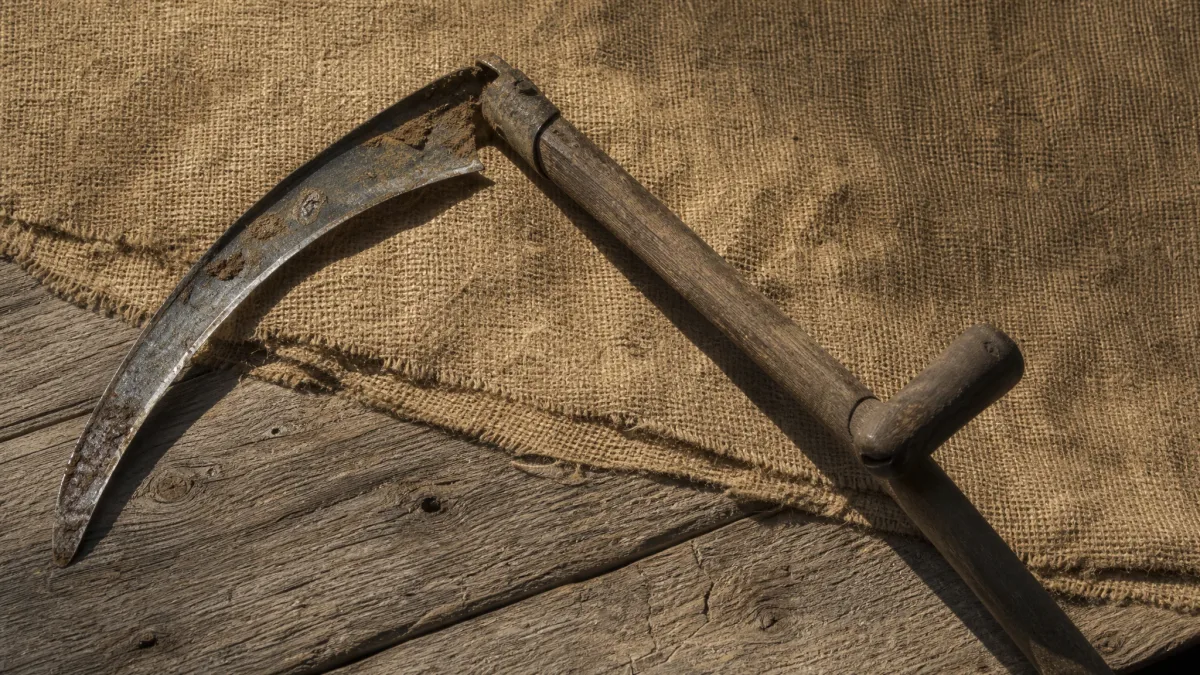
Cutting grain with a hand sickle is not varied labour. It is the same bent-forward posture, the same loaded shoulder, the same grip repeated thousands of times across a single day – the exact movement pattern that modern occupational health frameworks classify as a repetitive strain injury risk and require employers to mitigate with rest breaks and tool rotation. Ancient farming had none of those interventions.
An ancient farmer doing this work as an adult had been doing versions of it since childhood. The tolerance was not decided on or summoned – it was deposited, incrementally, over years of graduated exposure. By adulthood the body and nervous system had learned to register that particular ache as background noise rather than alarm signal.
The research on pain tolerance distinguishes between this kind of accumulated threshold – built through repeated, low-level loading – and the heightened sensitivity that develops in its absence. Sedentary bodies are not weaker by nature; they are calibrated by their conditions, and those conditions have involved very little sustained physical loading.
For a body meeting this workload for the first time, the pain signal is accurate. The nervous system is not catastrophising – it is correctly reading tissue stress that the body has no prior framework to absorb. That is the important distinction: pushing through is not a matter of deciding to be tougher. It would require a specific physical history that no amount of resolve on a single day can replicate.
How Hard Each Barrier Hits — From Annoying to Disabling
- Sleep deficit (first day): Manageable on day one; accumulates into serious impairment by week two
- Pain from sickle work: Acute by mid-morning for an unconditioned body; no training shortcut exists
- Caloric deficit by noon: A 2,000–4,000 calorie daily gap degrades decision-making and motivation rapidly
- Sustained low-arousal attention: Interrupt-trained modern attention fails within hours of single-motion repetition
- Uncontrollable harvest-stakes anxiety: No safety net, no recourse — chronic distress with no exit, from day one
Scale reflects impact on an unconditioned modern adult; ancient farmers had a lifetime of habituation reducing each cost.
You Would Run a Caloric Deficit by Noon

Even setting aside what the body feels, the arithmetic of energy makes the day unsustainable in a way that willpower simply cannot override.
A harvest-season field worker burns somewhere between 4,000 and 6,000 calories in a day. A subsistence farming household could provide, at best, 2,000 to 3,000 calories – and less in lean years. That is not a gap closed by eating more at lunch. The food was not there. The household grew what it could, stored what survived, and rationed through the harvest window without the option of simply ordering more.
The body begins drawing on its own reserves quickly – within the first few days of that deficit, not after weeks.
What sustained caloric shortfall actually feels like from the inside is not just hunger. It produces a specific kind of psychological deterioration: shortened temper, decisions that feel harder than they should, a motivation that drains steadily and does not refill overnight. Each of those effects makes the physical labour harder to sustain, which compounds the energy cost, which deepens the deficit.
Ancient farmers’ bodies had been conditioned across entire lifetimes – and arguably across generations – to function inside this state without collapse. A modern adult eating a typical Western diet arrives with a metabolism that expects reliable surplus. That expectation is not greed or softness; it is what the body was trained on.
Endurance athletes do train under caloric restriction and manage it – but with carefully selected modern foods, supplementation, and built-in recovery periods. A harvest field in a subsistence household offered none of those buffers.
Ancient Harvest Day — At a Glance
🌅 Start time
4–5 AM
⏱️ Active labor
14–16 hours
🔥 Calories burned
4,000–6,000 /day
🍞 Calories available
2,000–3,000 /day
🌾 Harvest window
2–4 weeks, no rest days
⚙️ Primary tool
Hand sickle — 1 acre per person per day
Daily deficit
Up to 4,000 calories short every single day of the harvest window — drawn from the body's own reserves.
Ten Hours of Repetition Demands a Different Attention

The physical cost of caloric deficit is real, but it sits alongside a demand the body cannot carry alone: the work itself requires a quality of attention that modern life has spent years dismantling.
Cutting grain with a hand sickle is not intellectually demanding. The motion is learned in an hour. What it asks instead is something harder to name – a low, steady, unbroken focus held across ten-plus hours with no variation, no input, and no interruption. Not alertness. Not concentration in the sharp sense. A kind of patient, continuous presence that has nowhere else to be.
That is structurally the opposite of what most modern people have trained their attention to do.
The average working day now runs on interruption. A notification arrives, a tab opens, a message pulls the eye sideways. Researchers who study attention find the average interval between task-switches in modern knowledge work is measured in seconds, not minutes. The attentional habit that builds from years of this is not focus – it is readiness to divert. It is a reflex, and it is deeply grooved.
Put that reflex in a grain field and the cost is not a missed email. A moment of inattention with a sickle at waist height produces a cut hand. A wandering row wastes sheaves a subsistence household cannot afford to lose. Every lapse has a price the body or the harvest pays.
Long-distance runners, meditators, and people who work a single craft for hours at a stretch describe something close to this attentional state – a settled, low-arousal endurance of sameness. They are a minority, and none of them arrived there quickly. The capacity is not gone from human beings. It has simply been replaced, in most modern people, by something so different that one day of necessity offers no path back to it.
Survival Stakes Produce Inescapable Anxiety

Ancient harvest work carries a psychological weight no amount of attentional discipline can neutralise: the outcome was never fully in your hands, and the penalty for failure was death.
The idea that working purely for survival would feel clarifying – a single clear purpose, no abstraction, no ambiguity – assumes the person has real agency over whether they succeed. Ancient farmers did not. Weather, blight, and insects determined the harvest as much as labour did, and no amount of effort converted those variables into something controllable. Researchers who study stress draw a hard line between stressors a person can influence and stressors they cannot; that line is where manageable pressure becomes chronic distress.
No backup existed. No insurance, no communal grain store beyond what the household held, no state mechanism to absorb a failed year. A two-to-four-week harvest window with no rest days was not an intense season – it was a single, unrepeatable performance on which every life in the household depended. Missing it, or losing it to rain in the final week, was not a setback.
Purpose without control is not the same as meaning.
Some psychological frameworks argue that a singular, clear purpose reduces existential anxiety. The evidence for that holds most consistently when the person also commands the means to pursue it. The ancient farmer had the purpose and lacked the control – which is closer to the clinical description of helplessness than to the clarity those frameworks promise.
A modern person dropped into that harvest field carries no lifetime of habituation to this condition. The anxiety would not be background noise. It would arrive on the first morning and compound with every cloud on the horizon, adding a psychological burden on top of every physical one already in place.
💡 PRO TIP
Purpose Is Not the Same as Control
Having a clear goal reduces anxiety when you also control the means to reach it. Ancient farmers had the goal; weather and landlords often held the means. That combination is not simplicity — it is chronic helplessness with a good reason attached.
Your Identity Was Collective, Not Individual

A strong individual identity might seem like exactly the thing to carry a person through that level of anxiety – but ancient farming did not offer individual identity as a resource. It offered something structurally different, and a modern person would experience the difference as a loss.
Modern Western selfhood is organised around a particular loop: effort produces visible personal progress, progress produces recognition, recognition confirms individual worth. That loop runs in the background of almost every working day – the project completed, the promotion earned, the skill developed. Ancient farm work had none of its components. Labour fed the household. A good harvest belonged to the collective. Failure shamed it. There was no mechanism available to point at the grain and say: that is evidence of who I am as an individual.
For a person whose psychology runs on that feedback, its absence is not a minor adjustment.
People raised in collectivist cultures – where effort is offered to the group and worth is measured in contribution rather than individual achievement – describe this structure as natural and, at times, genuinely sustaining. That is not a small data point. It means the gap between ancient and modern is not a fixed feature of human nature but a product of what each world conditioned its people to need. The modern Westerner finds the collective structure unbearable not because all humans would, but because this particular person was built otherwise.
One day inside that system would not teach a person to draw meaning from collective labour. It would do something narrower and harder: remove the individual feedback loop without replacing it, leaving the modern identity without the mechanism it depends on and no equivalent to step into.
There Was No Space That Belonged Only to You
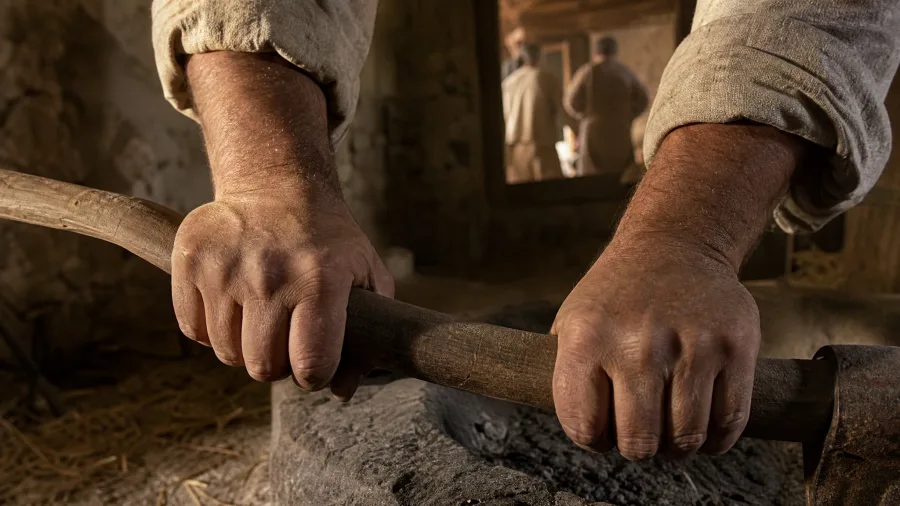
Even setting aside the collapse of individual identity in collective labour, there was nowhere to go at the end of it. The farmstead was not a place you left work to return to – it was the work. Animals slept in adjacent rooms or directly below the living quarters; their noise, smell, and need for overnight attention were constants. When the sickle went down, the pigs still needed feeding, the fire still needed tending, and the smell of the day’s labour did not separate from the smell of the room.
Modern recovery depends heavily on environmental cues. A different room signals rest. A closed door signals privacy. A change of context – leaving the office, sitting in a car, changing clothes – tells the nervous system that vigilance is no longer required. The ancient farmstead offered none of these transitions, because the stimuli that demanded alertness were never absent.
Winter made it worse, not better.
When outdoor labour paused, what replaced it was enforced confinement in near-total darkness with the same small group of people in the same single space for months. The physical exhaustion lifted, but the psychological pressure simply changed shape – monotony and isolation where physical depletion had been.
Ancient communities built strong seasonal rituals precisely to supply what the physical environment could not: harvest feasts, saints’ days, collective ceremonies that functioned as enforced psychological resets, marking a boundary the architecture itself never provided. Researchers who study community psychology have noted the cost of losing equivalent collective rituals in modern secular life.
The modern person conditioned to switch off through private space and chosen entertainment would find none of that mechanism available here. The day would never psychologically end – and that is a specific conditioning failure, not a character one.
What Recovery Actually Required Then vs. Now
Modern Recovery
- Context switch (leaving a building) tells the nervous system vigilance is done
- Private space is a structural guarantee, not a seasonal reward
- Entertainment is chosen, solitary, and available on demand
- Sleep timing is self-set; light and temperature are controllable
- A bad week ends — paid leave exists as a legal floor, not a favour
Ancient Recovery
- No context switch existed: the room that held the animals was the room for sleep
- Collective feasts and saints' days were the only engineered boundary — and they were rare
- Winter rest meant months of confinement with the same small group in the same dark space
- Sleep onset was fixed by sunset; overnight animal care broke it regardless
- During the two-to-four week harvest window, no rest day was structurally possible
Rigid Hierarchy Left No Psychological Escape Route

The social structure governing those waking hours added a constraint that physical exhaustion alone cannot account for. An ancient farming household could not leave its land, renegotiate its obligations, or refuse what a landlord or village authority demanded. That is not a description of difficulty – by modern occupational standards, it is a description of chronic high-severity stress, the kind that today prompts formal workplace intervention.
Researchers who study wellbeing consistently find that perceived control is among the most significant factors in psychological health. Remove it entirely, close every exit, and the pattern that emerges is what the psychology literature calls learned helplessness – a state in which a person stops attempting change not because they are weak but because experience has confirmed that attempts produce nothing.
The ancient farmer managed it because they were never offered an alternative.
A person raised inside total subordination from birth does not experience it as deprivation – it is the expected shape of existence, and their psychology forms around it. The modern adult arrives at any situation carrying a fully developed expectation of autonomy: the ability to quit, appeal, negotiate, leave. That expectation is not a luxury feeling. It is a load-bearing structure.
People raised in highly authoritarian households show measurably greater tolerance for rigid hierarchy, which confirms what the rest of this article keeps returning to – the gap is one of conditioning, not character. One day inside that structure would not feel to the modern mind like simplicity or clarity. It would feel like the removal of something so fundamental that its absence has no name, because it was never expected to disappear.
Death Was Ambient, Not a Rare Event

Control over work and social standing could be stripped away by a landlord’s word. What the ancient world asked next went deeper than that: it asked you to live inside death the way you live inside weather – as a constant, not a crisis.
A child growing up on a subsistence farm in the pre-industrial world watched animals killed for winter meat before they could reliably read. They stood at a sibling’s burial before they turned ten, because roughly a third of children born in those communities did not survive to adulthood. A community where average life ran somewhere between 35 and 45 years – already shortened by that childhood toll – buried its members often enough that grief had a practiced shape to it, not the acute shock that arrives when something rare occurs.
The modern world moved death out of the house and into hospitals, then behind paperwork, then into abstraction. The result is not protection but vulnerability. Terror management theory, developed by researchers studying how humans handle awareness of mortality, makes the uncomfortable case that distancing from death amplifies fear of it rather than reducing it. The repeated exposure the ancient farmer received from birth was a form of psychological preparation – one the modern adult was systematically denied.
It is not a fixed trait. Hospice workers and people raised on working farms consistently describe the same shift: close, regular contact with death changes its weight. The capacity for that habituation is intact. It was simply never asked for, because the modern world built itself around not needing it.
🌾 How a Single Ancient Harvest Day Unfolded
4–5 AM: Rise and prepare
Work began at first light after roughly seven to eight hours in the same space as animals and family, with no private preparation time.
Morning: Peak sickle hours
The coolest hours were for the hardest cutting — bent-back, grip-intensive work that demanded the body's sharpest output first.
Midday: No real rest
A brief pause to eat the day's small ration, often eaten in the field, before returning to cutting and bundling.
Afternoon: Bundling and stacking
Cut grain was gathered, tied into sheaves, and stacked — different muscles, same sustained load, building on an already depleted body.
Evening: Animal and household tasks
Before sleep, animals were fed, water was drawn from the well, and basic household maintenance was completed in failing light.
8–9 PM: Sleep — same space, same sounds
Sleep happened where the day had been lived, surrounded by the same stimuli, with the same day beginning again before dawn.
Progress Was Not a Concept Available to You

If the ancient farmer’s relationship with death shaped how they understood the present, the structure of their work shaped how they understood the future – which is to say, they mostly did not. The same field, the same sickle, the same four-to-five AM start, the same social rank: nothing in that life offered a mechanism by which effort translated into a different life, because the system was not designed to allow one.
Researchers who study human motivation have identified growth and competence as needs nearly as fundamental as belonging and control. The relevant point is not the theory itself but what it implies: those needs do not simply disappear in a system that cannot meet them. They have to be rerouted entirely, redirected toward mastery of what is already there and toward the continuity of something larger than one person. That rerouting was not a private decision the ancient farmer made one evening – it was built in across a full lifetime, reinforced by every structure around them, from harvest ritual to the way children were taught.
That is the reframe a modern person cannot fake in a single day. Someone who spent twenty years in education being told that sustained effort leads somewhere different and better does not arrive at the field as a blank slate. They arrive carrying an expectation so deep it reads as common sense: that the point of hard work is movement. When the work offers only repetition, that expectation does not dissolve – it turns into a question the day cannot answer.
The capacity for this kind of satisfaction is real. Potters, surgeons, and weavers who have spent years inside a single discipline report something recognisable as contentment with repetition and refinement. But they reached it through deliberate years of investment, not through necessity arriving on a Tuesday morning. The ancient farmer was not built differently. They were built earlier.
Frequently Asked Questions
Could someone physically fit actually do a full day of ancient harvest work?
Physical fitness helps with the caloric burn and muscle load, but it does not address the sleep schedule, the attentional demands of sustained single-motion repetition, or the psychological weight of genuine survival stakes. Most of the barriers identified here are about conditioning, not raw fitness — and conditioning is specific to the stimulus that built it.
Why is ancient farm work psychologically harder than modern physical jobs?
Modern physical jobs — construction, landscaping, warehouse work — come with scheduled breaks, legal hour limits, caloric access, and at least some perceived autonomy. Ancient harvest work combined extreme physical load with uncontrollable outcomes, no rest days across weeks, caloric deficit, rigid hierarchy, and zero separation between work space and living space. The psychological compounding of those factors is what makes the comparison striking.
Did ancient farmers actually struggle with this, or did they just adapt?
They adapted — across childhood, across generations, in a body and mind shaped from birth by that world’s specific demands. The point is not that ancient farming was unbearable for ancient farmers; it is that the adaptation they carried was real and costly and took a lifetime to build. A modern adult does not inherit that adaptation by choosing to try for one day.
What does this say about modern stress and resilience?
It says that resilience is not a character trait — it is a product of specific prior exposure to specific demands. Modern people are genuinely resilient to the stressors their world produces: digital overload, ambient uncertainty, complex social signalling. That resilience is real. It is simply not transferable to a completely different set of demands without years of equivalent preparation.
Is the romanticisation of pre-modern life a psychological phenomenon?
Yes — and a well-documented one. The mind tends to strip discomfort from imagined pasts and retain the appealing simplicity. Ancient farm life appeals partly because it represents clarity and embodied purpose, which modern life genuinely lacks in some ways. The appeal is not irrational; the mistake is imagining you could step into that life without the body and psychology built specifically for it.
What modern activity comes closest to the attentional demands of sickle work?
Long-distance running, open-water swimming, and experienced meditation practice are the closest analogs — low cognitive complexity, high duration, rhythm-dependent, with real consequences for attentional drift. All three require deliberate and sustained training to reach the state comfortably. None of them replicate the physical load or the survival stakes, but attentionally they are the nearest modern equivalent.
What This Gap Actually Tells You About Your Own Psychology
The modern person would fail not because modern people are weak, but because they are differently conditioned. A world built on artificial light, individual achievement, the removal of death from daily view, and interrupt-driven task-switching shapes the mind as thoroughly as it shapes the schedule. The ancient world replaced each of those things with its opposite, and the people who survived it were the product of that replacement, the same way you are the product of yours.
The headline was not an insult. The reason it is true is actually the opposite of one. Adaptation cuts both ways. The ancient farmer could not have survived a modern office week – the cognitive fragmentation, the social ambiguity, the abstract stakes with no physical resolution – any more than a modern office worker could survive the harvest. Each is a precise fit for the demands their world made, and a poor fit for the demands it did not.
Which means the useful question is the one you are now equipped to ask. The next time you hit a wall – at work, in a relationship, under some pressure you cannot quite name – before you call it a failure of will, ask whether it might instead be a failure of preparation: a demand your world never trained you for, placed on a mind that was built for something else entirely. The ancient farmer woke before dawn knowing exactly what the day required and exactly what it would cost. That knowledge came from a life that taught it. The question worth sitting with is which of your own demands have ever given you the same chance.
The Sleep Section Is the One to Start With
If one section in this article describes a gap you recognise in yourself right now, the sleep cycle section is the most immediately actionable — and the most compounding if ignored. Read it again with your own schedule in mind.