
Most adult children have had the same thought at least once: there is still time, it would feel strange to bring it up now, the parent seems fine. And so the conversation gets postponed – again, and again, until something happens that makes it impossible to have well.
The window does not close slowly. It closes at a specific moment – a diagnosis, a fall, a phone call from a hospital corridor – and at that point several of these conversations become either legally irrelevant or simply too late to have in the way they deserved.
These five conversations are the ones that matter most, the ones families most consistently avoid, and the ones where knowing exactly why they stall – and how to open them anyway – makes the difference between a family that navigates a crisis with clarity and one that does not.
What follows is the five, ordered by urgency, with the reason each one stops before it starts and the sentence that opens it anyway. Start at the top. The first two are time-sensitive in ways the others are not.
Quick Tips Before You Start
Pick a Calm Setting
Start these conversations at a normal meal or walk, not during a holiday or a health scare when pressure is already high.
One Topic Per Talk
Don't stack all five into one sit-down. Cover one conversation well rather than five conversations badly.
Ask, Don't Inform
Your job in these talks is to ask what the parent wants — not to tell them what you've already decided makes sense.
Record With Permission
A phone recording or a follow-up text summary means nobody misremembers what was agreed. Ask first.
Leave It Open
End each conversation with 'we can come back to this' so it feels like a dialogue, not a closing argument.
1. A Health Crisis Is Too Late to Ask
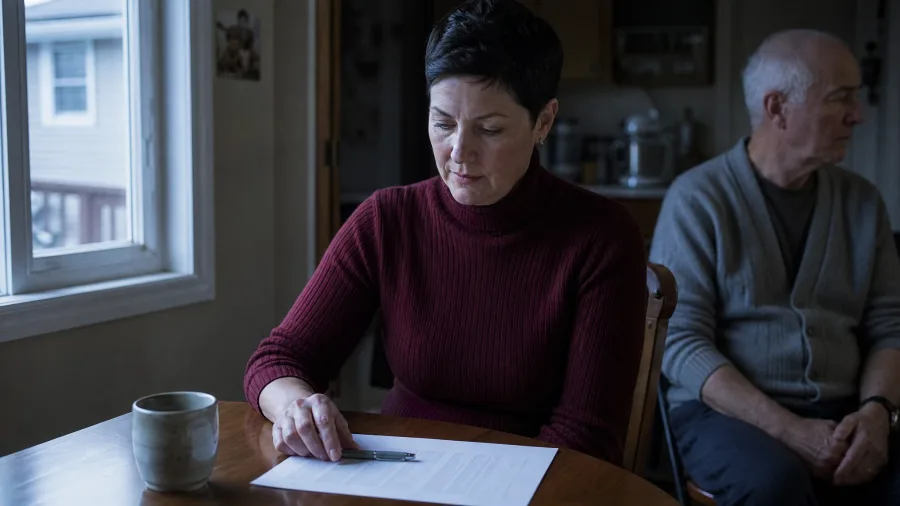
A stroke, a fall, a sudden cardiac event – and within the hour, a doctor is asking the family what the patient would have wanted. If no one knows, the hospital does not wait. Decisions default to staff protocols and state guidelines, not to what the parent would have chosen, and not to what the family believes is right.
Two pieces of paperwork prevent this entirely. An advance directive spells out which interventions the parent wants and which they refuse. A durable power of attorney for healthcare names the specific person authorized to speak for them when they cannot. Neither requires an attorney to initiate – only the parent’s clear choice and a signature.
they treat this conversation as morbid, as if raising it signals an expectation that something is about to happen. The opposite is true. Getting these documents in place is the one act that removes the worst burden a family can face – making irreversible decisions under pressure, with no idea whether they got it right. The line that opens the conversation without triggering that resistance: ‘I’ve been thinking about how much easier things would be for all of us if we just knew what you’d want – can we talk about that?’
💡 Tip: An advance directive and a healthcare power of attorney are two different documents serving two different purposes — ask for both, not just one.
Terms Worth Knowing Before You Talk
2. Not Knowing Where the Will Is Costs Everyone

The common advice is to wait until the right moment, to read the room, to raise the subject gently over time. Estate attorneys and financial planners who work with families in crisis say the same thing: the right moment almost never arrives on its own, and waiting for it means most families enter a crisis with no idea where anything is.
The practical cost is specific. A bank account without a named authorized contact can be frozen while the family is still in the hospital waiting room. A life insurance policy no one knew existed can lapse unclaimed. Digital accounts – stored funds, active subscriptions, online assets – can become permanently inaccessible simply because no one thought to ask. The question is not what is in the documents. It is whether anyone knows where to look.
Parents often hear this conversation as their children calculating what they stand to receive. That resistance is worth naming directly: ‘I don’t need to know what’s in it – I just need to know where it is and who else knows.’ That reframe changes the ask entirely. The location of the will, a financial power of attorney, insurance policies, account records, and any digital asset instructions – five categories, no dollar amounts required.
A fireproof box, a sealed envelope held by a trusted person, a single handwritten page listing where everything lives – any of these is enough. Families who have this information move quickly when a crisis hits. Families who don’t spend weeks, sometimes months, untangling what could have been settled in one afternoon.
⚠️ COMMON MISTAKE
Confusing the Location Question With the Contents Question
Asking 'where would I find your will?' is not the same as asking 'what's in it?' Most parental resistance to this conversation comes from conflating the two. Name that distinction early and the conversation opens far more easily than you expect.
3. Their Housing Preference Shifts as Health Declines
Not what you assume, not what seems reasonable – what they have said out loud to you. If the answer is no, you are in the majority, and the gap is almost certainly wider than you think.
Most parents picture staying in their own home as long as possible. Most adult children picture a point when assisted living becomes the necessary call. Neither side has said this to the other. When a health event forces the question, those preferences get filtered through exhaustion and urgency, and the parent often feels the decision has already been made without them – because in practice, it has.
Researchers who study how people adjust to declining health find, consistently, that a sense of control over major decisions is one of the strongest predictors of how well that adjustment goes. This conversation is protective in a measurable way. Four things need to be settled: who has the authority to decide if the parent cannot, what specific conditions would make a change in living situation necessary, what the parent would need to see to reconsider their preference, and whether they have already been thinking about this privately. The last one tends to surprise people. Often they have.
🏠 How to Open the Housing Conversation Step by Step
Start With Their Current Thinking
Ask 'have you ever thought about what you'd want if living here got harder?' before offering any opinion of your own.
Name Specific Scenarios
Walk through a concrete situation — a mobility issue, a driving change — so preferences are attached to realities, not abstractions.
Ask Who Makes the Call
Establish who the parent wants making housing decisions on their behalf if they cannot make it themselves.
Ask What Would Change Their Mind
Find out what condition or circumstance the parent themselves would accept as a reason to change arrangements.
Record What Was Said
Follow up with a short text or email summary so both sides have the same memory of what was agreed.
4. Family Stories Vanish if Nobody Ever Asks
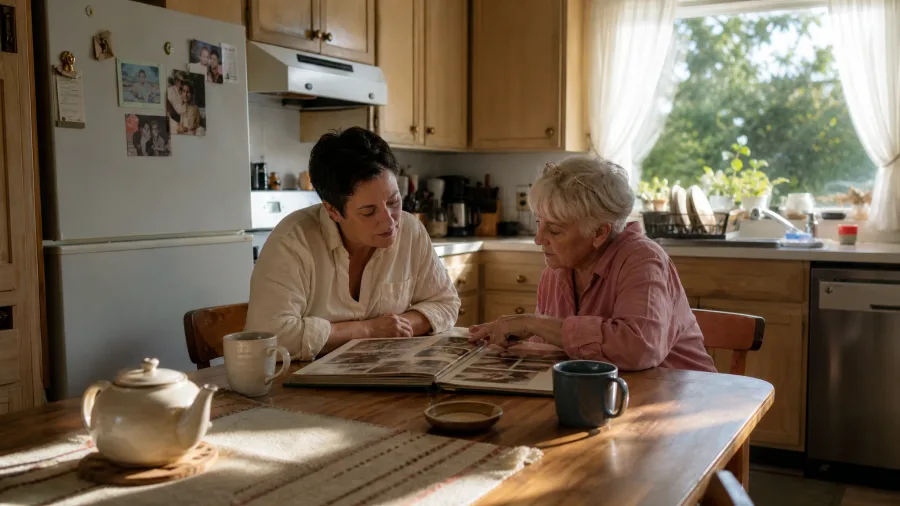
Three questions are enough to start: what your parent is most proud of, what they would do differently, and what they most want remembered.
Those three questions cannot be answered by a document, a photograph, or anything left in a filing cabinet. They live entirely in the person who is still here to answer them. Researchers who study how people construct a sense of self have found, consistently, that knowing your family’s history connects directly to resilience and a more grounded identity – not as a sentimental bonus, but as a mechanism that actually functions across generations.
This conversation asks nothing logistically. No signatures, no passwords, no plans. It signals interest in a life, not interest in an estate, which is exactly why it tends to open doors that the harder conversations keep running into. An afternoon, a recorded phone call, four questions sent by text – the format carries almost no weight. What carries weight is that someone asked.
The regret here runs in one direction only. Nobody looks back and wishes they had let their parent talk less about their life. The window on this one closes quietly, without a legal trigger or a hospital visit – it closes the last time a question could have been asked and wasn’t.
💡 Tip: Record the conversation with your parent's permission — even a voice memo on your phone. Written notes miss the tone, the pause, the laugh.
Which Conversations to Prioritize Right Now
- Family history, stories, and what the parent wants remembered — Lower urgency than the others — but the only one where nothing can be recovered once the window closes.
- Housing preferences if health changes — Not urgent today, but becomes impossible to have calmly once a crisis has already started.
- What support the parent actually wants from you now — Offering the wrong kind of help repeatedly builds resentment on both sides without either noticing.
- Medical wishes and healthcare power of attorney — No substitute exists for these documents — without them, strangers make the call.
- Will location and key financial documents — Accounts can be frozen and assets permanently lost if no one knows where to look.
Order reflects risk of irreversibility — the 'stop' items have no workaround once a crisis arrives.
5. What They Need From You Is Rarely Obvious

Most adult children start from the wrong question. Instead of asking what the parent actually wants, they decide based on what they themselves would want in that position – more company, less housework, a place nearer to the family – and then move toward providing exactly that.
The gap is almost never visible from the inside. A parent who doesn’t want weekly check-in calls might accept them anyway and gradually stop answering. A parent who refuses help with grocery shopping gets written off as stubborn, when the actual signal is simpler: that particular kind of help feels like being managed, not supported.
Two sentences sit on either side of that line. One is ‘I’ve been thinking about what would help you most – can you tell me what you actually need?’ The other is ‘I’ve set up a grocery delivery, and I’ll come by on Sundays.’ Both come from the same place – genuine care – but only one keeps the parent in the driver’s seat of their own life.
Researchers who study how older adults adjust to declining health find that a sense of control over daily decisions is one of the most consistent predictors of wellbeing – more so than the amount of help received. That finding matters here, because it means the adult child who stops to ask rather than arrange is doing something with real consequences, not just being deferential.
The practical goal of this conversation is not a single answer but an ongoing map: what kind of help is welcome right now, what crosses into interference, and how that line is likely to shift as circumstances change. Neither side should be guessing, and neither side should be absorbing resentment in silence while pretending the arrangement is working.
Two Ways This Conversation Goes
Offer-First Approach
- 'I think we should look at moving you closer to us'
- Assumes the problem and the solution before asking
- Parent feels managed, not heard
- Refusal reads as stubbornness
- Resentment builds quietly on both sides
Ask-First Approach
- 'What would actually be useful to you right now?'
- Discovers the real need before proposing anything
- Parent's autonomy stays intact
- Refusal becomes useful information
- Both sides work from the same understanding
Frequently Asked Questions
What if my parent shuts down as soon as I bring any of this up?
A shutdown is usually a signal that the conversation opened at the wrong size. Start smaller — not ‘let’s talk about what happens if you can’t make decisions’ but ‘I’ve been thinking about something, can I ask you one question?’ One question is not a conversation about mortality. It is one question. Most shutdowns happen in response to the perceived weight of the whole subject, not to the first sentence.
Do these documents need a lawyer, or can my parent fill them out themselves?
An advance directive and a healthcare power of attorney can be completed without an attorney in most states — forms are available through state health departments and many hospitals provide them for free. A will and financial power of attorney are more complex; for those, an attorney is worth the cost. The point is that ‘needing a lawyer’ is not a reason to delay the conversation about what your parent wants — it is a reason to book an appointment after the conversation has happened.
My parent says they don’t want to talk about any of this. How do I push without damaging the relationship?
You don’t push — you name the reason you’re asking. ‘I’m not trying to plan for you to be gone, I’m trying to make sure that if something happened, I’d know how to help you the way you’d want to be helped.’ That reframe removes the implication that you are expecting the worst. Then leave it and come back. One clear ask, one honest reason, one genuinely open door. That is not pressure. It is an invitation.
Is it too late to have these conversations if my parent’s health has already declined significantly?
Some of them, yes — a parent with significant cognitive decline cannot legally execute new documents, and a parent in acute crisis cannot have a calm conversation about housing preferences. That is precisely the cost this article is describing. For a parent whose health is declining but who is still cognitively present, these conversations remain possible and worth having now. The window is smaller; it has not closed.
How do I bring up the family history conversation without it feeling like I’m already saying goodbye?
Lead with curiosity, not gravity. ‘I realized I don’t know that much about what things were like when you were young — would you be up for talking about that sometime?’ That is an expression of interest, not a valediction. Most parents respond to genuine curiosity about their own life more warmly than almost anything else an adult child can offer.
The Conversation That Opens All the Others
Start with the fourth conversation – family stories. It asks nothing logistically, puts no pressure on anyone, and it tends to remind both of you that talking can feel like closeness rather than an obligation being discharged. That shifts the temperature for everything that follows.
When you are ready for the harder ones, the same sentence opens any of them: ‘I’ve been putting off asking you something important, and I don’t want to keep waiting – can we talk?’ It is not dramatic. It is honest, and honesty is usually what the other person has been waiting for too.
That one-in-three figure is not someone else’s family. The window that feels open today is the same window every adult child assumed was open until a phone call made it irrelevant. The only conversation that is actually too late is the one that still has not happened.
Start With One Question Today
You don't need a plan or a sit-down — you need one honest question. Pick the conversation at the top of this list that your family hasn't had yet, and use the opening line from that section this week.