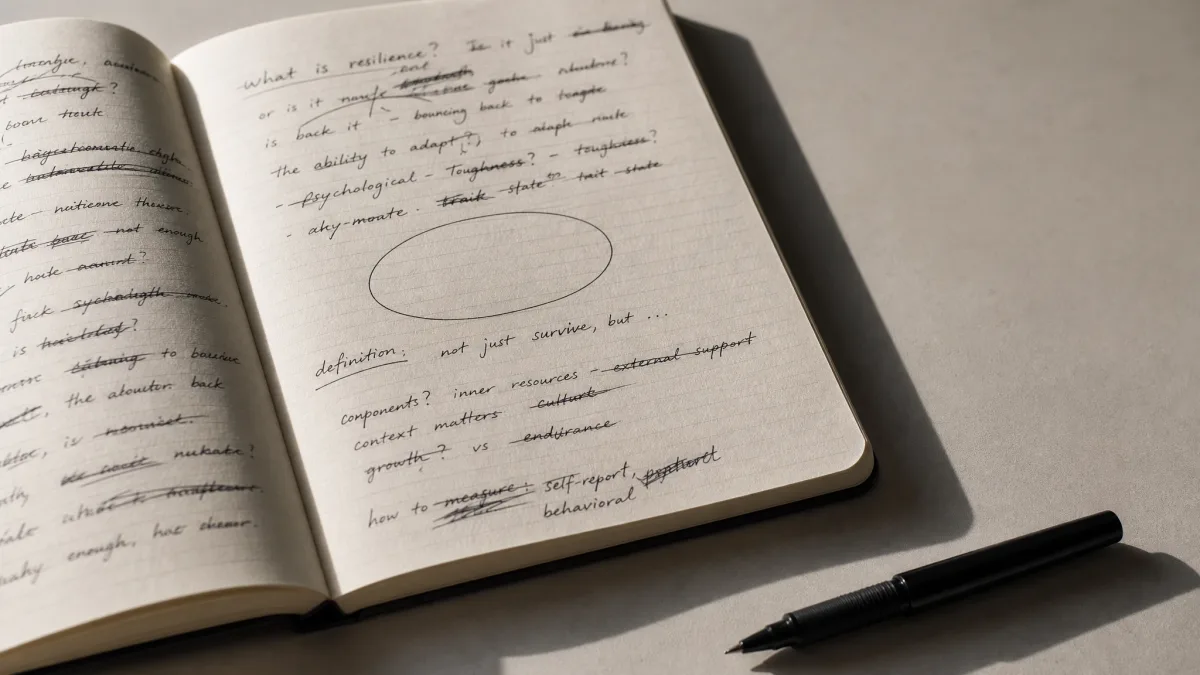
The pen moves, the page fills, and when someone asks what the concept actually means, the words stop coming.
That silence is not a study hours problem. The chapter was highlighted in three colors. The notes are thorough. The material felt understood every time the eyes passed over it – and then it was not there when it mattered, in the exam room or the meeting or the conversation where it needed to appear.
Re-reading and highlighting are recognition exercises. They make the material feel familiar, and that feeling is persuasive enough to pass for knowledge right up until the moment you have to produce something from scratch. Recognition and recall feel identical from the inside. They are not the same process.
Writing a bad explanation before you open a single source forces your brain to retrieve and reconstruct rather than recognise – and that reconstruction, however clumsy, is the only process that builds knowledge you can actually use. The gaps it exposes are not discouraging; they are a map.
What follows is a four-move method – attempt, diagnose, target, test – that works on any bounded concept and fits inside 25 to 45 minutes. The moves are specific enough to run today.
This Is Not the Standard Four-Step Summary You Have Seen

The version most people have encountered is not what Feynman actually did. The technique carrying his name grew from his memoirs and interviews – his own account of how he stress-tested his understanding of physics – not from any pedagogical formula someone later formalized and packaged.
Online summaries tend to reduce it to ‘explain the concept simply.’ That advice is not wrong. It is just missing the move that makes the whole thing work.
The missing move is writing a bad explanation before opening any source material – not a careful summary, not a rough draft, but a deliberately premature attempt that will be incomplete and wrong because it has to be. That wrongness is the point. The gaps and stalls and placeholder phrases the attempt produces are not signs of failure; they are a precise record of exactly where understanding does not yet exist. The bad explanation is the diagnostic instrument.
Re-reading and highlighting never produce that record. They feel productive because the material looks familiar on the page, but familiarity is not the same as being able to reconstruct the idea without the page in front of you. The gap between those two things stays invisible until an exam or a meeting strips the page away. None of the standard study moves force the learner to discover what is missing – they just postpone the discovery to the worst possible moment.
What People Get Wrong About This Technique
Feeling Like You Know Something Is Not the Same as Knowing It

The skip that matters is not a missing step in a four-step list – it is a missing distinction between two processes that feel identical from the inside but produce completely different results.
When the brain encounters familiar material, it registers it as known. The words match the words already stored, the phrases look right, and the whole thing produces a quiet signal of competence – one that is subjectively indistinguishable from being able to explain the material to someone else. This is not a character flaw or a failure of effort. It is simply how recognition operates: fluency with the words gets mistaken for command of the structure.
Retrieval works differently. Building an explanation from scratch – before anything is open, before any prompt beyond your own memory – forces the brain to reconstruct the concept rather than confirm it. That reconstruction is the process that actually makes knowledge durable and usable when a test or a real conversation demands it.
a chapter re-read for the third time still feels like progress because each pass makes the words more familiar, even when the mechanism behind them remains murky.
The bad explanation breaks that cycle precisely because it exposes the difference. When words run out around the 150- or 200-word mark – sooner than expected, with the page still mostly blank – that is not a sign the method is failing or the topic is unusually hard. The stopping point is the illusion giving way. What felt known turns out to be a shape without any internal structure, and now it is visible on the page. That is the whole point of writing before opening anything.
Re-Reading vs. The Bad-Explanation Method
Re-Reading
- Each pass makes the words more familiar, not the structure clearer
- No output means no gap is ever pinpointed
- Third read feels as productive as the first
- Time invested scales with chapter length, not your actual confusion
- Nothing to show for it that a future version of you can test
Bad Explanation First
- First attempt surfaces gaps at the 200–400 word mark, usually one page
- Each gap becomes a specific, targeted re-study target: 10–20 min per gap
- Second explanation attempt takes roughly half the time of the first
- Full session per concept: 25–45 minutes regardless of source length
- Works on any bounded concept — theorem, process, event, principle
Start by Writing It Out Before You Open Anything

Producing the bad explanation is the move that forces retrieval – but the specific way it is done determines whether the gaps actually surface or whether the exercise quietly converts back into recognition.
Close the source completely before starting. Not minimized in another tab, not sitting open beside the notebook. Any visible text – even a heading or a diagram – gives the brain something to recognize, which immediately undermines the diagnostic purpose. The exercise only works if the only material available is what is already inside.
Think silently and the gaps stay invisible. The mind fills in what is missing without registering the fill – a vague sense of ‘and then that connects to the next part’ can stand in for a mechanism it does not actually have. Write it down or say it out loud, and that substitution becomes impossible: the sentence either exists on the page or it does not.
One fixed prompt does the job: explain the concept as though the person reading has never encountered it before. That framing changes the output immediately. It turns the writing into communication rather than recall, which surfaces every step that quietly assumed the reader already knew the thing being explained.
Running out of coherent sentences before the page is full – often within the first 150 to 200 words – is the expected, normal experience. It is the signal that the method is working.
Jargon needs its own flag. Writing ‘it involves activation energy somehow’ is not an explanation of activation energy – it is a marker for a gap. Technical terms are not banned, but any term that appears without the mechanism behind it gets circled, not counted as understanding.
⚠️ COMMON MISTAKE
The Tab You Left Open Undoes Everything
Keeping the source material visible — even minimized, even just the chapter title — is enough to shift the brain back into recognition mode. The diagnostic only works when retrieval is the only option available. Close it completely before you write the first sentence.
Vague Words and Skipped Steps Are Precise Gap Addresses

What the written attempt produces is not a rough draft to discard – it is a document that contains its own grading key, if you know how to read it.
Hedging language is the clearest marker. Phrases like ‘this somehow leads to’ or ‘this connects to the pressure part somehow’ are not vague by accident – they are exact flags for missing causal links. The mechanism is absent; the gesture toward one is all that made it onto the page. That sentence is a coordinate, not a failure.
The contrast between gap language and confident language is visible without any reference material. Compare these two sentences about the same concept: ‘heat increases molecular speed, which raises the frequency of collisions against the container walls’ describes a chain of cause and effect. ‘It basically has something to do with heat and pressure’ gestures at a relationship without showing it. One of those sentences can be followed step by step; the other cannot. The page tells you which is which.
Gaps show up as specific locations.
The goal when reading back through the attempt is to circle three or four sentences or transitions – not shade the whole page. If everything feels uncertain, the concept being studied is too large; the fix is to break it down to a smaller, bounded unit and run the attempt again on that piece alone. A general fog is not actionable. A sentence with a missing step between its halves is.
Knowing that step two and step three are both present in the explanation but that their connection is nowhere on the page is a precise instruction – it names exactly what to look up. That specificity is the whole point. Everything in the attempt that carries a clear mechanism is already understood and does not need to be touched again. Only the circled lines move forward.
What Your First-Attempt Language Is Actually Telling You
- Clear causal sentence: 'X increases because Y lowers Z' — A real mechanism exists. This section is learned — skip it in re-study.
- Technical term used correctly with the process described — The term is carrying real understanding, not acting as a placeholder.
- Jargon dropped without a mechanism: 'it involves entropy somehow' — Circle it. The word is present but the structure behind it is not.
- Step listed but its connection to the next step is absent — Both steps exist; their relationship does not. That relationship is the gap.
- Blank space or 'I don't know how this part works' — A hard gap. Targeted lookup required before the second attempt.
- Entire paragraph written in vague motion: 'this basically affects things' — No mechanism, no direction, no cause. The unit of study may need to be narrowed.
Return to the Source Only for What You Could Not Say

The circled gaps are a short, specific list of questions, and the only productive response to that list is to answer exactly those questions in the source – nothing more.
Re-reading the full chapter feels like the responsible move. It is not. Running through all the familiar material reactivates the same sense of recognition that created the problem in the first place: the words feel known, the gaps feel closed, and the illusion of competence reassembles quietly around the same holes. A targeted lookup breaks that pattern by forcing contact only with what is actually missing.
The move is deliberately narrow. Open the source to the passage that addresses the circled gap. Read that passage. Stop there, unless following that passage reveals that the gap is larger than it first appeared and genuinely requires a paragraph more of context. Surrounding sections are not part of the task.
Timing matters here.
The second explanation attempt belongs immediately after the targeted lookup – not later that evening, not the next morning. While the filled gap is still active and the structure of the first attempt is still present, writing the second version takes roughly half as long as the first because most of the architecture is already built. Only the newly filled sections are different.
The arithmetic makes the method’s efficiency concrete. Filling one gap precisely and then writing a second attempt tends to run somewhere between ten and twenty minutes per gap. Re-reading an entire chapter commonly takes an hour or more and, because it relies on recognition rather than retrieval, closes fewer gaps in that time. A full cycle – first attempt, gap identification, targeted reading, second attempt – typically lands somewhere in the range of 25 to 45 minutes per concept, and what it produces at the end is a second explanation that can actually be tested, not a feeling that the material has been covered.
✍️ One Full Session, Start to Finish
Close Everything
Source material out of sight before a single word. Visible notes let recognition substitute for retrieval — the exact problem you are trying to break.
Write the First Attempt
One handwritten page or 200–400 typed words. Do not stop before the page is full — the gaps only appear after the easy sentences run out.
Circle the Gaps
Mark hedges ('something to do with'), placeholder terms, any step whose cause you cannot name, and any transition you skipped. Each mark is a precise lookup address, not a reason to re-read the chapter.
Targeted Lookup
One gap, one passage. Budget 10–20 minutes per gap. If the passage reveals the gap is deeper than it first looked, follow exactly one paragraph more of context — then stop.
Write the Second Attempt
Start immediately — not later, not tomorrow. The architecture from the first attempt is still intact; only the filled sections change, which is why the second attempt takes roughly half the time.
Run the Stranger Test
Any sentence requiring the stranger to already know what is being explained is a gap the second attempt did not close. One more targeted lookup fixes it; another chapter re-read will not.
You Understand It When a Confused Stranger Could Follow You

Confidence after a second attempt is still not a reliable finish line – it is the same unreliable signal that made re-reading feel sufficient in the first place.
The actual benchmark is whether an imagined person with zero prior knowledge of the topic could follow every step from the opening sentence to the conclusion without needing to already know the thing being explained. No real audience is required. Picturing a specific, uninformed listener is enough – and the moment that imagined person gets stuck on a sentence, another gap has appeared. That simulated incomprehension is harder to dismiss than a private feeling of vagueness, which is exactly why it works as a check.
The standard is binary at each step.
Either the imagined listener can follow without prior knowledge or they cannot. There is no middle category where the explanation is sort of clear if you already know a little about the subject. That partial-credit version is just the illusion of competence with better posture, and the binary standard removes it from consideration entirely.
This is how Feynman actually used the approach – not to produce explanations that sounded elegant, but to find the precise sentence where his own model stopped being a model and became a placeholder. The simplicity was diagnostic, not stylistic, which is why the method applies equally to an economic principle, a historical event, a biological process, or a theorem in physics. The domain does not change the test.
When the imagined listener reaches the end without needing a single piece of assumed background, the session is finished. That is the exit condition – not a page count, not a timer, not the feeling that enough time has been spent.
The Feynman Session — At a Glance
⏱️ Full session length
25–45 min per concept
✍️ First attempt target
200–400 words or one handwritten page — stop when gaps show, not when it feels complete
🔍 Re-study per gap found
10–20 min — targeted only, not the full chapter again
⚡ Second attempt vs. first
Typically half the time — shorter is a signal the gaps were real and are now closed
📐 When to stop gap-filling
When you can name the gap precisely, not just feel it — vagueness is not a gap, it is a prompt to re-read
The binary check at each sentence
Could the imagined listener follow this step with zero prior knowledge? Yes or no — 'sort of, if you know a little' counts as no.
Frequently Asked Questions
Does the Feynman Technique actually come from a peer-reviewed study?
No. The technique comes from Feynman’s own memoirs and interviews, where he described how he personally stress-tested his understanding of any concept. It was not designed as a pedagogical formula; it is a description of a practice. The underlying principle — that retrieval strengthens memory more than re-reading — is supported by learning research, but the technique itself is not a product of that research.
What if I can barely write one sentence before I get stuck?
That is the expected outcome for a genuinely unfamiliar concept, and it is useful data. Write what you can — even ‘I know this starts with X and ends with Y and I cannot say anything about the middle’ — and circle the entire middle as a gap. Stopping early just means the gap is large; it does not mean the method is wrong for this material. Break the concept into a smaller bounded unit if needed.
How is this different from the standard practice of self-testing or flashcards?
Flashcards and self-testing practice retrieval of isolated facts. The Feynman method forces you to retrieve and connect — to produce a causal chain or a process, not just a definition. The diagnostic value comes from the gaps in the connection, which flashcards are not designed to surface. The two approaches are complementary: flashcards for vocabulary and definitions, the bad-explanation method for mechanisms and relationships.
Can I use this for a whole subject, or does it only work on single concepts?
Single bounded concepts — one theorem, one process, one event, one economic principle. Applying it to ‘all of thermodynamics’ produces a document so full of gaps that it loses its diagnostic precision. The method works when the unit of study is small enough that gaps are locatable sentences rather than a general sense of not knowing the subject.
What does ‘targeted lookup’ actually mean in practice?
After circling a gap, go to the source and find the one sentence or short passage that directly answers that specific gap. Read it, understand it, close the book. That is the full step. The temptation is to keep reading into the surrounding context — resist it. That surrounding context is the beginning of re-reading, which reactivates recognition and rebuilds the illusion of competence you just spent effort collapsing.
Is this method still useful if I already understand the concept pretty well?
Yes — and it will tell you faster than any other method whether ‘pretty well’ is real or illusory. If the first attempt produces 300 words with clear mechanisms and no hedging language, the session will be short and the second attempt will confirm it. The cost of discovering you already know it is 15 minutes. The cost of assuming you know it and discovering otherwise on a test is considerably higher.
Close the Book First, Then Start Writing
Close whatever source is open right now and write out what you think you know about one concept in plain language. Not an outline, not bullet points – sentences. Stop the moment the phrasing turns slippery or the sentence will not finish cleanly. That stopping point is not a signal to wait; it is the first precise instruction the method gives you.
If 30 minutes is what is available, keep the unit small – one process, one principle, one event – and run the full cycle once: first attempt, circle the gaps, look up only the gaps, second attempt. Stop there. One finished cycle is more durable than two half-finished ones.
With a full study block, chain the cycles rather than widening each one. Use the second explanation for the first concept as the opening attempt for the next connected idea, so the session builds something with structure instead of a row of isolated passes. The only thing the method requires is the willingness to write something bad on purpose – and the pen moving across a half-empty page, sentences stopping mid-thought, is exactly where it begins.
Try It on the Concept You Studied Last
Close whatever you have been reading, set a timer for 20 minutes, and write the explanation from scratch. The gaps that appear in the first 200 words are the only thing worth studying next.