The most surprising thing about a Tuareg guide leading a caravan across the Sahara is not that he survived the crossing – it is that he found it ordinary.
Timbuktu to Tripoli: roughly 1,500 miles, 70 to 90 days, with the next reliable water anywhere from three to seven days ahead and no guarantee it would be there when he arrived. Daytime temperatures above 110 °F. Nights dropping below 40. By his own reckoning, this was not an ordeal. It was work.
The instinct, when you encounter that fact, is to assume the gap is mostly motivational – that a determined person with good gear and genuine commitment could close it. That the guides were simply tougher, more stoic, built for it in some way you are not.
What the psychology actually shows is different. The capacities that made the crossing functional – in the body, in the perceptual system, in the way fear and thirst and sleeplessness registered – were assembled across a specific developmental window, through childhood exposure that started around age eight and compounded for a decade before anyone led a caravan alone. Those capacities cannot be reverse-engineered in adulthood. By the end of this article, you will know exactly which gap would defeat you first – and why that is a developmental fact, not a character flaw.
Quick Tips Before You Start
It Is Always Built
Every capacity in this article was assembled through years of structured exposure — none of it was summoned from willpower alone.
Follow the Theme Order
The article moves from body to mind to group to expertise — each section deepens the previous one, so the sequence matters.
The Numbers Are Real
Temperature, distance, and water-gap figures come from the historical record of trans-Saharan trade routes — they are not estimates.
Childhood Is the Variable
Apprenticeships began around age 8 to 10, during the window when the nervous system is most plastic. Adult acclimatization is a different and slower process.
The Caravan Was the Technology
A working caravan of 50 to 1,000 camels was a distributed cognitive and logistical system, not a group of individuals walking together.
What the Body Was Trained to Tolerate
Before anything cognitive — before navigation, before social structure, before meaning-making — a body has to remain functional at 110 °F with rationed water and fragmented sleep. The caravan guide’s first advantage was physiological, and it was built over years, not acquired in preparation.
This theme covers the three physical demands that an unacclimated modern person would find most disabling, and why each one defeated people not through lack of will but through the simple absence of the right developmental history.
1. Heat Tolerance Is Built Over Years, Not Days
The easy assumption is that heat is mostly a comfort problem – unpleasant, manageable if you push through it. That assumption is wrong in a specific and measurable way.
At 110 °F, which is a routine afternoon in the central Sahara, an unacclimated adult’s judgment starts degrading within hours. Not days – hours. Cortisol rises fast under sustained heat stress, and the prefrontal cortex, which handles route decisions and risk assessment, is one of the first systems it compromises. By the time a modern person feels genuinely impaired, they have already been making worse decisions for a while without knowing it.
A Tuareg child who began walking route fragments beside experienced navigators around age 8 or 9 was doing something physiologically consequential: accumulating heat exposure during the years when the nervous system is still forming, which physically lowered the cortisol response those temperatures would later trigger. The nervous system, trained early enough and often enough, stops treating 110 °F as an emergency signal. That recalibration is structural – it lives in the wiring, not the attitude.
Adult acclimatization, done carefully over weeks, produces real but partial adjustment. What it does not produce is the threat-response rewiring that came from a decade of childhood conditioning. One crossing, however well-prepared at the start, cannot install what ten years of specific exposure built.
The Timbuktu-to-Tripoli Route — At a Glance
📏 Total Distance
~1,500 miles
📅 Crossing Duration
70–90 days
🌡️ Daytime High
110 °F+
🥶 Overnight Low
Below 40 °F
💧 Water Gap
3–7 days between wells
🐪 Camel Load Capacity
~400 lbs per animal
Human Water Need
At least one gallon per person per day in extreme heat — with no guarantee the next well was functional or uncontaminated.
2. Thirst Becomes Unbearable Before It Becomes Dangerous
The answer is almost certainly yes, and immediately – because clean water has always been close enough that waiting felt pointless. That reflex is the problem.
On a route where the next well was three to seven days out and might be dry or contaminated on arrival, a caravan carried everything it needed with no resupply guarantee. The danger was not dying of thirst outright – moderate dehydration, well before any physical crisis, produces anxiety and cognitive fixation that actively degrades judgment. Professional crossers had learned, through years of reinforcement from experienced guides, to ration against a schedule and hold steady while thirsty. That is a conditioned response built over time, not a decision made fresh each morning. A modern person fighting that reflex is also fighting every expectation the body has ever learned, which compounds the distress rather than simply adding to it.
💡 Tip: The research term is 'conditioned thirst response' — the body learns to escalate panic at specific dehydration thresholds based on what it has been trained to expect as normal supply.
The Caravan Route in Numbers
3. Sleep Deprivation Breaks Decision-Making First

It is two in the morning and the caravan is moving. The sun will be punishing by eight, so the miles happen now, in the dark, while the body wants to be horizontal.
Caravans ran this pattern across weeks – night travel, broken daytime sleep in shifting heat, no consolidated rest. Sleep research is plain about what this costs an unacclimated person: beyond 72 hours of sustained disruption, hallucinations arrive and decision-making collapses. The guide’s job – reading terrain, adjusting the route, catching early signs of trouble – required the sharpest cognition at the exact moment the unacclimated body had the least of it.
Professional crossers had spent years training the nervous system to extract functional rest from fragmented windows. That adaptation was not a trick they applied – it was structural, built gradually. A modern person’s sleep architecture expects a single consolidated block, and it does not flex on demand. Knowing the 72-hour threshold is coming does not push it back.
⚠️ COMMON MISTAKE
Motivation Does Not Move the Threshold
Knowing that you are approaching 72 hours without proper sleep does not delay the cognitive collapse that follows it. The threshold is physiological, not psychological — which is exactly why the guides trained for it from childhood rather than managing it with awareness in the moment.
What the Mind Was Trained to Read
Physical endurance gets most of the attention when people imagine desert crossing, but the cognitive demands were just as limiting — and just as specifically built. A guide who could tolerate the heat but could not read a dune formation, a star path, or an early sign of camel illness was still a liability.
The three entries in this section cover the cognitive architectures that separated professional crossers from everyone else: the internal navigational library, the calibrated threat response, and the psychological management of sustained monotony.
4. Navigation Was a Memorized Cognitive Map
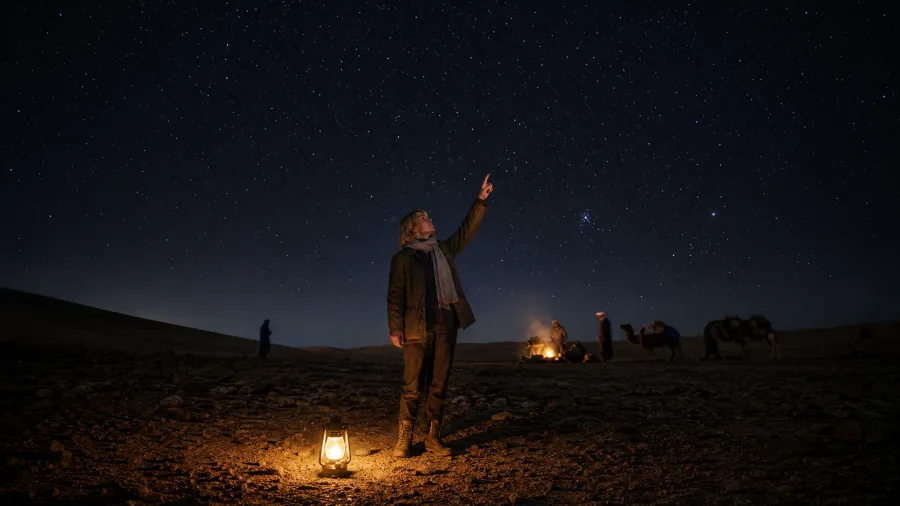
Roughly a decade of walking the same routes is what it took before a Tuareg guide led one alone.
That figure is easy to read as a long apprenticeship and miss what it actually means. A boy beginning at age 8 or 9 was not studying navigation the way a student studies a map. He was accumulating thousands of hours of direct exposure: the particular way a dune face angles when the harmattan has been blowing east for three days, the star cluster that aligns with a specific pass only in the dry season, the faint discoloration of sand above a buried seep. None of it was stored as a rule. It was stored as recognition – the instant, confident reading that something is right or wrong before any deliberate reasoning runs.
The misread is assuming this is a knowledge problem. Spend a week studying Saharan geology and star charts and it feels like progress, because facts accumulate. What does not accumulate is the cognitive architecture those facts have to live inside – the pattern-recognition structure that only forms through direct exposure to real conditions across years. Expertise researchers describe the same threshold in surgeons and chess players: domain-level pattern recognition requires roughly a decade of deliberate, contextual practice because the brain is physically reorganizing how it processes the domain, not just adding files to a folder.
Remove that structure and the desert offers no substitute. There is no landmark obvious enough to navigate by without training, no star bright enough to be unambiguous to an untrained eye in a sandstorm, no well marked by anything a first-time crosser would notice. Disorientation in the central Sahara becomes fatal within days. A modern person arriving with solid preparation and genuine commitment would not be navigating badly – they would be operating without the cognitive equipment the route actually requires.
🧭 How a Tuareg Navigation Specialist Was Built
Age 8–10: First Apprenticeship
A child begins shadowing experienced guides on shorter route segments, learning star positions and dune patterns through direct observation.
Early Teens: Active Role Participation
The apprentice takes minor active responsibilities — water-gap tracking, camel condition assessment — still under close supervision.
Mid-Teens: First Full-Route Crossing
The apprentice completes the Timbuktu-to-Tripoli route as a secondary guide, with a senior navigator making all final calls.
Late Teens: Independent Night Segments
Familiar route sections are navigated independently at night; the senior guide verifies decisions but does not lead them.
Early Adulthood: Lead Navigator
After multiple full-route completions across varied conditions — roughly a decade after the first apprenticeship — the guide leads independently.
5. Risk Reading Was Calibrated, Not Fearless
Miscalibration in either direction is fatal. A guide who reads a sandstorm wrong and keeps walking through one that requires full shelter does not get a second attempt; neither does one who shelters from a storm that would have passed in an hour and loses two critical travel days as a result.
The assumption is that professional crossers managed this through fearlessness – that something in their temperament simply muted the fear response in conditions that would overwhelm an ordinary person. That is not what the record shows. Fear responses were present and sharp. What distinguished them was precision: reading the early signs of illness spreading through a camel string, or distinguishing wind behavior that precedes a burial storm from ordinary gust patterns, are calibrated judgments built through years of seeing which readings were right and which were wrong, with survival as the only scorecard.
Accuracy was the edge. Not the absence of fear.
Modern emergency responders are trained on exactly this principle – not to eliminate the fear response but to direct it accurately toward actual threat rather than noise. Aviation accident research documents the opposite failure in detail: crew members who override a correct assessment, or fail to challenge a wrong one, are often responding to the wrong signal entirely. The fear fires regardless. What differs is whether it lands on the right target, and that targeting is trained, not innate.
A caravan guide who had spent years watching experienced navigators assess a building storm – standing beside them, seeing the outcome, correcting his own read against theirs – had a calibrated response by the time he led independently. The calibration was not a personality trait he was born with.
A trainable output can be checked against outcomes and corrected. A personality trait cannot.
What Calibrated Risk Reading Actually Requires
6. Boredom Was Not a Problem They Had to Fight
“I just need something to do” is what isolation volunteers say around day three – and most of them are in a controlled room with food delivered, not walking through featureless sand for another two months.
Ninety days on the Timbuktu-to-Tripoli route is where this distinction matters most. A working caravan was not empty time that had to be survived. It was a functioning social world: strict occupational roles that gave each person a specific stake in the day’s outcome, oral recitation traditions that carried history and poetry across the evening hours, music, and the ongoing negotiation of trade arrangements that would only close when the caravan reached its destination. The time was full because the structure was designed to fill it.
That structure is the exception worth understanding. Someone raised inside a caravan culture knew how to inhabit the role, the oral tradition, the hierarchy – not because they had decided to engage but because engagement was the only mode they had ever known on a long route. The social architecture was not a comfort layer they could access or ignore. It was the psychological mechanism keeping cognition organized across the long middle of the crossing, when the novelty of departure was gone and arrival was still weeks away.
The same physical environment offers no such structure to a person dropped into it without that history. No role, no oral tradition, no occupational stake in the outcome. Isolation research is consistent on this: cognitive restlessness becomes genuine distress faster than almost anyone predicts, and it degrades judgment long before the body is in trouble. The caravan did not solve boredom by enduring it – it solved boredom by building a world dense enough that boredom had nowhere to start.
💡 Tip: Psychologists call this 'role salience' — having a specific, recognized function within a group dramatically extends the time a person can sustain effort under hardship.
The Psychology Behind the Crossing — Key Terms
What the Group Made Possible
The physical and cognitive demands above were not met by individuals operating in isolation — they were met by a social structure that distributed load, enforced decisions, and maintained meaning across the full length of the route. Remove that structure and the crossing becomes a fundamentally different and far more dangerous undertaking.
This theme covers the three social mechanisms that made professional crossing possible: the caravan’s internal organization, the non-negotiable authority of the guide, and the meaning frame that made sustained suffering bearable enough to complete.
7. The Caravan Structure Was a Psychological Support System
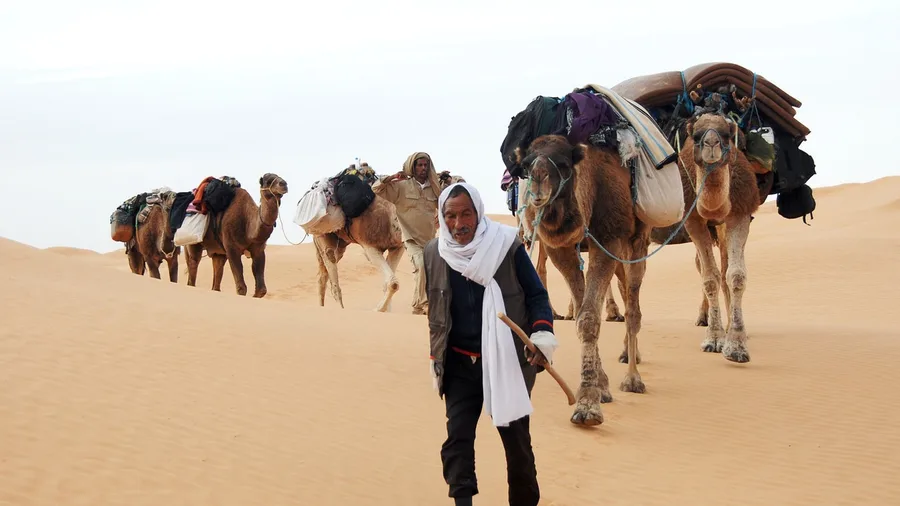
Almost never by plan. The historical record of solo accounts is nearly entirely survivors of caravan disasters – people who continued because the group was gone, not because solo travel was ever the design.
A caravan of 50 to 1,000 camels divided its people into strict roles: guide, merchant, loader, herder. Each role held specific knowledge the others lacked. When one person made an error, the system absorbed it rather than collapsed under it. Researchers who study group cognition call this distributed competence – the group’s total functional capacity exceeds any individual’s, precisely because no single node carries the full load.
Hierarchy and shared ritual were not ceremony laid over the top of the real crossing. Under genuine extremity, they suppressed panic, kept people behaviorally consistent, and stopped decision-making from fragmenting into individual improvisation at the worst moments. The structure was the crossing. Remove it and what remains is a different and far more dangerous undertaking entirely.
A Working Caravan — Structural Facts
⚖️ Single Camel Load
~400 lbs — loader role existed solely to manage this weight distribution
🗺️ Guide Training Start Age
8–10 years old — navigation authority was decades in the making
🐪 Camel Water Interval
Every 3–5 days in moderate heat; herder tracked this per animal
💧 Human Water Minimum
At least 1 gallon per person per day — merchant role controlled rationing
🤝 When Role Boundaries Hardened
Under crisis — improvisation outside your role was socially suppressed, not just discouraged
What 'Distributed Competence' Actually Meant
Each role held knowledge the others lacked and could not quickly acquire. A merchant who lost their guide did not become a navigator — they became lost.
8. Trust in the Guide Was Load-Bearing, Not Optional
The instinct is to say that following a good leader is a matter of character – choose to trust, and you will. That is the wrong frame entirely.
When a merchant on the Timbuktu-to-Tripoli route quietly drank ahead of his ration, he was not making a personal choice about his own body. He was pulling water from a shared account that the whole caravan had to live on for the next four or five days. Correction was immediate and came from every direction at once – not from a formal authority but from fifty people whose lives were on the same ledger. That social pressure was the enforcement mechanism, and it worked because everyone around him had grown up inside a world where the guide’s call was simply how things functioned. Not a rule to be weighed, but a structure as obvious as the sun.
Aviation accident research documents what happens when that structure breaks down in modern settings: crew members who know something is wrong stay quiet, or override a commander at the worst possible moment, because individual judgment feels like the right tool under pressure. It is a deeply conditioned reflex. The caravan crossers were not less individualistic by nature – they had been socialized from childhood into a hierarchy whose authority was experientially obvious, reinforced across years of routes where deference had visibly kept people alive. That is not a disposition you pack.
9. Shared Suffering Was Meaningful, Not Merely Endured
The easy assumption is that people endured the crossing through willpower – gritting through the suffering until it ended. That framing misses the most important part of what kept them going.
Hardship researchers find consistently that identical physical pain is tolerated far longer when it is attached to a clear purpose. The frame does not just change how a person thinks about suffering – it changes the physiological experience of it. For a caravan merchant, the suffering was denominated: salt, gold, and cloth delivered to Tripoli after a successful 1,500-mile crossing could represent years of income. Every difficult day had a specific number behind it.
When conditions were at their worst – deep into the route, when the economic calculation alone stopped being enough to hold against the accumulated weight – religious and cultural ritual performed en route did functional work. Not decorative work. It re-anchored meaning at the exact moments the body was loudest.
A modern person attempting the same route for adventure or personal challenge carries a thinner frame. ‘I wanted to prove I could do it’ and ‘my family’s livelihood depends on this delivery’ are not equivalent anchors under 90 days of genuine extremity. The modern frame was built for a different scale of demand – and it is not weakness that makes it collapse sooner, but a straightforward mismatch between the frame’s design and the load it is being asked to carry.
What This Reveals About Expertise and Human Limits
The previous three themes establish what was required: physical tolerance, cognitive architecture, social structure. This final theme asks the deeper question — what does all of that tell us about human capability, and specifically about the difference between what is built and what can be summoned in the moment?
The two entries here address the questions that everything above builds toward: whether determination can substitute for conditioned competence, and whether modern people are genuinely weaker than the people who made these crossings.
10. Willpower Cannot Substitute for Conditioned Competence
The question the crossing keeps raising is whether the guides were simply built differently – tougher, more stoic, constitutionally suited to hardship in a way that most people are not. They were not.
A Tuareg guide who led caravans across the central Sahara was not a harder category of human. He was an ordinarily human person whose nervous system had been specifically prepared – through a decade of graded exposure beginning around age 8 or 9 – to operate in conditions that would disable an unprepared adult within days. The preparation was the difference. Not the person.
Stress inoculation research and expertise research arrive at the same finding by different routes: repeated exposure to a specific demand physically restructures the brain’s response to that demand. Threat arousal drops. Pattern recognition sharpens. These are not attitude shifts – they are structural changes, and they accumulate across years of practice, not across a determined week of effort.
That mechanism is why a modern person attempting the same crossing would not fail from insufficient courage. The failure would come earlier and quieter – in the heat response, in the sleep architecture, in the navigation cognition – because the specific developmental history that built those capacities was never there to begin with. Determination cannot install in a month what conditioning built across a childhood.
The same logic holds for a trauma surgeon working a 14-hour shift, a deep-sea fisherman reading weather in open water, or a combat soldier making decisions under fire. None of those people are exceptional humans. All of them are the output of years of structured preparation in a specific domain. The Saharan guide is not a special case – he is simply a case where the preparation is unusually visible, because the environment it answered was unusually extreme.
11. Modern Comfort Reset the Baseline, Not the Species
“People back then were just tougher.” It is the most common reading of historical hardship, and it is wrong in a way that matters.
The brain does not maintain what the environment does not demand. That is neural plasticity working as designed – not decline. The same person who would be overwhelmed navigating the Sahara without water for four days is carrying cognitive loads that would have been genuinely incomprehensible to a medieval caravan guide: simultaneous coordination across multiple institutions, dense urban threat-reading, information management at a scale and speed the caravan world never approached. Those are built capacities too, assembled in response to a different set of demands.
Caravan mortality was real and significant. This was not a life anyone chose for the discipline it offered – it was economically necessary work with serious costs attached. The psychological principle it illustrates is not that earlier humans were superior but that expertise has always been situational. The brain builds what the environment asks for. Saharan crossers were experts in their environment. The people reading this are experts in theirs.
Frequently Asked Questions
Could a modern person train to cross the Sahara the way caravan guides did?
Physically, yes — adult acclimatization produces real physiological adaptation, and deliberate practice builds navigational skill over time. What adult training cannot fully replicate is the nervous system rewiring that childhood stress inoculation produces, which means the baseline threat-arousal response stays higher. A well-trained modern person could make the crossing with adequate support; they would not arrive at the same physiological baseline the childhood-conditioned guides started from.
What was the most common cause of caravan failure?
Water miscalculation was the most consistently lethal failure — arriving at a well that was dry, contaminated, or buried after a storm with no alternative within the gap. Navigation errors that added days to an already tight water supply produced the same outcome. Both failures came down to information quality, which is exactly what the guide’s trained pattern recognition was built to provide across hundreds of prior route-hours.
What is stress inoculation and why does it matter here?
Stress inoculation is the process by which repeated early exposure to a stressor physically lowers the body’s cortisol and panic response to that stressor in later encounters. The effect is strongest during childhood development, when the nervous system is most plastic. Tuareg apprenticeships beginning around age 8 to 10 were, functionally, a structured stress inoculation program — whether or not anyone called it that at the time.
Is the 72-hour sleep deprivation threshold really that fixed?
The research on this is consistent: beyond 72 hours of sustained sleep disruption, unacclimated individuals show measurable hallucinations and decision-making collapse regardless of motivation or awareness of the state. The threshold is physiological. Polyphasic sleep tolerance — the ability to function on fragmented windows — is buildable through structured conditioning, but that conditioning needs to be in place before the demand is placed on it, not assembled during the crossing itself.
Why did caravan guides have absolute authority over route decisions?
Because distributed decision-making under extreme stress produces gridlock and panic at exactly the moments when speed and clarity matter most. The guide’s authority was not cultural preference — it was a functional solution to a real coordination problem. Aviation accident research reaches the same conclusion from a different angle: clear hierarchy produces better outcomes under crisis conditions than individual autonomy assertion does, and the caravan tradition arrived at the same answer through direct survival feedback over centuries.
The Gap Was Never Physical Fitness
The largest single gap between you and a professional Saharan crosser is not cardiovascular fitness. It is not courage, and it is not pain tolerance. It is the years of childhood conditioning that literally rebuilt threat perception, water management, sleep architecture, and navigational cognition before adulthood began – during the window when the nervous system forms most efficiently and before it stops being that malleable.
A guide who started walking fragments of the Timbuktu-to-Tripoli route at age eight or nine was not tougher than you. He was earlier. The preparation preceded the demand by a decade, and the nervous system that met the Sahara was already a different instrument by the time he arrived.
That is not a verdict on modern people. Expertise was never improvised – not in the Sahara, not anywhere. The crossing was made possible by a system of structured transmission across generations, and the system was the real achievement. The guide was its product. So are you, in the capacities your own environment spent years building. The question worth sitting with is simply which environment did the building – and what it prepared you to cross.