
Most people assume that real friendship requires sitting down, making eye contact, and saying something honest out loud – and that two men who prefer to fix a fence together in near-silence are choosing the easier, shallower version. That assumption is wrong, and it costs more than most people realise.
Take two men who have known each other for fifteen years. Put them across a restaurant table and something tightens – the conversation lands in the wrong register, the silences feel like failures. Put them side by side replacing fence posts on a Saturday morning and an hour disappears before either of them notices. Both men are vaguely aware this is true about themselves, and both carry a faint suspicion that the fence doesn’t quite count.
It does count. The discomfort with face-to-face conversation is not emotional immaturity or a reluctance to go deep – it has a documented psychological basis, and the side-by-side format is not a workaround for that discomfort but a structure that produces genuine closeness in its own right.
What feels like the lesser version of male friendship is often the version that actually sustains older men. The risk is not that it runs shallow. The risk is that it disappears when the activity stops – and that the men inside it never quite believed it was worth protecting.
By the end of this piece you will be able to name why your friendships feel the way they do, stop second-guessing whether they count, and take one specific step this week to keep them alive.
Direct Eye Contact Raises Men’s Guard

When two men sit down for a deliberate talk, the format itself creates a problem. Sustained eye contact between men does not reliably read as warmth or openness – for many, it reads as evaluation. A test of something: sincerity, status, whether you’re going to say the right thing. The setting designed to signal ‘I’m listening’ triggers, instead, a low-level guardedness that makes real disclosure harder, not easier.
This is not a character flaw or emotional immaturity. Researchers who study male stress response have documented a pattern where direct social scrutiny – being looked at, being assessed – activates self-protective behaviour rather than openness. The face-to-face format assumes mutual gaze means safety. For many men, physiologically, it doesn’t.
Socialisation compounds this. In most male peer groups, eye contact historically carried competitive weight as often as connective weight. A held gaze meant a challenge as readily as it meant understanding. Decades of that conditioning do not fade with age – they tend to deepen. The man who found a direct, sustained conversation somewhat loaded at thirty is likely to find it more so at sixty-five, not less.
None of this applies to every man. Some find face-to-face conversation entirely natural, and that is equally valid. The point is not to pathologise either mode – it is to establish that where the difficulty exists, it has a real cause. It is not avoidance, and it is not a sign the friendship is deficient. The format is simply harder than it looks.
A Shared Task Redirects the Eyes

The structural fix is almost absurdly simple: give both men something else to look at. When attention lands on a shared external object – a car engine that won’t start, a jigsaw half-finished on a table, a chess position neither man can quite read – neither man is the subject of the other’s gaze anymore. The self-monitoring drops. Nobody is performing. What gets said gets said without the weight of being watched while saying it.
The object doesn’t need to be demanding or competitive. It just needs to be genuinely shared – something both men are actually attending to. A half-dismantled engine under a bonnet works. So does a jigsaw puzzle. The chess board is not a lesser version of the car; it supplies exactly the same structural function. Both men’s eyes have somewhere to go that isn’t each other’s face.
This is where the loss of later-life structure bites hardest.
Work supplied a third object automatically – a problem to solve, a task to complete, a shared deadline. Team sport did the same. So did a regular commute with a colleague, or coaching a kids’ football team on a Saturday morning. None of those men sat down and decided to build a close friendship; the structure assembled it for them. When those containers disappear, the third object disappears with them, and most men don’t notice what’s gone until the conversation starts feeling harder than it used to.
💡 PRO TIP
The Object Does the Heavy Lifting
The third object in a side-by-side setting does not need to be interesting to anyone outside the room. A half-assembled model, a game in progress, a map being planned — any of these reduces the social pressure that makes honest speech harder. The object is not the point; the redirect is.
Conversation Emerges Here; It Cannot Be Demanded
The talk that emerges when both men are focused on something else tends to go further than a scheduled conversation – not despite the lack of intention, but because of it.
A planned catch-up creates a performance standard the moment it’s arranged. Something meaningful should be said. Silence becomes a small failure. The unspoken pressure to justify the meeting produces exactly the kind of self-consciousness that keeps real disclosure out. A walk, a drive, an afternoon working on something together – none of that asks for anything. Talk is optional, which is the whole point.
When the obligation disappears, so does the anxiety around it. What gets said is said because the man decided to say it, not because the format demanded something from him. That difference is not subtle. It changes what gets said entirely.
Silence in these settings carries a different weight too. Two men walking without talking are not failing to connect – the quiet reads as ease rather than evidence that the friendship has run dry. That absence of pressure is itself something; it makes the next honest exchange more available, not less. Older men who think back to their most unguarded conversations almost always place them somewhere incidental – on a long drive, mid-task, walking back to the car. That’s not coincidence. The format removed the demand to perform intimacy, and the honest thing surfaced on its own.
How Much Social Pressure Each Format Creates
Low pressure on the left makes honest speech more likely; high pressure on the right activates self-protection.
- Walking side by side, no agenda: No audience, no obligation — the lowest-pressure setting for honest exchange.
- Shared task with a third object: Attention is split; neither man is performing for the other.
- Casual pub or coffee, side by side: Some social expectation, but no formal agenda to satisfy.
- Dinner table, face to face: Sustained mutual gaze raises the stakes; silence reads as awkward.
- Scheduled 'let's talk' conversation: Explicit talk mandate makes self-monitoring and guarding most likely.
Accumulated Time Builds Closeness Without Disclosure

That question – whether relatively little talk adds up to anything real – rests on a particular assumption about how closeness is built. The assumption is that depth requires disclosure. It is not wrong exactly, but it is incomplete.
Consider a standing Saturday routine: coffee at the same place, a walk of roughly the same length, back by noon. Repeat that for a decade. Neither man may have said much about what frightens him or what he regrets. What has accumulated in that time is something else – a demonstrated willingness to keep showing up, week after week, to no particular agenda. That is not a small thing. Reliability at that scale is its own form of emotional investment, and both men know it even if they have never said so.
The worry that a quiet friendship is shallow tends to misread how bonding through repeated action works. The bond is not stored in what was said; it is encoded in the pattern itself – in the fact that the other man was there last week, and the week before, and the one before that. Presence over time is evidence of commitment. It just does not arrive in the form of sentences.
Verbal disclosure is one way closeness gets built, and for some people it is the primary one. Treating it as the only valid measure imports a framework that fits certain relational styles well and others poorly. A friendship that runs deep through shared routine and demonstrated reliability is not a pale version of the real thing – it is a different structure producing the same result.
Action Is How Many Men Say ‘I Care’
Those acts of presence – the ones that look practical on the surface – are not a substitute for care. They are care, spoken in a different register.
Consider what it takes to drive a man to an early-morning hospital appointment: you rearrange your day, you sit in a waiting room for two hours saying almost nothing, and you are still there when he comes out. No speech was prepared. Nothing personal was disclosed. The communication happened through the arrangement of the morning itself.
Or the friend who, three days after a bereavement, appears at the door with food and stays for twenty minutes without once asking how the grieving man is ‘really doing’. Or the one who remembers a casual complaint about a broken gate, shows up one Saturday with tools, and the whole thing is handled before lunch. What looks like practicality is, in each case, the man making visible exactly where he stands.
The real cost of missing this is that support already present goes unrecognised. A man who reads care only in words will look at those three scenarios and come away feeling alone – when he is, in fact, being held by the friendship in the only language it has reliably spoken.
One honest qualification belongs here. Some men do shelter behind action to avoid exchanges that genuinely need words – a serious illness, a marriage under strain. The language of showing up is real, but it has limits, and those limits matter. Knowing the difference between care expressed through action and care used as a reason not to speak is what lets a man receive one without mistaking it for the other.
Side-by-Side Friendship — What It Actually Delivers
🤝 Bond mechanism
Repeated presence, not disclosure
🔇 Silence reads as
Comfortable, not stalled
🚨 Crisis availability
High — low-maintenance format survives long gaps
🗓️ Key variable
Regularity over novelty
⚠️ Real limitation
Cannot replace all verbal exchange
Bottom line
A quiet friendship built on consistent presence is not thin — it is a different architecture of closeness.
These Friendships Hold in a Crisis

The real test of any friendship is what it does under pressure, and this is where the structure of side-by-side friendship tends to surprise people.
When illness or bereavement arrives, the man who has never asked how you are feeling is often at the door within an hour. His presence is not a sudden change of character – it is the continuation of a pattern that was already established. The friendship has been running on demonstrated reliability for years, and when the moment demands it, that same reliability produces something that looks, in practice, indistinguishable from deep care. Because it is.
The low-maintenance structure also means the bond survives gaps. A friendship built around regular contact but not emotional debt remains available when it is suddenly needed – there is no distance to close first, no accumulated silence to explain, no relationship to repair before the support can begin. Two men who have not spoken for three months can pick up exactly where they left off, and that continuity is not accidental. It is structural.
There is a real limitation worth naming. Friendships built entirely on presence and action, with no emotional vocabulary at all between the two men, can fall short in specific ways. A man who needs to be heard – not helped, not accompanied, but actually heard – may find that need goes unmet. The side-by-side format holds well under most forms of pressure. It is not infinitely sufficient.
Side-by-Side vs. Face-to-Face: What Each Format Does Well
Side-by-Side
- Removes the obligation to perform intimacy
- Survives long gaps without relationship debt
- Allows honest speech to surface on its own terms
- Holds up under crisis without needing repair first
- Scales across different physical abilities and interests
Face-to-Face
- Direct gaze can activate self-protection rather than disclosure
- Silence reads as failure rather than comfort
- Talk becomes a performance standard, not a choice
- Can exhaust itself under sustained emotional load
- Requires deliberate scheduling to maintain
Retirement Removes the Built-In Scaffold

The friendships that hold in a crisis are often the same ones that quietly vanish a few years before the crisis arrives – not because anything went wrong between the men, but because the structure that assembled them disappeared — a pattern familiar to men with no hobbies after retirement.
For most men, sustained closeness with other men came packaged inside something else. A workplace where you spent eight hours a day within twenty feet of the same people. A football team that met every Sunday and expected you there. A school run or a shared commute that put two men in the same car three times a week without either of them having to decide to make it happen. The friendship was real. The care was real. But the contact was arranged by the container, not by the men themselves.
When the container goes, the contact goes with it.
That is the part that catches men off guard. No argument happened, no falling-out, no gradual cooling of interest. One man retired, or the team folded, or the children grew up and the school run ended – and the mechanism that had been placing them in the same space every week simply stopped running. Within a year, a twenty-year friendship had shrunk to a text at Christmas. Neither man chose that. Neither man wanted it.
This is a structural problem, which means a structural solution is the only kind that works. Goodwill does not replace a scaffold. Intending to catch up is not the same as a standing arrangement that requires both men to show up next Tuesday at the same time they showed up last Tuesday. The friendship did not weaken – the assembly point disappeared, and something deliberate has to be built in its place.
⚠️ COMMON MISTAKE
The Friendship Did Not End — The Container Did
When a shared routine disappears, men often interpret the lost contact as evidence the friendship was never that strong. It usually means the opposite: the bond was real enough to survive for years inside a structure that is now gone. The friendship needs a new container, not a post-mortem.
Men Undervalue These Friendships and Lose Them
Part of what makes rebuilding that structure harder than it should be is that many men have already written the friendship off as something smaller than it was.
The idea that genuine closeness requires sitting face-to-face and working through feelings did not come from nowhere – it came from therapy culture, from the way friendship is depicted in most films and television, and from women’s friendship norms that were gradually absorbed as if they applied universally. Older men took that in without necessarily questioning it, and the result is a quiet but damaging habit of categorisation: this man is a close friend, we talk about real things; that man is ‘just a mate I do stuff with.’
That second category is where the loss happens.
A man who frames a friendship as ‘just doing stuff together’ tends not to register it as something worth protecting. When the shared activity ends, he lets the contact drop rather than asking what could replace it. He does not grieve the friendship because, by his own accounting, it was not quite the serious kind. The friendship disappears without anyone deciding it should.
What that framing gets wrong is how the friendship’s value was built in the first place. Its weight came from reliability – from the accumulated count of times the other man showed up, stayed, and came back the following week. That is not a lesser form of closeness. It is closeness, arrived at by a different route.
This is not an argument against wanting more verbal depth in a friendship – a man who wants that should look for it, and that preference is entirely valid. The argument is narrower: do not let someone else’s definition of what friendship should look like talk you out of protecting something real.
Isolation in Later Life Carries Real Health Consequences

Losing these friendships is not just a social inconvenience. The health consequences of social isolation in older men are serious – serious enough that public health bodies including the NHS, the CDC, and national institutes on ageing have made it a research priority. Rather than rely on a figure cited here, go directly to one of those sources for current data; what they consistently find is that the direction and magnitude of the risk is substantial, not marginal.
What makes this especially hard to catch is the speed at which it happens.
Because men’s friendships are built on shared structure rather than on the habit of reaching out directly, losing the structure can tip a man from well-connected to near-completely isolated within a couple of years – and neither he nor anyone around him may name it as it is happening. He is not sitting alone weeping. He is getting on with things, staying busy, telling himself he is fine. The contact just quietly stopped.
Men are also, as a group, less likely to identify what they are experiencing as loneliness or to seek new social connections to correct it. A woman in the same position is more likely to name the problem and do something about it. That difference matters: it means the risk does not self-correct through awareness the way it sometimes can in other populations.
None of this is inevitable. Retirement does not automatically lead here, and the point is not alarm but timing. The window to act is before the scaffold is gone, not after the isolation has already settled in.
📉 How a Side-by-Side Friendship Fades After Retirement
The container closes
The job ends, the team disbands, or the commute stops — the automatic meeting point disappears.
Contact drops without a decision
Neither man ends anything; the mechanism that assembled them simply stops operating.
Both men wait
Each assumes the other is fine, or that something will come up naturally.
The gap normalises
Months pass; re-initiating now feels heavier than it did when contact was automatic.
The friendship is quietly gone
No argument, no ending — just the absence of the structure that held it.
Any Recurring Shared Activity Recreates the Conditions
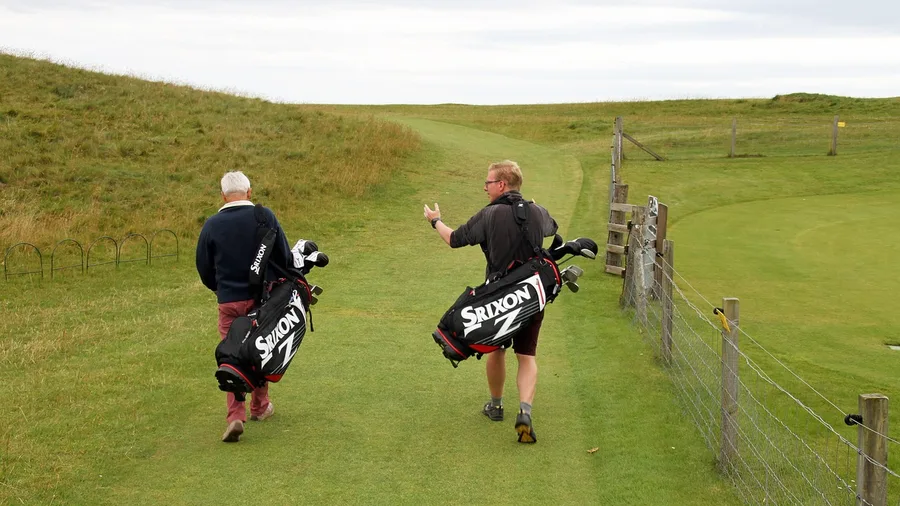
The activity itself is almost beside the point. What determines whether the structure works comes down to two things: whether it happens on a predictable schedule and whether both men are looking at the same thing rather than at each other.
Golf qualifies. So does a repair cafe, a walking group, a weekly card game, or showing up every second Saturday to turn over a shared allotment plot. None of these outranks another on psychological grounds – the format is what does the work, not the physical demand or the skill involved.
That matters practically. A man who cannot sustain long walks or physically taxing activity has exactly the same options as anyone else. A chess club meets the structural requirement just as well as a Sunday round of golf. A regular film screening works. The exertion is irrelevant; the shared focus is everything.
Regularity is the variable that turns an activity into a scaffold. When both men already know the next meeting is in the diary, the friendship stops requiring effort to maintain – it simply continues. Novelty and variety sound appealing but are actually the weaker ingredients here. Rhythm and reliability are what build accumulated weight over time.
One distinction worth holding: casual proximity is not the same thing as a genuine shared focus. Two men sitting in the same room, each reading something different or watching separate screens, are near each other but not structurally together. The third object – the thing both are attending to – is what drops the social vigilance that makes honest exchange possible. Without it, the side-by-side format loses most of what makes it effective.
After 65, the Invitation Has to Be Deliberate

Knowing the right structure still leaves one problem standing: someone has to build it, and that someone is almost certainly you.
Here is what tends to happen instead. Both men finish the last shared activity, go home separately, and each quietly assumes the other is busy, content, or will be in touch when ready. Weeks pass. Neither is fine, neither reaches out, and the friendship does not end – it just goes silent while both men wait for the other to move first.
That wait is the thing worth breaking. Not with a phone call asking how someone is doing, not with a vague ‘we should get together sometime’ that costs nothing and commits to nothing. One question, said at the end of the walk or the card game or whatever it was: ‘Same time next week?’ That is the entire move. It takes four seconds and it converts a one-off into a structure.
The awkwardness of asking is real – it can feel like need, like pressure, like making more of something than the other man bargained for. It is none of those things. The other man is almost certainly sitting with the same hesitation, hoping someone else blinks first. The man who asks is not pushing anything on anyone; he is ending the impasse both of them are already in.
A standing arrangement also removes a recurring cost. Each individual plan requires friction – a text, a confirmation, the small risk of rejection. A rhythm set once simply continues. The friendship stops needing to be restarted and starts being something that is already in motion.
Frequently Asked Questions
Is shoulder-to-shoulder friendship psychologically as valid as face-to-face closeness?
Yes. Closeness is built through repeated presence, demonstrated reliability, and accumulated shared experience — not only through verbal self-disclosure. Side-by-side friendship develops genuine bonds through a different mechanism, one that is particularly well-suited to how many men process social connection. It is a different architecture, not a lesser one.
Why do men’s friendships fade so quickly after retirement?
Because most male friendships are held inside a container — a workplace, a team, a regular commute — rather than maintained by direct contact-seeking. When the container closes, contact drops to near zero without either man deciding to end the friendship. The bond was real; it just depended on a structure that no longer exists. Rebuilding requires replacing that structure deliberately.
Do older men need face-to-face conversation to maintain their mental health?
Regular social contact matters enormously for mental and physical health in later life — the format matters less than the consistency. Men who maintain regular side-by-side contact with another person are getting meaningful social connection. The risk arises when all structured contact disappears entirely, not when the format is side-by-side rather than face-to-face.
What is the best activity for building shoulder-to-shoulder friendship after retirement?
The one that will actually happen weekly. A golf round, a walking group, a repair café, a card game, a chess club — none outranks the others psychologically. The only requirements are a shared focus (a genuine third object) and a regular, predictable rhythm. Physical ability should not be the limiting factor: seated, low-exertion activities work just as well structurally.
Should I worry if my close friend and I never really talk about personal things?
Not automatically. A friendship built on consistent presence, mutual reliability, and years of shared activity is a genuinely close friendship. If you want more verbal openness, it is worth seeking — but the absence of frequent personal disclosure does not mean the bond is hollow. The question to ask is whether the friendship shows up in difficult moments. If the answer is yes, the bond is real.
How do I re-initiate a friendship that has drifted since we both retired?
Make a specific, low-stakes standing ask rather than a broad intention. Suggest one activity with a fixed rhythm — a weekly walk, a regular card game, a monthly film — and end the first session with ‘same time next week?’ That one move converts a one-off reunion into a continuing structure, which is what the friendship actually needs. Do not wait for the other person to go first.
The Format Was Never the Problem
Shoulder-to-shoulder friendship is not a lesser substitute for intimacy. It is a psychologically sound format that builds genuine closeness through accumulated presence, recognises care expressed in action rather than only in words, and holds under real pressure in the ways that matter most. That is not a consolation prize – it is the structure.
The two men at the fence were not failing to have a real friendship. They were having one, in the format that works for them. The only risk was that they might not know it, and therefore might not protect it when the fence got fixed and the reason to show up stopped being obvious.
So when the afternoon ends – whatever the activity, however small – say ‘same time next week?’ That question is the scaffold. Asking it is the whole of the work.
The Friendship Needs a Container — Build One This Week
The psychology section of this article explains exactly what a 'third object' is and why any shared activity qualifies. Start there, pick one, and make the ask.