
Why reading more books isn’t making you smarter? You close the back cover and feel a surge of accomplishment.
Yet a week later, you struggle to recall a single usable insight when someone asks what it was about. This article settles the biological reality of why high-volume reading fails to build intellect, and the friction your brain requires to actually retain new ideas.
Quick Tips Before You Start
Stop counting books
The number of books you finish means nothing for your intellect.
Pause between chapters
Your brain requires biological quiet time to store complex ideas.
Close the book to test
Looking away from the page is the only way to prove you learned it.
The Illusion of Competence
The gap between the immediate feeling of consuming content and the biological reality of storing memory starts the moment you open a book. Reading creates a subjective feeling of understanding that completely masks your failure to store the information.
You are mistaking recognition for recall.
0. Recognizing words feels identical to true knowing

Zero recall happens while your eyes move rapidly across the page.
The brain experiences a fluency illusion when text flows easily, equating the simple recognition of concepts on the paper with successful memorization. Looking at a printed paragraph uses completely different neural pathways than pulling that concept from a blank slate.
Close the book and say out loud: “The author is arguing that…” and finish the sentence yourself.
If you cannot produce the words to finish that script, you did not learn the concept.
0. Finishing the book becomes the primary reward
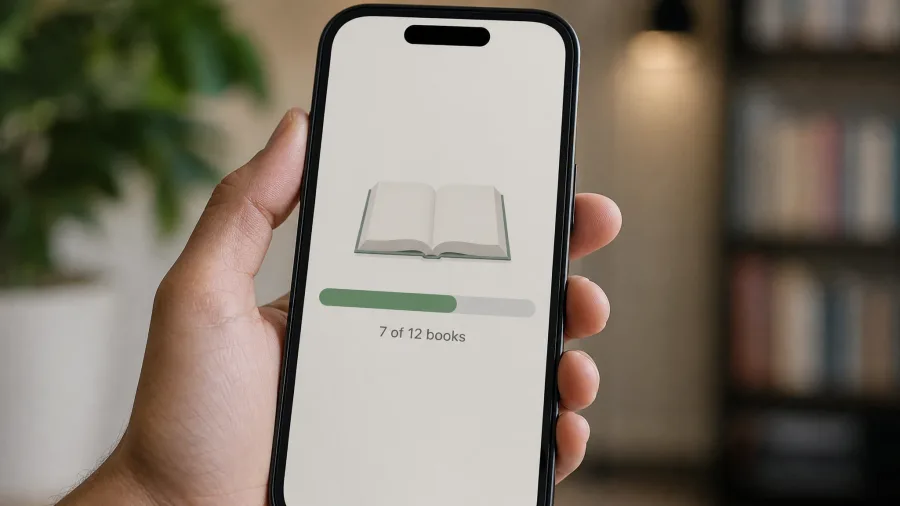
Why are you so obsessed with hitting your annual reading challenge target? The tracking app shifted your intrinsic motivation for knowledge into an extrinsic reward for simple task-completion.
The brain rushes past dense, complex arguments simply to reach the final page and log the achievement. Goal-oriented readers turn a reading session into an obstacle course rather than a learning environment. The satisfaction of closing the back cover replaces the satisfaction of retaining the ideas.
Quitting books early actually builds a better intellect.
When you drop a book the moment its arguments become repetitive, you break the compulsion to just finish things. You start reading for the ideas again, rather than the metrics of your app.
The counterintuitive reality is that a library of half-finished books often represents a healthier cognitive diet than a perfectly completed annual challenge.
💡 Tip: Do not set a numerical goal for books read this year.
The satisfaction of closing the back cover entirely replaces the satisfaction of retaining the ideas inside.
— The trap of volume reading
0. Highlighting outsources your memory to the page

Dragging a yellow marker across a page prompts your brain to intentionally delete data it believes is safely stored elsewhere. This cognitive offloading requires zero mental processing, making it a completely passive habit.
The physical act of highlighting mimics the feeling of learning while biologically reducing the effort needed to remember the information. Unless you write active marginalia translating the concept into your own words, you gain zero neurological benefit from marking the page.
The only exception is highlighting to build a searchable index for a specific project.
Passive Reading vs. Active Synthesis
Passive Intake
- Highlighting whole paragraphs
- Rushing to the next chapter
- Trusting the author's summary
- Reading to hit a daily page count
Active Synthesis
- Writing notes in the margins
- Closing the book to test recall
- Arguing with the author's logic
- Stopping when an idea needs processing
Cognitive Bottlenecks
Consuming text rapidly deprives your mind of the time required to structurally alter its memory networks. These biological bottlenecks cannot be bypassed by reading faster or skipping breaks.
Your memory requires friction to function.
0. Speed reading eliminates necessary cognitive friction

“I read a book a week” is a confession, not a boast. Absorbing text rapidly eliminates the necessary mental effort required to map new concepts onto your existing beliefs.
The brain requires idle downtime during a reading session, such as putting the book down for five minutes, to process and synthesize complex ideas. Speed-reading yields a retention rate near zero for complex arguments, while analytical, slow reading anchors the concepts permanently.
The rush to ingest words deprives you of memory changes.
Read at the pace of a spoken conversation. When a paragraph introduces a heavy concept, look away from the page and force yourself to explain it back to the room.
This forced friction guarantees the information actually makes it through your biological bottlenecks and into long-term storage.
0. Binge-reading prevents necessary spaced retrieval

Consuming an entire book in a single weekend subjects the material to a steep forgetting curve. Natural memory decay will rapidly erase most of those specific details within a week. Binge-reading feels incredibly productive in the moment, but it actively works against how your biology stores information.
Reading a book slowly over several weeks naturally builds in the spaced retrieval required to solidify memory and interrupt the decay process.
Try this ten-second self-test right now.
Can you recall the central argument of the last three books you binge-read? If your mind goes completely blank, the sheer momentum of your reading speed destroyed your retention. You prioritized the intake of words over the synthesis of the ideas.
Forcing your mind to recall yesterday’s chapter before starting today’s session physically thickens the neural pathways holding the information. The brain requires that slight struggle of pulling a fading memory back to the surface in order to mark it as important enough to keep permanently.
Sit down and open the book, but do not read the first word until you summarize what happened in your previous sitting.
🔄 The Spaced Retrieval Cycle
Read a single chapter
Consume the material slowly and take your time.
Wait twenty-four hours
Allow natural memory decay to begin weakening the immediate recall.
Test your memory
Before opening the book again, try to state the previous chapter's main point.
Check the text
Open the book to verify your summary and correct any errors.
0. Starting new books immediately overwrites recent knowledge

You read the final sentence, close the back cover, and immediately reach for the next title sitting on your nightstand. Jumping straight into the next book causes cognitive displacement, preventing the previous book’s conceptual framework from moving into long-term storage.
Think of your short-term memory as a crowded waiting room. Retroactive interference actively blocks memory consolidation as new incoming data overwrites the fragile, recently acquired information.
Hunger for the next title interrupts biological quiet time.
A mandatory digestion period of three days between finishing one complex text and starting another is required to solidify the arguments.
Use this waiting period to write a single-page summary of the book, forcing your brain to finalize its storage before you flood it with new data.
⚠️ COMMON MISTAKE
The Logging Trap
Logging a book as 'read' gives you a chemical reward identical to actually learning it. You feel accomplished while retaining absolutely nothing.
The Missing Mechanics of Application
Taking in information is only the first half of the equation. If you do not actively argue with the text or tie it to a real-world problem, the brain’s relevance filters will quietly discard the data.
Knowledge dies without an immediate application.
0. Borrowing an author’s conclusion prevents critical thinking

I used to nod along with every persuasive paragraph, assuming I was getting smarter just by exposing myself to brilliant insights. I never stopped to challenge the logic.
Adopting an author’s worldview without actively arguing with the text weakens the critical analysis muscles required to reach those answers independently. Many modern non-fiction books spoon-feed easy conclusions, entirely sparing the reader the effort of generating insights on their own.
Agreeing with the author replaces the effort of building an argument.
The Retention Filter
🎯 Purpose
Solve an active problem
⏱️ Timing
Just-in-time reading
🛠️ Application
Used within 48 hours
0. Ideas lacking a practical hook are quickly discarded
People claim that all reading automatically expands your mind, but memory researchers consistently find that abstract information failing to solve an active problem is rapidly pruned away.
The brain’s relevance filters are absolutely ruthless. Associative memory networks drop data that cannot be linked to an ongoing project, such as a specific work presentation, a difficult conversation, or a personal habit change you are currently attempting.
Your brain deletes what it cannot immediately use.
Readers who consume information without a specific, practical application lose the data within days. Read strictly on a just-in-time basis for your current life challenges.
This approach guarantees the new knowledge immediately anchors to a real-world action you are already taking, permanently wiring it into your memory.
Frequently Asked Questions
Why do I feel like I understand a book perfectly while reading it?
This is the fluency illusion. Your brain recognizes the vocabulary and syntax, which feels identical to understanding the concept, but it uses completely different neural pathways than actual memory retrieval.
Should I stop highlighting my books entirely?
Yes, unless you are building a specific searchable index. Highlighting tricks your brain into cognitive offloading, where it deletes the information because it believes the data is safely stored on the page.
Does reading faster help me absorb more information?
No. Speed reading eliminates the cognitive friction required to map new concepts onto existing beliefs, dropping your retention rate for complex arguments to near zero.
What should I do immediately after finishing a book?
Wait at least three days before starting a new one. Use this biological quiet time to discuss the concepts or write a one-page summary to prevent cognitive displacement.
Why can I only remember books that relate to my job?
Your brain’s relevance filters rapidly prune away abstract information that fails to solve a current, active problem. Associative memory networks only hold onto data tied to an ongoing project.
The Active Recall Shift
The exact three-step routine you must execute the moment you finish a chapter changes everything. First, close the cover immediately. Second, force yourself to state the author’s main argument out loud to the room. Third, write that single sentence down in your own words.
This shifts your goal from finishing the text to testing your recall.
Test Your Recall Now
Scroll back up to the self-test in section five and see if you can remember the premise of your last read.