It happens to all of us eventually. You knock a glass of water off the table. You see it falling. In your mind, you’re already catching it—you can practically feel the cool glass against your palm. But in reality? You’re watching it shatter on the floor before your hand has even moved three inches.
It’s frustrating. Maybe even a little embarrassing. And if you’re anything like me, a quiet, nagging thought pops up: “Am I losing it? Is this just what getting older feels like?”
Here’s the thing: We tend to think of reaction time as a young person’s game—something for boxers, sprinters, or video gamers. We treat it like a fixed talent, like having blue eyes or being tall. You either have it, or you don’t.
But that’s wrong.
Reaction time isn’t a talent; it’s a skill. And more specifically, it’s a physical loop in your nervous system that can be greased, tightened, and sped up, no matter your age.
I’ve spent some time digging into the latest research—looking at everything from Stanford neuro-studies to training protocols for elite athletes—and what I found is actually pretty hopeful. You don’t need to accept the “slow down.” You just need to train for the speed up.
Here is the science of why we slow down, and five specific, two-minute drills you can do in your living room to stop it.
The “Why”: It’s Not Your Muscles, It’s the Signal

First, let’s clear up a massive misconception.
For years, scientists thought older adults reacted more slowly because they were just being careful—the “Hesitancy Hypothesis.” The idea was that we trade speed for accuracy as we age. But recent research from Stanford University blew that out of the water.
They found that the delay isn’t because you’re hesitating. It’s because the “planning” phase in your brain—the time it takes for your neurons to reach the threshold to say “GO”—takes longer.
Think of it like a dial-up internet connection versus a fiber optic.
- The Eye: Sees the falling glass.
- The Brain: Identifies “Glass!” and plans “Catch it!”
- The Body: Moves the hand.
The eye works fine. The hand works fine. The bottleneck is step 2. The “buffering” symbol in the middle.
Data from the massive MindCrowd study shows that our processing speed peaks at age 24. After that? We lose about 7 milliseconds (ms) of speed every single year.
Seven milliseconds sounds like nothing, right? But do the math. Over 40 years, that adds up to nearly a third of a second. In the real world, that gap matters.
The Scary Math of Driving
I don’t want to scare you, but we need to look at this table. It shows what happens when you’re driving at 65 mph (approx 105 km/h) and you need to slam on the brakes.
| Your Reaction Time | Distance Traveled Before You Even Hit the Pedal |
| 0.75 sec (Trained/Fast) | 71.5 feet |
| 1.50 sec (Average/Aging) | 143.0 feet |
| The Difference | 71.5 feet |
Source: Derived from NHTSA data and reaction distance physics.
That’s the difference. A 71-foot gap is the difference between a close call and a catastrophe. This is why we train. Not to be ninja, but to be safe.
The Drills: 2 Minutes a Day to “Grease the Groove”
You don’t need a gym membership for this. You need a little bit of space and a willingness to look slightly silly for a few minutes.
1. The Ruler Drop (The Classic)
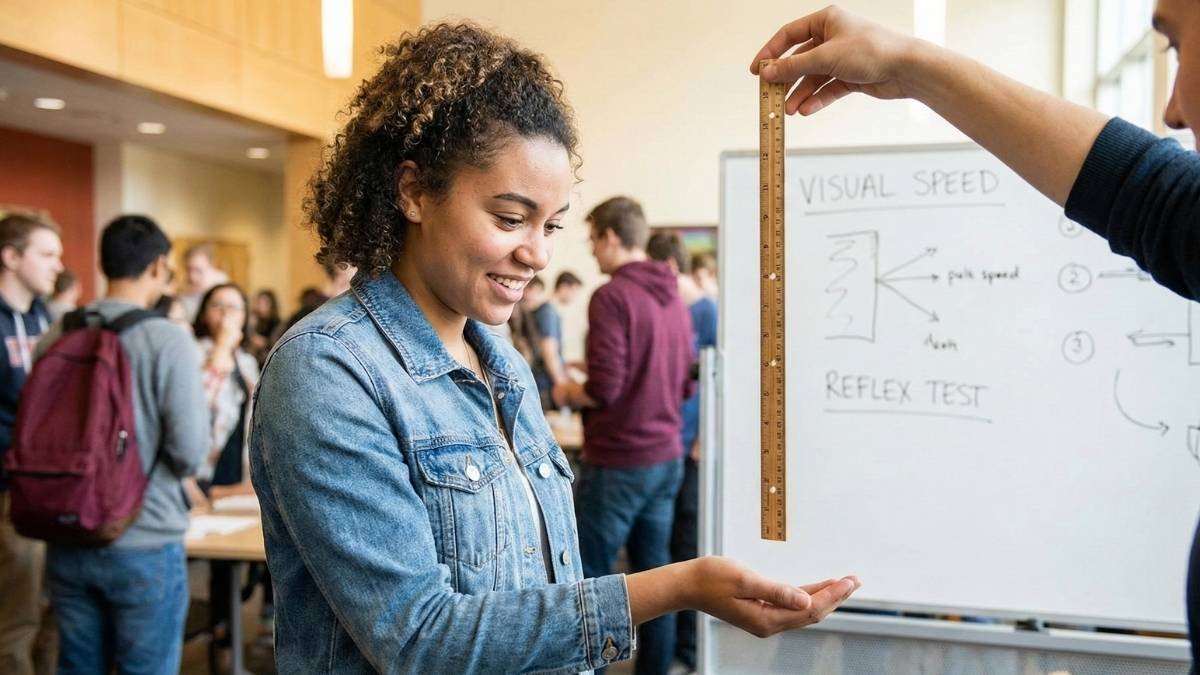
What it trains: Pure spinal reflex and visual speed.
You probably did this in high school physics. We use gravity because it never lies. Gravity accelerates objects at roughly $9.8 m/s^2$. If you catch the ruler later, you are slower. If you catch it sooner, you are faster. Immediate feedback is the gold standard for learning.
How to do it:
- Partner: Have a friend hold a standard 12-inch (30cm) ruler vertically, dangling it with the “0” mark right between your open thumb and index finger.
- The Wait: They drop it without telling you when. No “3, 2, 1.” Just drop.
- The Catch: Pinch it as fast as you can.
- The Score: Note the number by your thumb. Lower is better.
Solo Version (The “Reaction Ball”):
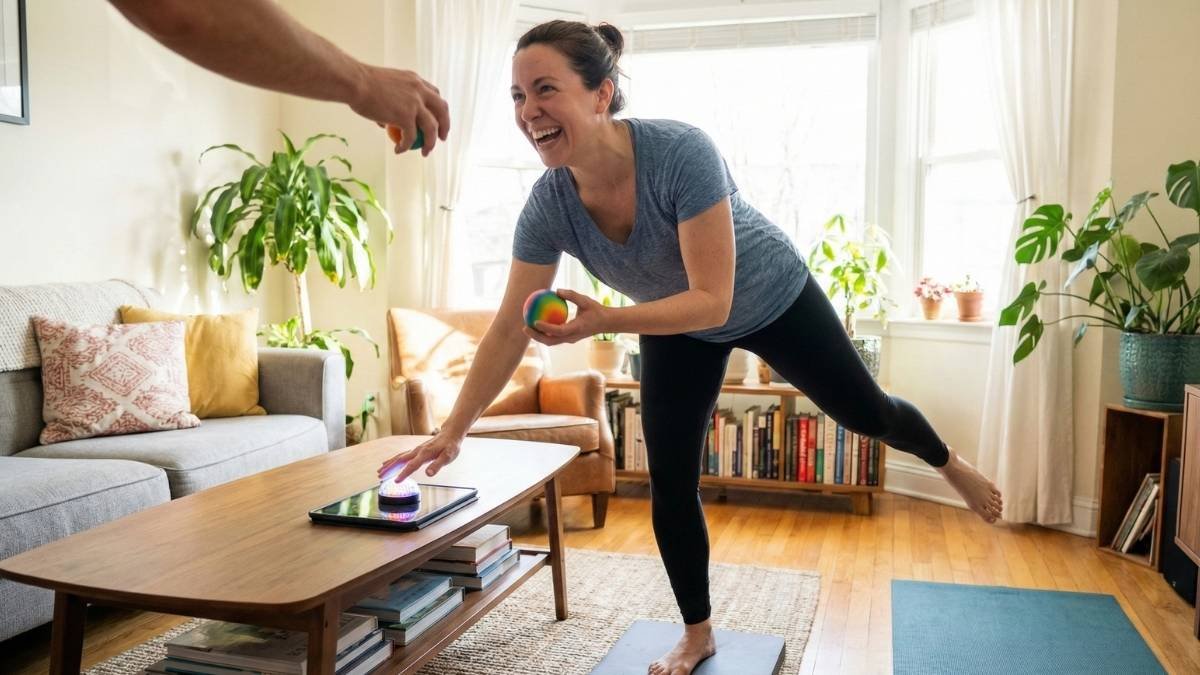
I do this one by myself. Take a tennis ball (or a bumpy “reaction ball” if you want to be fancy). Stand facing a wall about 3 feet away. Throw it against the wall with one hand, catch it with the other. Too easy? Turn your back to the wall, twist, throw, and try to find it.
2. The “Clock Face” Saccades
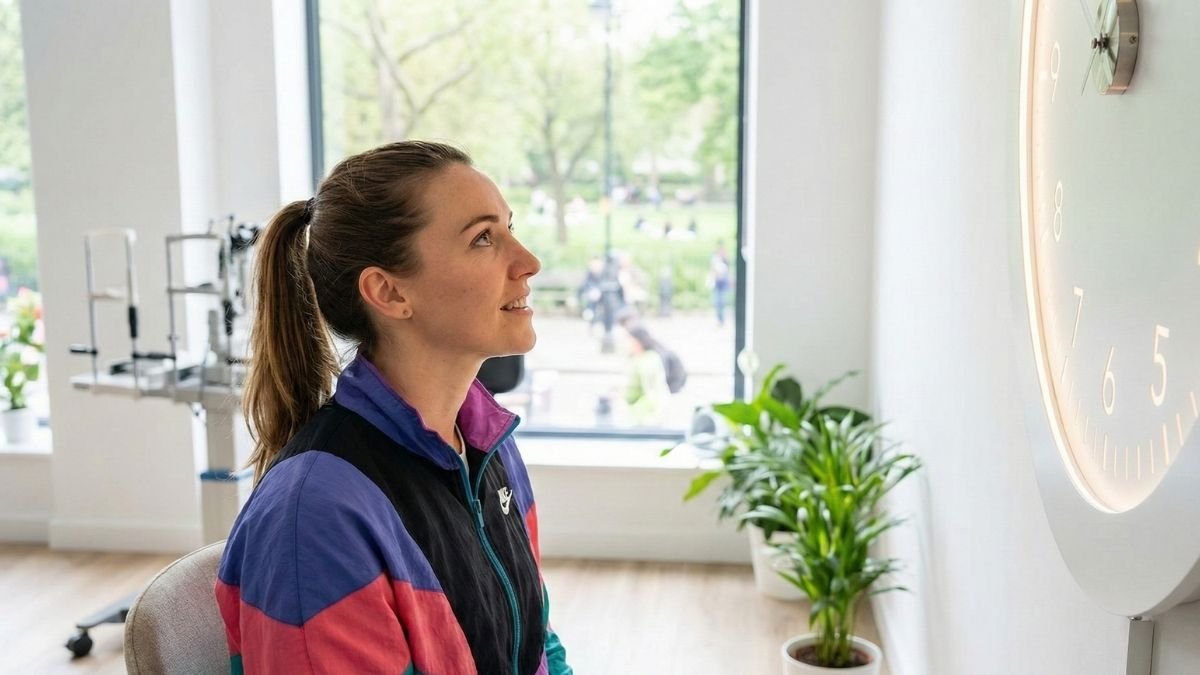
What it trains: Eye speed and balance.
Most of us have “lazy” eyes. Not medically, but functionally. We stare at screens all day, so our eyes forget how to dart around quickly and accurately (movements called saccades). If your eyes are slow, your body is slow.
How to do it:
- Imagine a giant clock face on your wall. Stick a Post-it note directly in the center with an ‘X’ on it.
- Stand comfortably. Lock your eyes on the ‘X’.
- The Rule: Keep your head totally still. Like a statue. Only your eyes move.
- Dart your eyes up to 12 o’clock, then snap back to the X.
- Dart to 1 o’clock, snap back to the X.
- Go all the way around the clock.
Why it works: This strengthens the frontal eye fields in your brain. If you feel a little dizzy, stop. That just means your visual system is weak and needs this work.
3. The Wall Ball “Brain Teaser”
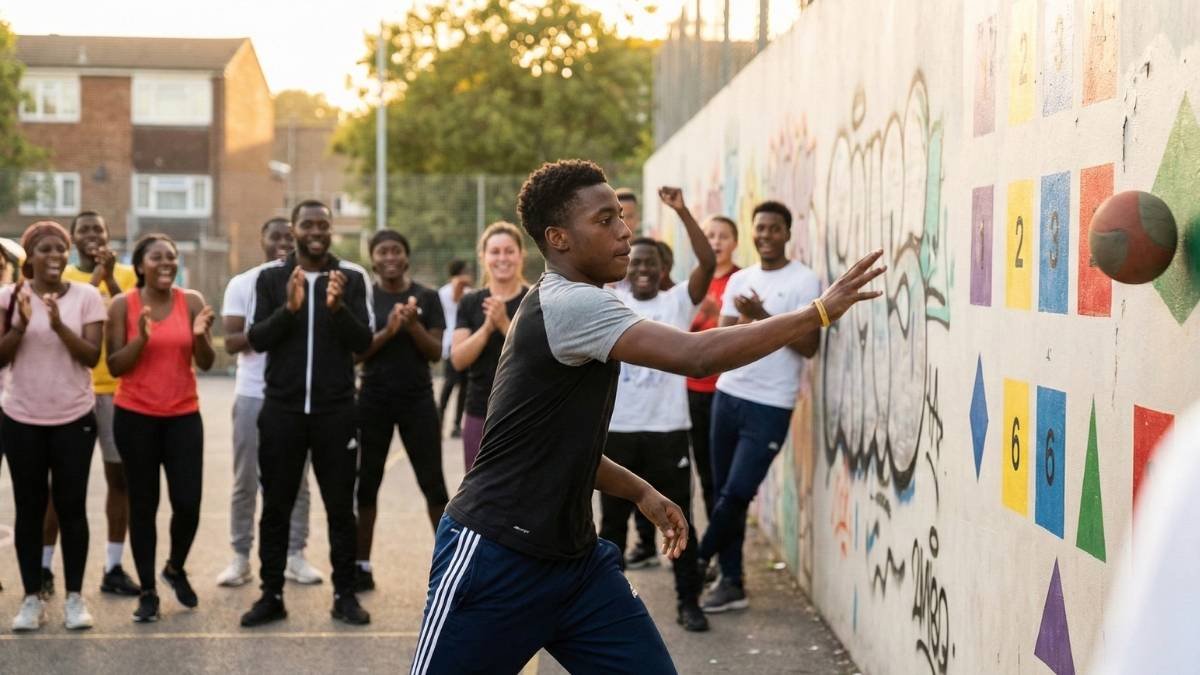
What it trains: Decision-making under pressure (Executive Function).
This is my favorite because it’s frustrating. Real life rarely gives you one signal. It gives you choices. Do I brake or swerve? This drill forces your brain to process logic while moving.
How to do it:
You need a tennis ball and a wall.
- Level 1: Throw and catch. Easy.
- Level 2 (The Drill): Have a partner call out random numbers while the ball is in the air.
- If the number is EVEN (2, 4, 8…), catch with your RIGHT hand.
- If the number is ODD (1, 3, 7…), catch with your LEFT hand.
It sounds simple, but doing math while tracking a moving object lights up your prefrontal cortex like a Christmas tree. This reduces what scientists call “Cognitive-Motor Interference”—basically, it teaches your brain to walk and chew gum at the same time.
4. The “TV Side-Eye”

What it trains: Peripheral vision and calmness.
When we get stressed or focused, we get tunnel vision. Literally. Our world shrinks to a pinhole. Peripheral vision is faster than central vision because it bypasses certain processing centers to detect motion instantly. Opening your periphery actually calms your nervous system.
How to do it:
- Turn on the TV to something with fast cuts—an action movie or sports.
- Turn your body 90 degrees away from the TV.
- Pick a spot on the wall in front of you and stare at it softly.
- The Task: Using only your side vision (don’t look!), try to clap every time the camera angle changes on the screen.
It feels weird at first, but you are waking up the rod cells in your retina that detect motion. This is the skill that stops you from bumping into people in crowded grocery stores.
5. The Infinity Walk

What it trains: Left-Right brain integration and fall prevention.
This looks deceptively simple, but it’s a powerhouse for preventing falls. It forces you to cross your midline, helping the left and right hemispheres of your brain talk to each other.
How to do it:
- Place two chairs about 4 feet apart.
- Walk in a “Figure 8” pattern around them.
- The Twist: Pick a spot on the wall at eye level. Keep your eyes locked on that spot the entire time you walk.
- As you turn away from the wall, you’ll have to rotate your head over your shoulder to keep eye contact.
If you want to really cook your noodle, try reciting the alphabet backward while doing this. If you stumble or stop walking to think, that’s a sign your automatic motor skills need polishing.
Need More Help? Look Into These
You honestly don’t need a penny to start training your brain—gravity is free. But if you find yourself getting bored or just want to challenge your nervous system with that extra layer of unpredictability, there are a few tools I’ve seen experts use that are actually worth the investment.
1. The “Unpredictable” Reaction Ball

I mentioned this in the solo drills section. It’s a rubber ball with six lumps on it. When you drop it or throw it against a wall, you have zero idea where it’s going to bounce. It forces you to stay low and react to the movement in real-time, rather than predicting the path.
2. HECOstix

You might have seen pro athletes (or NFL quarterbacks) using these. It looks like a three-legged spider made of foam. The game is simple: you play catch, but your partner calls out a color (Red, Blue, Green) while it’s in the air. You have to process the command and grab only that leg. It’s the ultimate “Think + Move” drill.
3. An Agility Ladder

Falls often happen because our feet get tangled when we try to correct our balance. An agility ladder (those flat plastic rungs you lay on the floor) trains you to pick up your feet precisely and quickly. It connects your eyes to your toes, improving that critical footwork coordination.
4. Weighted Juggling Balls

Remember how we talked about neuroplasticity? Juggling is one of the few activities proven to actually grow gray matter in the visual processing centers of the brain. You don’t need to be a clown—just learning the basic 3-ball cascade is a massive workout for your nervous system.
5. A Balance Disc (Wobble Cushion)

If standing on one leg is too easy, stand on this. It’s an air-filled cushion that makes the ground unstable. Doing the “Clock Face” eye drills while standing on this forces your vestibular system to work overtime to keep you upright.
The Takeaway
Look, I know adding “one more thing” to your daily routine feels impossible. But we aren’t talking about an hour at the gym. We are talking about playing catch with yourself while the coffee brews.
The research is clear: The brain is “plastic.” It changes based on what we ask it to do.18 If you stop asking it to be fast, it will slow down.
So, try the Ruler Drop tonight. See where you land. Then try it again next week. You might be surprised at how quickly you can get that “snap” back. Stay sharp.