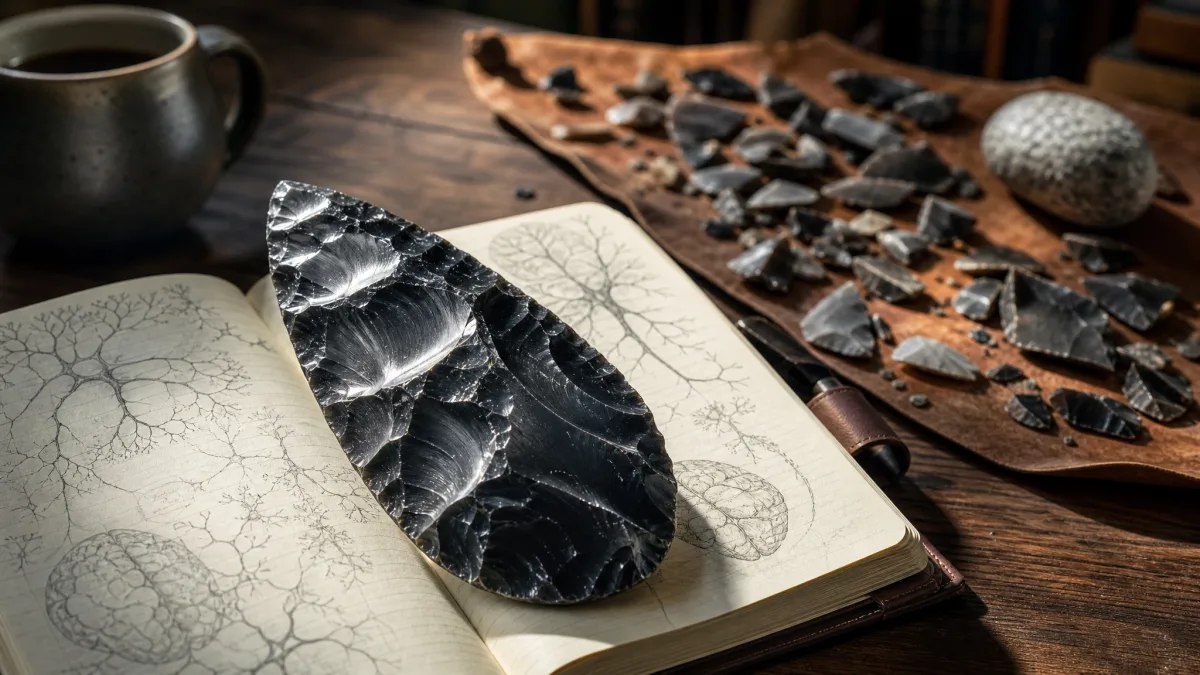
People assume early human survival was a matter of brute physical strength and outrunning predators on the open savannah. But grasping a rock and hitting it against another rock is not a primitive reflex.
Advanced toolmaking emerged roughly 1.76 million years ago, demanding absolute mastery over conchoidal fracture mechanics in flint or obsidian.
The evolutionary pressure to perfect this single, unforgiving craft laid the neurological foundation for modern complex thought. Tracing the mechanics behind prehistoric flintknapping reveals how striking stone forged the human capacity for deep learning.
The intense cognitive and motor demands of this work embedded the structural architecture for hierarchical planning and language long before the first civilizations existed.
⏳ The Sequence of an Acheulean Masterpiece
Select the Core
Find a piece of flint or obsidian with predictable conchoidal fracture mechanics.
Map the Geometry
Visualize the teardrop shape hidden inside the raw stone.
Prepare the Platform
Carefully grind a flat surface on the edge to receive the strike.
Execute the Strike
Hit the platform at a precise angle between 45 and 80 degrees.
Thin the Edges
Repeat the process symmetrically to thin the tool without snapping the center.
The Acheulean Handaxe Was the Original Masterpiece

The work centered entirely on producing a single, highly specific object known as an Acheulean handaxe.
This was not a rough rock with a sharp side, but a carefully proportioned, symmetrical teardrop flaked on both faces. Hominins appearing around 1.76 million years ago spent their days shaping flint and obsidian into this exact, repeating form.
Older toolmaking styles did not require this kind of discipline.
Before the teardrop design emerged, a maker would just smash two river cobbles together, pick up the sharpest random splinter that fell off, and immediately start cutting.
The symmetrical axe forced the maker to look at a raw chunk of obsidian and project a finished three-dimensional shape onto it. Because you cannot put stone back once it breaks off, that hidden shape had to dictate every single physical movement.
The raw material offered no instructions.
Maintaining that clear mental image across hours of chipping is what separated the master from someone just banging rocks together to see what happened.
The Evolutionary Shift in Toolmaking
Oldowan Tools
- Random flakes struck for a quick edge
- No planned final shape
- Fast execution with minimal practice
- Discarded quickly after immediate use
Acheulean Handaxes
- Symmetrical, bifacial teardrop design
- Deliberate shape planned from the start
- Required mastering conchoidal fracture mechanics
- Carried and reused over long periods
Why Hitting Rocks Demanded Hierarchical Thinking

Seeing a finished object inside a rough stone requires a maker to string dozens of related actions together, long before seeing any real progress. Psychologists call this hierarchical cognition, a way of thinking that splinters a massive goal into a long chain of strictly ordered, dependent tasks.
You cannot just hit the rock and hope.
You have to spend twenty minutes gently tapping the edge just to set up the exact surface where your actual, heavier blow will land.
That setup process creates a striking platform, and the physics of conchoidal fracture are violently unforgiving. The maker must swing another stone at that prepared ridge to peel off a flake, keeping the impact angle strictly contained between 45 and 80 degrees.
A slight deviation wastes the setup entirely.
Every single swing of the hammer stone carries the risk of instantly destroying an hour of intense, careful labor.
If a maker loses focus on the fiftieth strike and hits the ridge too high, the kinetic energy shoots straight through the center of the obsidian instead of peeling down its side. The entire stone snaps in half, rendering the whole effort worthless.
The Cognitive Hierarchy of a Strike
Brain Scans Link Stone Tools to Language
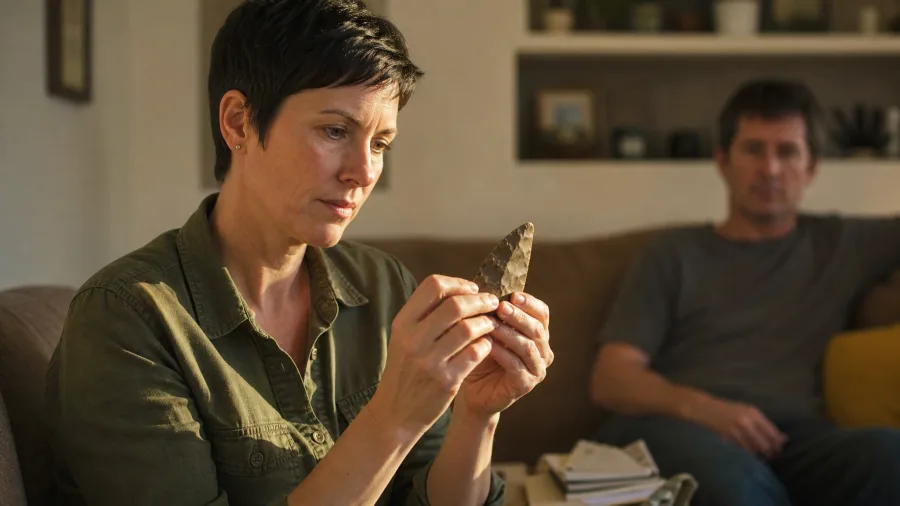
We can trace the mental toll of managing those catastrophic failure rates by watching the blood flow in a modern brain. When researchers put contemporary flintknappers into imaging machines and ask them to map out these sequences, the prefrontal cortex lights up intensely.
That region handles our highest level of planning.
But the physical act of managing the heavy strike and holding those precise angles requires an entirely different neurological system to fire at exactly the same time.
The extreme fine motor control required to adjust a wrist by two degrees directly engages an evolutionary precursor to Broca’s area. That exact piece of neural hardware is the same region modern humans rely on to process and produce speech.
The connection is not a coincidence.
Holding the geometric layout of a teardrop axe in your working memory looks remarkably like holding a long, twisting thought in your head.
The cognitive architecture necessary to nest physical actions inside one another – preparing a platform to take a flake to eventually thin an edge – uses the exact same structural logic as assembling a sentence with multiple dependent clauses. The syntax of striking stone became the syntax of speech.
The Origins of Syntax
Do Modern Novices Take 10,000 Hours?

That intense neural link between motor control and mental sequencing explains why this skill cannot be learned by observation alone. Understanding the geometry of a strike is useless without the physical repetition to execute it.
Today, anthropology students sit down with raw material and a solid conceptual grasp of fracture mechanics. They understand the physics. Yet they reliably require over 300 hours of practice just to thin a piece of stone without snapping the core in half.
The early stages are mostly blood and failure.
Hundreds of hours of novice knapping produce mostly shattered rocks and injured hands. A student cannot think their way past this curve. Knowing the physics conceptually never bypasses the absolute necessity of intense muscle-memory training.
This is the original definition of deliberate practice.
A prehistoric learner was not just passively repeating a brute motion until it became a habit. They were forcing a slow physiological adjustment to the harsh physical feedback of the stone, consciously recalibrating their swing after every failed attempt.
Knowledge Transfer Created the First Classrooms

Passing down a skill that demands years of physical conditioning meant adults had to halt their own work. They had to physically guide a beginner holding the stone.
A novice swinging blindly quickly ruins the raw material.
To prevent a shattered core, an expert could not just let an apprentice watch from the fire. They had to step in, adjust the grip, and manually align the beginner’s hand to strike the platform at a highly specific angle between 45 and 80 degrees. Teaching shifted from passive observation to active physical correction.
That shared visual and mental focus is what developmental psychologists call joint attention. Two individuals deliberately coordinate their understanding around a single object in real time.
This was the beginning of the classroom.
Leaving a learner to guess the physics on their own wasted time and precious flint. Taking the time to physically correct every wrong swing established the first active teaching mechanisms. That absolute requirement for intensive tutoring drove the evolutionary lengthening of human childhood, stretching out the years of dependence to give the brain time to absorb the work.
Early Teaching Methods
- Physical Correction — Physically adjusting the learner's hands forces the correct joint attention and motor feedback.
- Verbal Instruction — Explains the concept of a 45-degree angle, but fails to build the necessary muscle memory.
- Passive Watching — Leaves the novice unable to feel the correct striking angles, resulting in shattered cores.
The Tool That Built the Modern Brain

That biological shift to accommodate a decade of active toolmaking instruction left a permanent structural architecture in place for all future learning.
The intense evolutionary survival pressure to execute these exact mechanical sequences drove a massive, lasting expansion in neuroplasticity. Hitting rocks with this level of unforgiving precision permanently rewired human cognition across generations.
The hardware upgraded to meet the demands of the stone.
Today, we rely on that exact same ancient architecture for entirely abstract, modern tasks. The cognitive mastery of hierarchical, sequential strikes maps directly to a modern human’s ability to structure a software program, balance a mathematical equation, or construct a complex logical argument.
We are running new software on the Acheulean operating system.
The widely cited rule that true mastery demands a decade or 10,000 hours of focused repetition is not a modern productivity invention. It is not a recent cultural trend. It is a deeply embedded evolutionary feature of the brain, forged by the relentless physical pressure of striking rock against rock.
The ancient mastery of hierarchical sequential strikes maps directly to our modern ability to master coding or mathematics.
— The Evolutionary Legacy
Frequently Asked Questions
What kind of rock was used for early handaxes?
Early toolmakers preferred flint, chert, or obsidian. These stones fracture conchoidally, meaning they break in predictable cone shapes when struck, allowing for highly precise flake removal.
Did Neanderthals make Acheulean handaxes?
Yes, Neanderthals and Homo erectus both created highly sophisticated stone tools. Their cognitive capacity for complex sequencing was heavily developed through this daily, demanding practice.
How do archaeologists know the striking angle was exactly 45 to 80 degrees?
Experimental archaeology recreates the process today. Physics dictates that strikes outside this narrow angle range either crush the platform completely or bounce off without removing a flake.
Why couldn’t they just use naturally sharp rocks?
Naturally broken rocks dull quickly and lack the ergonomic balance of a deliberate handaxe. A bifacial tool provides a reliable, renewable cutting edge that can be resharpened continuously on the go.
The Cognitive Legacy of Hitting Rocks
The evolutionary pressure to master this specific, difficult craft permanently shifted human cognition, making your capacity for complex learning a direct result of hitting rocks. What looks like a brute-force reflex evolved into the exact catalyst that built the modern mind.
Every complex skill you master today runs on the neural hardware built to shape a teardrop stone.
The next time you struggle through a steep learning curve, remember that you are not failing. You are simply relying on the exact persistence that pulled humanity out of the open savannah.